


Campaigns are a temporary job for young people. Most staff are gone within a month of Election Day, and the median staffer stays for about seven months. About 60% of staffers are in college or less than three years out.
Winning is the ticket to Capitol Hill. Among campaign staff who have never worked in Congress, 14% of those on a winning campaign get a job in Congress within a year, compared to 3% of those on a losing campaign. Most go to work for the member they helped elect.
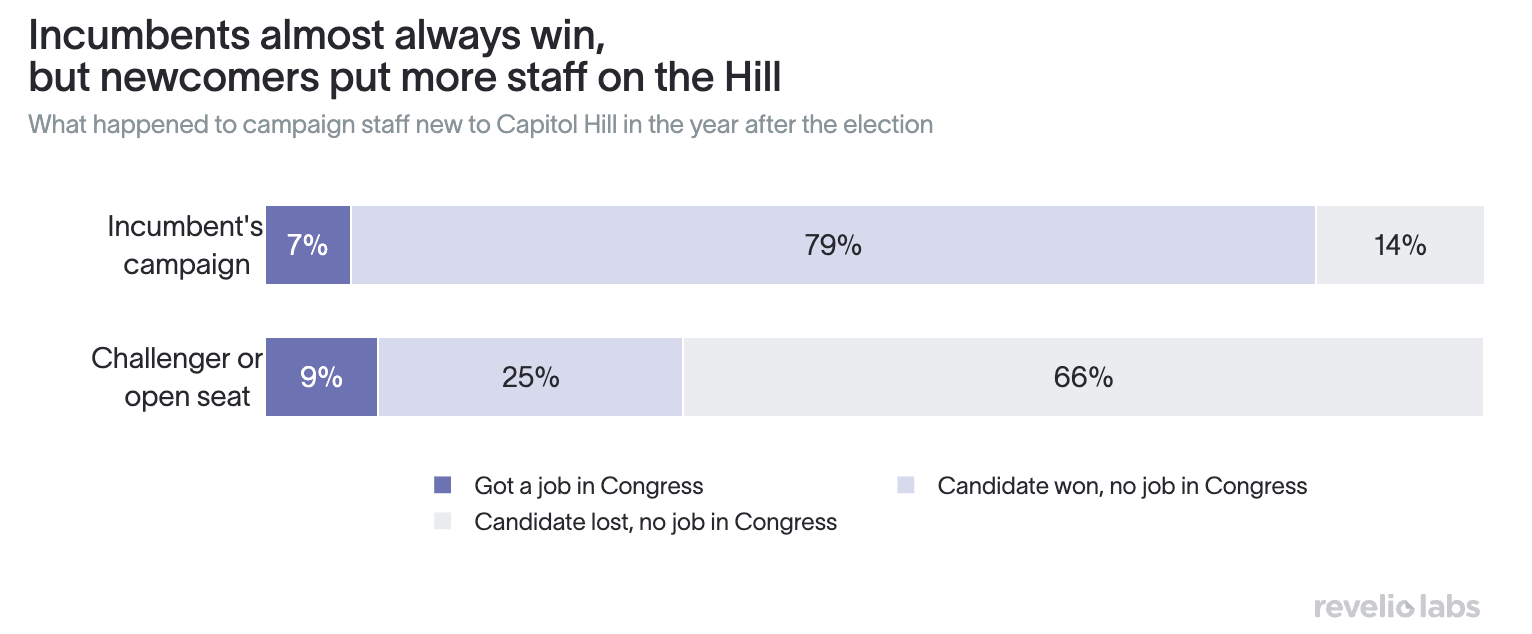
Even though incumbents win about 90% of their races, staff on challenger and open-seat campaigns are slightly more likely to get a job in Congress within a year (9% versus 7%). A newly elected member has to build an office from scratch, and almost a quarter of the staff who finish the campaign with them go on to work in Congress.
The election is over and the transition to a new Congress has begun. As we check our phones in vain, hoping for one more urgent fundraising text from a candidate three states away, the winners are preparing for their ascent (or return) to the halls of power, and the losers are licking their wounds. It is a season of reflection, gloating, and plenty of Monday-morning quarterbacking from our nation’s political pundits. But while candidates and campaigns are scrutinized, relatively little is said about the thousands of coffee-addled campaign staff who knocked on doors, made calls, scheduled interviews, and tweeted tweets to make it all happen. Who are they, and what happens to them now?
To find out, we linked Revelio Labs profile data to Federal Election Commission (FEC) data on Democratic and Republican House and Senate campaigns that raised at least $100,000, focusing on campaigns that made it to the general election from 2016 to 2024.
The long and short of it is that, as of last Wednesday, many staffers are already out of work—or soon will be. The majority are typically gone within a month of Election Day.
Most political campaign jobs last less than a year
While campaign headquarters empty out so quickly, staffing them up takes much longer. Some campaigns maintain headcounts for over two years, but almost 70% of staff on board at the peak join in the final year. Challenger campaigns tend to wait for the primary, usually about five months before the general, and their hiring jumps about 60% that month. Incumbent campaigns don't wait, and for good reason: incumbents won 99% of their primaries in our sample.
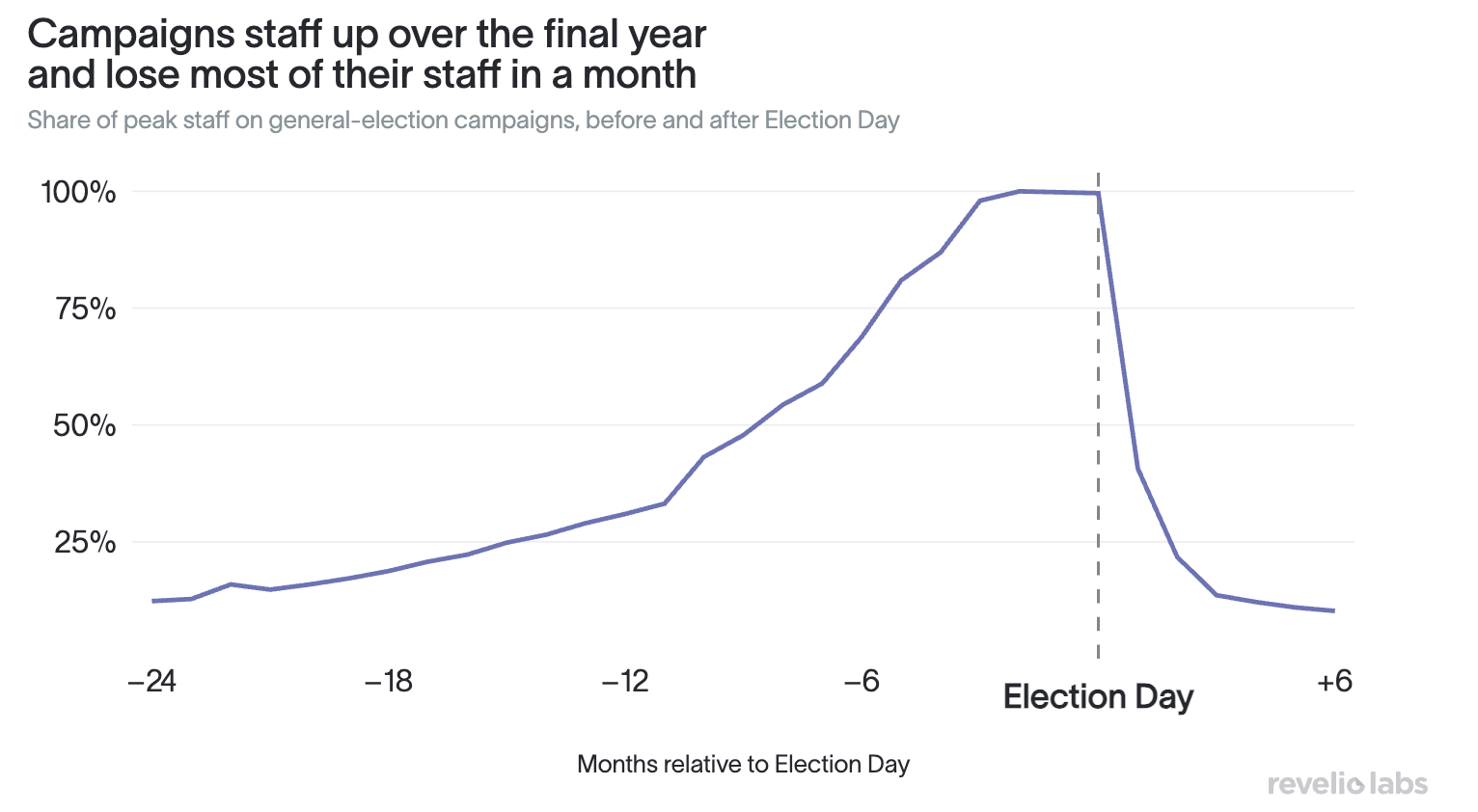
When the campaign ends, the last in tend to be the first out. Some senior staff stay on to close things down while everyone else moves on. For most of them, this was a temporary gig, not a career. The median staffer stays just seven months, and nearly 80% of those whose first campaign was between 2016 and 2020 never worked another election cycle.
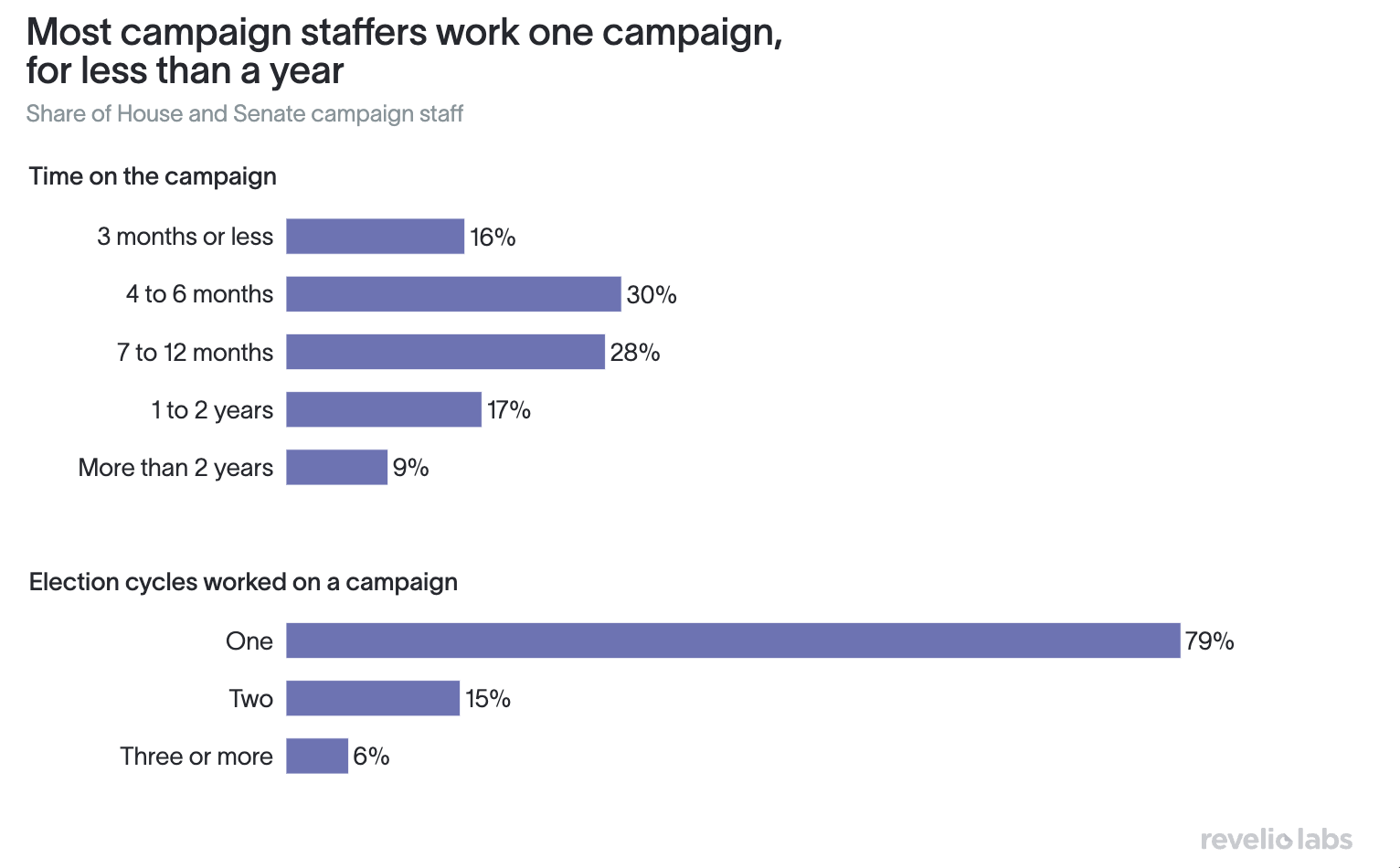
Few staffers move between campaigns, even within a cycle. Only about 7% work on more than one House or Senate campaign in the same cycle, almost always for the same party. Staff on campaigns that lose the primary rarely switch to the candidate who beat them: about a fifth go on to another campaign, but fewer than 1% go to work for the winner.
Campaign work is also partisan work. Of the roughly 2,500 people who worked on two or more House or Senate campaigns between 2016 and 2024, just four worked for both parties. Staff cross state lines far more readily than party lines: 38% worked on campaigns in more than one state.
Who works on political campaigns
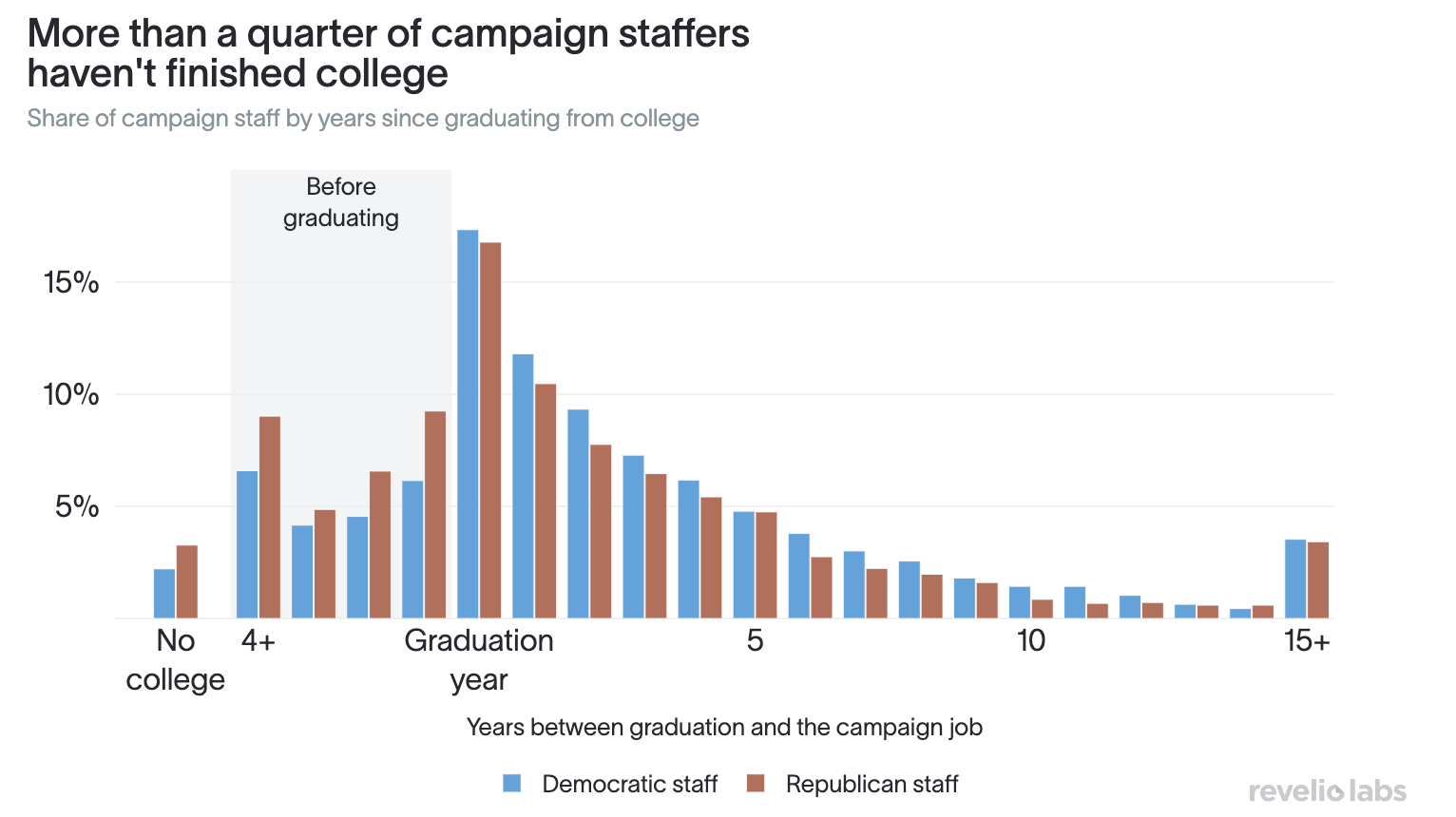
Who takes a job with an expiration date? Mostly the young and the college educated. Only 2% of Democratic staff and 3% of Republican staff list no college at all. About 62% of staffers are still in college or less than three years out. Republican campaigns hire more current students (30% of their staff, compared with 21% on Democratic campaigns), while Democratic campaigns hire more recent grads. Students mostly work in the field: more than half are field organizers. Staff three or more years out of college are the most likely to run the campaign: 30% hold leadership roles.
The parties recruit from different schools. The top schools for Democratic staff are George Washington, Michigan, American, Wisconsin and UT Austin. For Republican staff, they are Arizona State, South Carolina, Georgia, Liberty and Ohio State. No single school supplies more than 2.5% of either party's staff. Both parties hire from a diverse set of schools, but the types of schools differ.
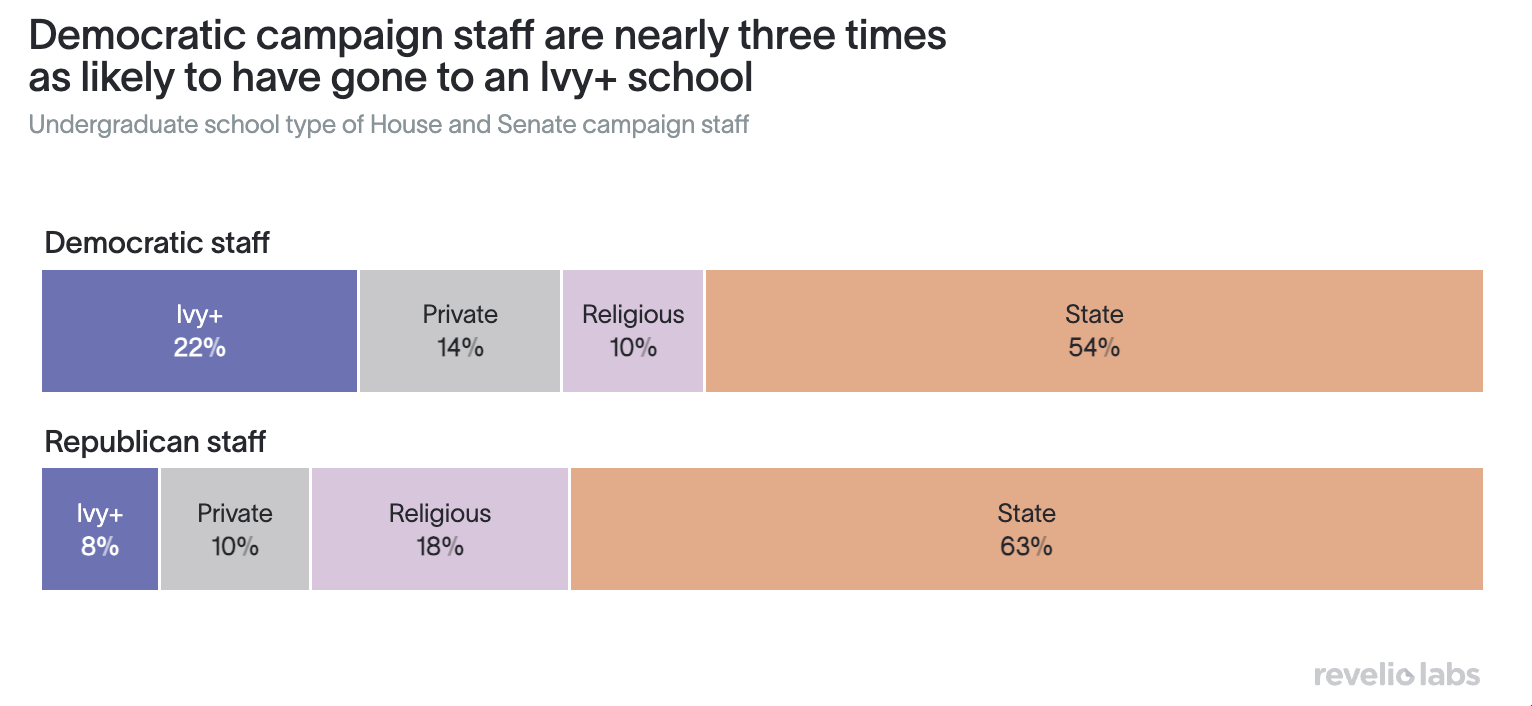
The clearest gap is at the top. Democratic staff are far more likely to have gone to an Ivy+ school (the Ivy League plus other elite private schools), 22% compared with 8%. Republican staff, on the other hand, are almost twice as likely to have gone to a religious school. The prestige gap shows up even at state schools, where the typical Democratic staffer's school ranks about 14 places higher (59th versus 73rd) in U.S. News.
Despite the differences in alma mater, the parties mostly hire from the same fields of study. Over half of staff in both parties studied political science or government, by far the most common fields. Among staffers from other fields, there is more of a split along party lines. Republican staff are three times as likely to have studied business, six times as likely to have studied accounting, and 16 times as likely to have studied agriculture. Democratic staff are three times as likely to have studied sociology, six times as likely to have studied environmental studies, and about 28 times as likely to have studied women's or gender studies.
Once hired, staff in both parties do the same kinds of jobs. Field staff, who make up about a third of the campaign, knock on doors and recruit volunteers. Fundraisers run call time and donor events. The rest manage the campaign, handle press and social media, do political outreach or policy work, or keep things running with scheduling and operations. But Democratic campaigns put 21% of their staff in fundraising, compared with 7% at Republican campaigns, while Republican campaigns put more of their staff into leadership and operations.
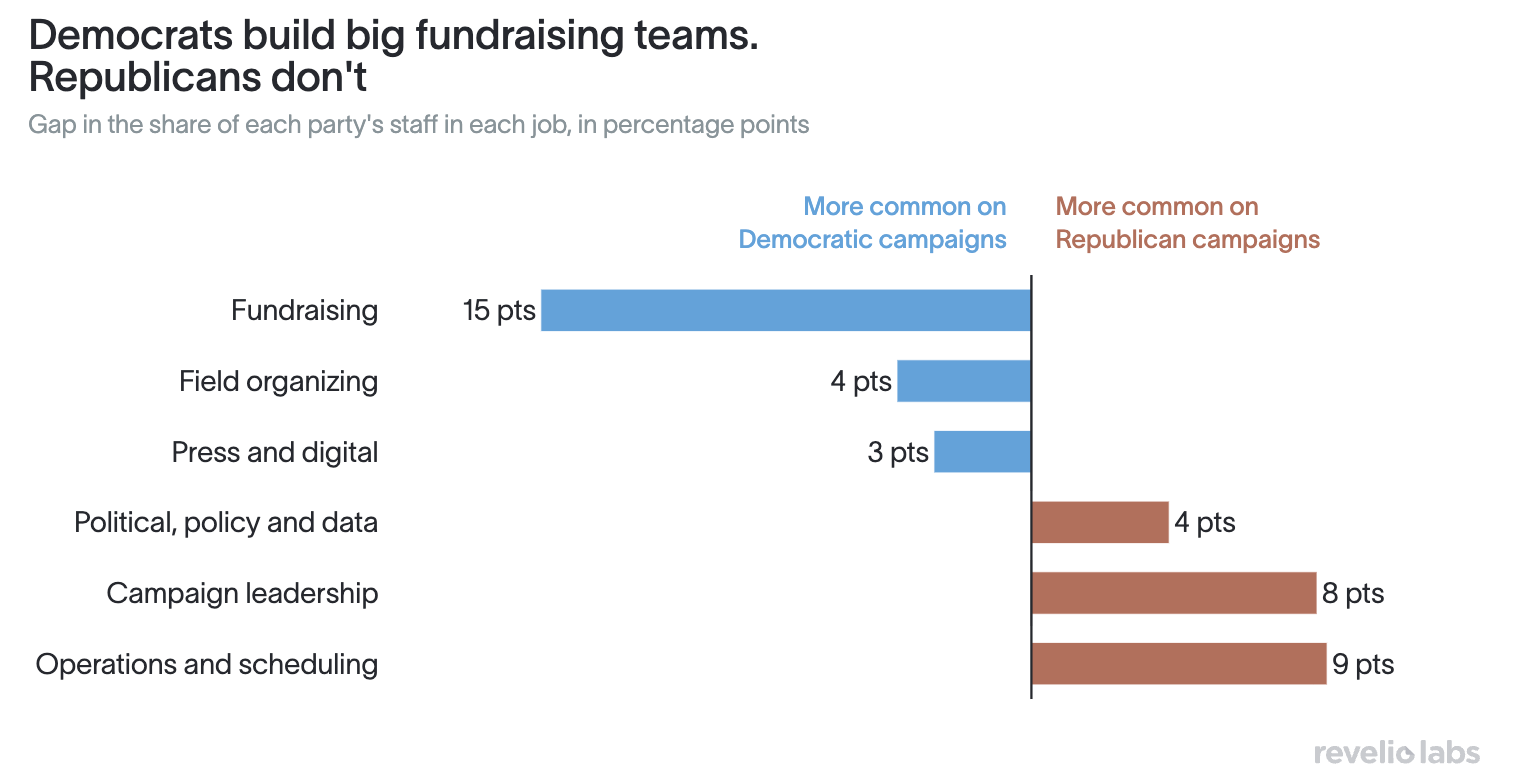
That fundraising gap comes down to who does the asking. According to FEC filings, Republican campaigns spend about 10% of their budgets on fundraising, twice the Democratic share, and almost all of it goes to outside firms. Democratic campaigns do more of their fundraising in-house, with paid staff, so payroll makes up 12% of their spending, compared with 4% at Republican campaigns.
What happens to campaign staff after the election
Once the votes are counted, where staffers go next depends on the outcome of the race and the type of campaign they worked on. Winners' staff often follow their candidate to Congress, and about two-thirds of those who land a congressional job work for the member they helped elect. Unsurprisingly, new members bring the most staff with them, since they have to build an office from scratch. Six months out, 28% of new members' staff are in Congress, compared with 18% of reelected incumbents' staff.
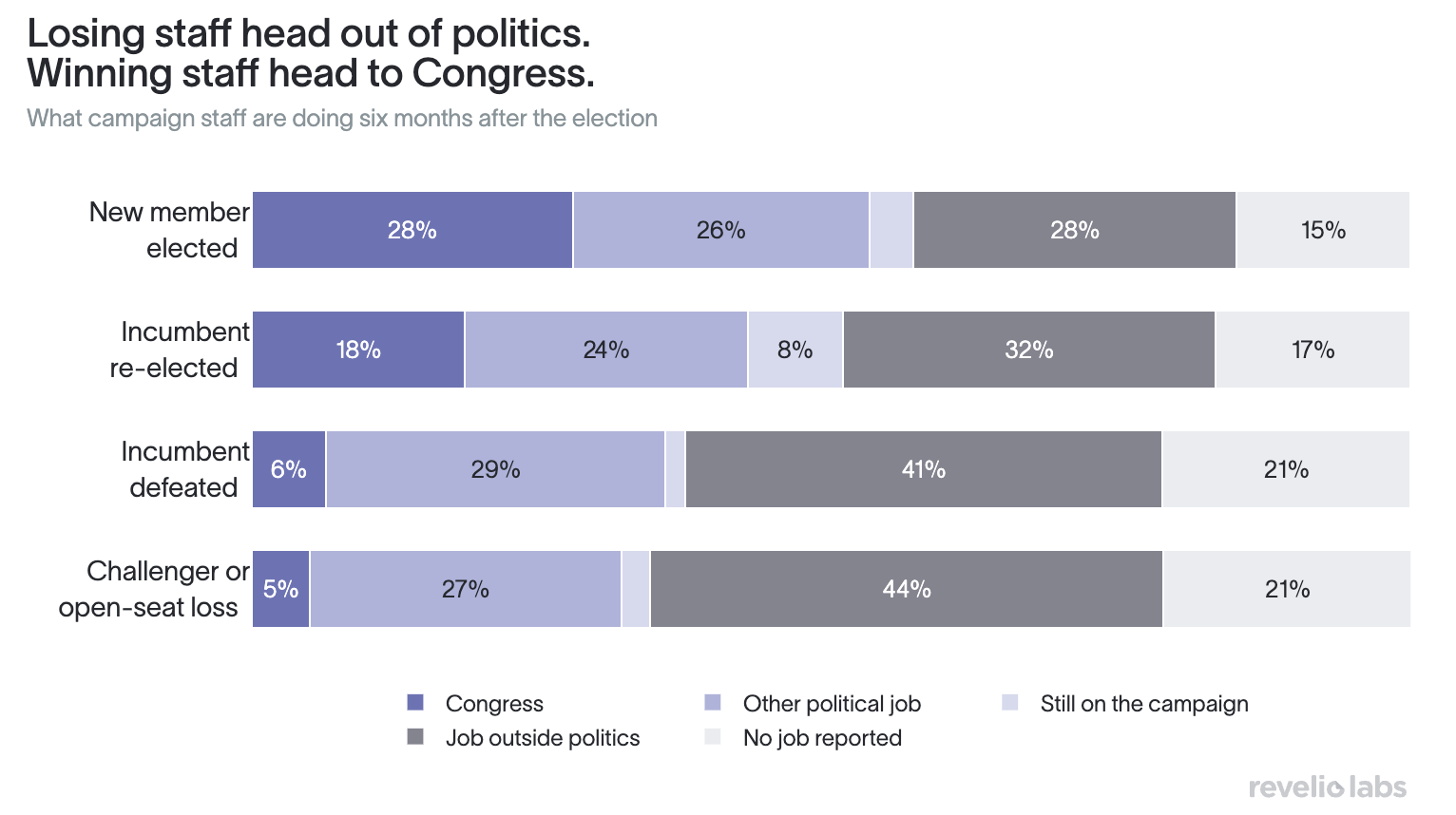
For staff on losing campaigns, the immediate path to Congress mostly closes. Five or six percent do manage to land in Congress six months after the campaign. Over a quarter find other political jobs, but most leave politics or have no job listed.
This suggests a tradeoff for ambitious staffers choosing which candidate to work for. Incumbents win far more often: 91% of their races in our sample. Despite the odds, challengers and open-seat candidates send a slightly larger share of their staff to Congress. Among staff new to the Hill, 9% of those on challenger and open-seat campaigns got a congressional job within a year, compared with 7% on incumbents’ campaigns. That’s because when a newcomer wins, almost a quarter of their staff go to Congress.
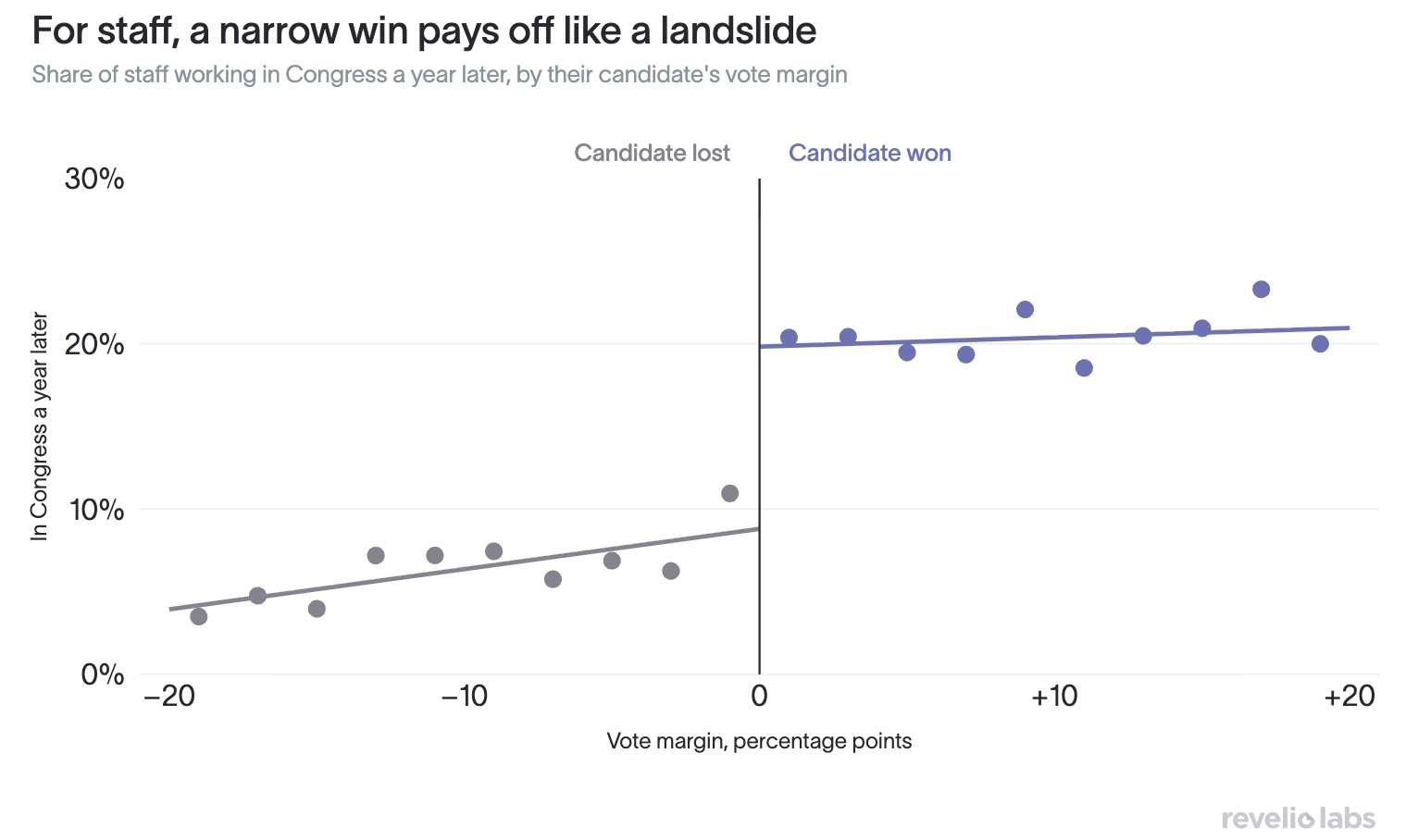
A narrow win pays off like a landslide
Of course, winning campaigns might simply hire better staff. To check whether the win itself is driving these differences in outcomes, we looked at races decided by less than 10 points, where staff on winning and losing campaigns looked similar before the election. To get enough close races, we went back to 2000. The payoff holds up. A year after the election, about 21% of staff on campaigns that barely won are working in Congress, compared with about 10% on campaigns that barely lost. A narrow win gets staff into Congress about as often as a landslide.
To see if there are lasting impacts, we followed everyone whose first House or Senate campaign was between 2000 and 2014 for the next ten years and sorted their careers into three types. Some kept campaigning for three or more election cycles. Some took at least one job in Congress, the federal government or another political employer, like a party, consultancy or advocacy group. Everyone else left politics.
Staff whose first candidate won were more likely to take a job in Congress, government or politics at some point in the decade (49% versus 39%). Those whose candidate lost were more likely to leave politics (46% versus 37%). Even a narrow win raises the probability of a staffer working in politics or government by about 8 points.
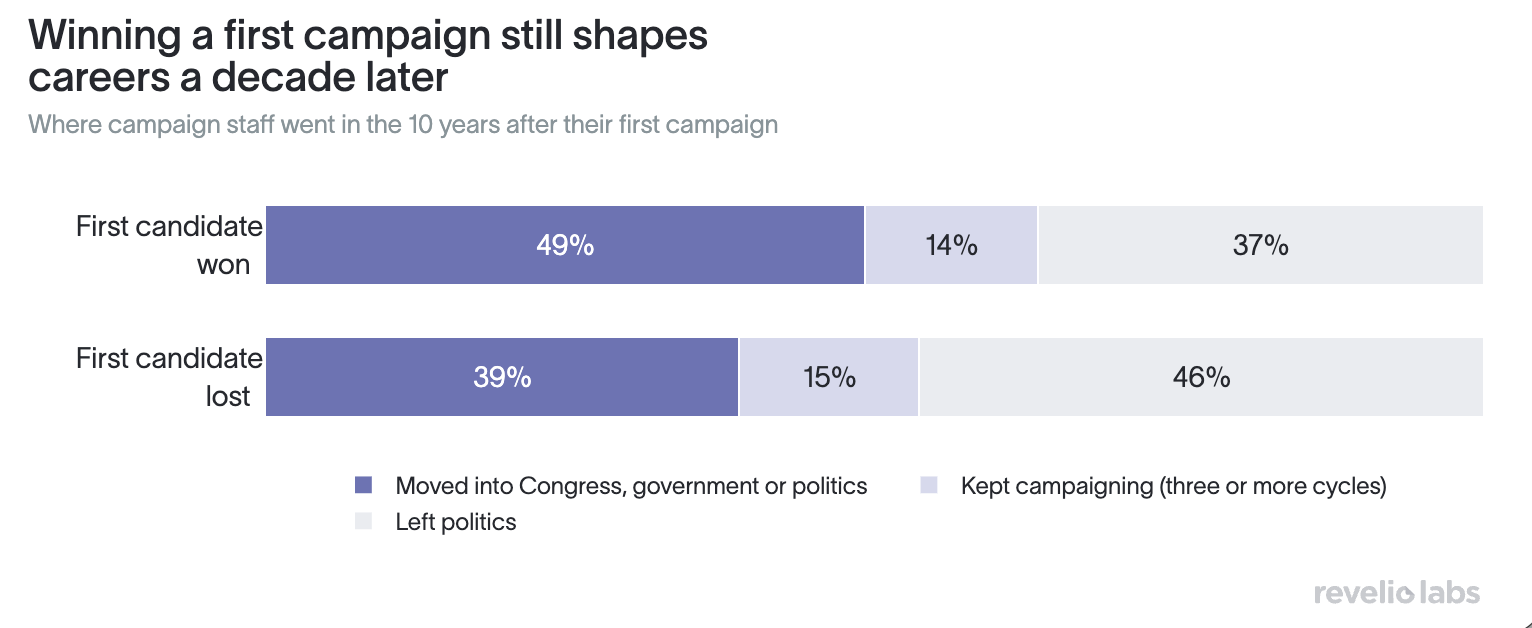
About 14% kept campaigning either way, and they tended to climb. Most of these serial campaigners hold senior titles on their latest campaign, and about half reach campaign manager, political or state director, or chief of staff.
Campaign work is a short and uncertain job, done mostly by people at the start of their careers. Most staffers start less than a year before Election Day and are let go soon after. Those lucky enough to work for a winning campaign now have an in with a powerful person and a much better shot at working for them. Those on losing campaigns can hopefully take comfort in having worked for someone they believed in. Either way, they helped make the election happen, most of them with no guarantee of what comes next for their country or their careers.
Free to reproduce with attribution and a link to reveliolabs.com.
Cite this article
- Plain text
- Revelio Labs, "What happens to campaign staff after Election Day?" November 10, 2026.
- HTML
- Revelio Labs, "<a href="https://www.reveliolabs.com/news/social/political-campaign-jobs-after-election-day">What happens to campaign staff after Election Day?</a>" November 10, 2026.
- Academic
- Wilkie-Rogers, C. (2026, November 10). What happens to campaign staff after Election Day? Revelio Labs.


