


What is monopsony?
When economists talk about market power, they usually mean firms’ power as suppliers of goods and services to charge higher prices, often called monopoly power. But firms can also exercise market power as demanders of labor. A firm that faces limited competition for workers can pay wages below the value those workers contribute to output, pocketing the difference as profit. Economists call this monopsony, and measuring and quantifying this force has been one of the central challenges in labor economics over the past two decades.
In this newsletter, we use Revelio Labs' workforce data to establish baseline estimates of employer wage-setting power across the US economy, examining how it varies across industry, occupation, and time. Our approach follows Manning (2003): we estimate how responsive workers’ voluntary quits are to changes in their wages, and use the responsiveness to back out the share of earnings that employers suppress relative to a competitive benchmark—the earnings markdown. We view this work as a foundation. Monopsony is a rich and consequential phenomenon, and future issues will build on these results to examine firm-level dynamics, the role of labor market concentration, and the policy implications of employer wage-setting power.
How we measure employer wage-setting power
Our estimates draw on a representative sample of US workers from Revelio Labs' workforce database, which tracks the employment histories and estimated wages of millions of US workers. We follow the monopsony framework of Manning (2003), in which a firm's wage-setting power depends on how responsive its workers’ voluntary quits are to wages—a relationship captured by the separation elasticity. We estimate this separation elasticity by regressing each worker's monthly voluntary quit probability on their log total compensation, controlling for worker fixed effects that absorb permanent differences in mobility.
To address the endogeneity of wages, we estimate a series of instrumental variables regressions, instrumenting log wages with the leave-one-out mean wage of workers in similar occupations, metro areas, and seniority levels at other firms. This peer wage reflects what other firms pay comparable workers and the competitive pressure this puts on the employer to adjust pay. These regressions estimate the separation elasticity, and converting the elasticity into an earnings markdown follows a simplified version of Manning's formula:
where is the wage elasticity of voluntary separations. A markdown of zero (infinite elasticity) implies an idealized, perfectly competitive labor market.
To produce robust cross-sectional estimates, we run regressions across multiple specifications: varying the quit measure, weighting scheme, and instrument construction, and combine results using inverse-variance weighted model-averaging. We then apply empirical Bayes shrinkage: noisy estimates for smaller groups are pulled toward the overall mean in proportion to their uncertainty, preserving genuine heterogeneity where the data support it while preventing extreme values from distorting comparisons across industries, occupations, and states.
It is worth noting that our estimates represent one of several approaches to measuring employer wage-setting power. The separation elasticity method identifies monopsony from the wage-responsiveness of voluntary quits and rests on simplifying assumptions around steady-state labor market dynamics and the relationship between labor flows and other inputs. We view our results as a baseline and aim to bring additional methods to bear in future work.
How much monopsony power do US employers have?
Our baseline result estimates markdowns over time, aggregating across all jobs and geographies in the US. From 2016 to 2022, the aggregate markdown averaged around 30%, broadly consistent with estimates from earlier periods: for every marginal dollar of output workers generated, they kept roughly 70 cents in compensation, with 30 cents retained by the employer either as profits or to cover other costs.
Since 2022, markdowns have fallen by roughly 10 percentage points, implying workers now keep closer to 80 cents on per marginal dollar of output. This represents a substantial decline in employer wage-setting power, likely reflecting the unusually tight post-pandemic labor market, including historically high quit rates during the Great Resignation and disproportionate wage growth and competition for workers at the bottom of the wage distribution. For instance, nominal wage growth for workers in the bottom half of the wage distribution peaked at over 7 percent in late 2022 and early 2023, compressing the wage distribution in ways that directly reduced employers' ability to set wages below workers' marginal product. This relative increase in labor power also coincides with the rapid diffusion of generative artificial intelligence and large language model tools, whose role we examine below.
A natural question is whether the compression in markdowns reflects rising wages or falling productivity—or both. On this front, BLS data show that nonfarm business labor productivity actually fell 1.5% in 2022 before recovering in 2023 and 2024. This observation suggests the markdown compression was driven primarily by wages outpacing productivity: employers competing intensely for workers during the Great Resignation accepted lower margins, paying above-trend wages even as measured productivity temporarily declined due to rapid hiring of new, less experienced workers. The result was a genuine compression of the gap between wages and marginal product.
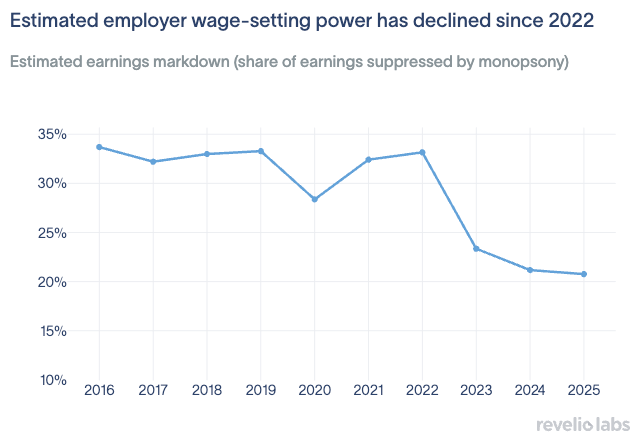
A 10 percentage point decline in markdowns—roughly a 33% compression relative to the pre-2022 baseline—is large, though large swings in aggregate markdowns are not unprecedented. Yeh, Macaluso, and Hershbein (2022) document that manufacturing markdowns decreased significantly from the late 1970s to the early 2000s, before sharply increasing by over 20% between 2002 and 2012. Kirov and Traina (2022) similarly find that workers' share of the marginal dollar they generated was halved in US manufacturing between 1972 and 2014. The magnitude of our estimated short-run compression is consistent with the broader literature's finding that aggregate markdowns are sensitive to macroeconomic conditions—particularly labor market tightness. Nonetheless, this result signifies a significant increase in worker power in the labor market.
Which industries have the most monopsony power?
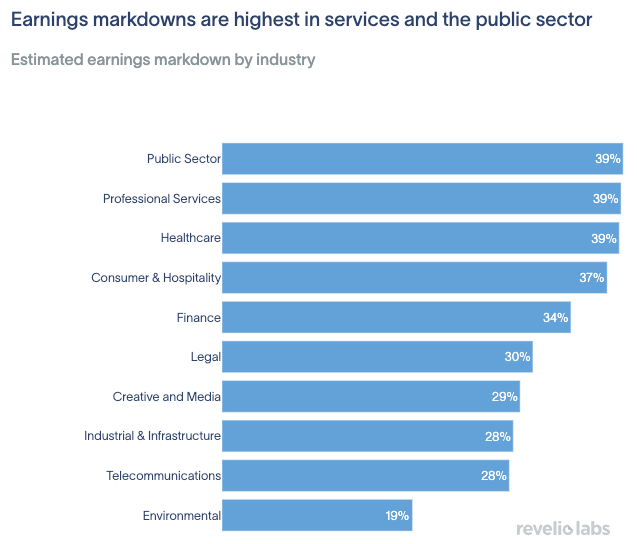
Earnings markdowns also vary substantially by industry. To produce industry-level estimates, we run separate regressions on stratified samples drawn independently for each of our 9 broadest sector definitions, partitioning the US economy.
This procedure reveals wide dispersion in markdowns across the US economy. Workers in the public sector and in professional and healthcare services face an average estimated markdown of 39%. Several mechanisms may contribute to these higher estimates: the relationship-dependent nature of consulting, staffing, and marketing roles, where firm-specific client relationships and project pipelines limit workers' outside options; the consolidation of hospital systems in local labor markets; and, in the public sector, nonpecuniary benefits such as job security, pensions, and civil service protections that reduce workers' sensitivity to wages, attenuating the separation elasticity even where formal monopsony exploitation may be limited. At the other end, workers in environmental, industrial infrastructure, legal, and telecommunications sectors face markedly lower markdowns, consistent with sectors where credentialed skills, stronger union representation, or national labor markets may limit employers' wage-setting power.
These differences in estimated markdowns offer a window into the balance of power between employers and workers. Where employers dominate local labor markets—facing few competitors for workers with specialized or location-specific skills—markdowns tend to be higher. But this balance is not fixed: it responds to the broader labor market environment and to policy, as we document below.
Which occupations face the largest markdowns?
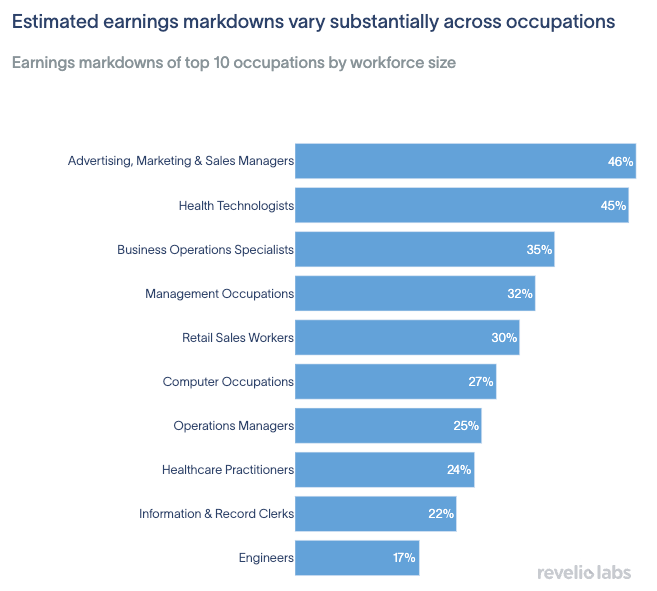
Turning to occupations, we estimate markdowns for the ten most populated occupation groups in our sample. Estimates vary substantially, ranging from 17% for engineers to 46% for advertising, marketing, and sales managers. Notably, healthcare practitioners face among the lowest markdowns in our sample, likely reflecting the portability of clinical credentials, despite the well-documented consolidation of hospital systems and the healthcare industry’s high average markdown.
The pattern broadly mirrors the industry results: workers with portable, standardized skills—healthcare practitioners, engineers, and computer workers—face lower markdowns, while workers in more relationship-dependent or firm-specific roles face higher ones.
Unions reduce employer wage-setting power
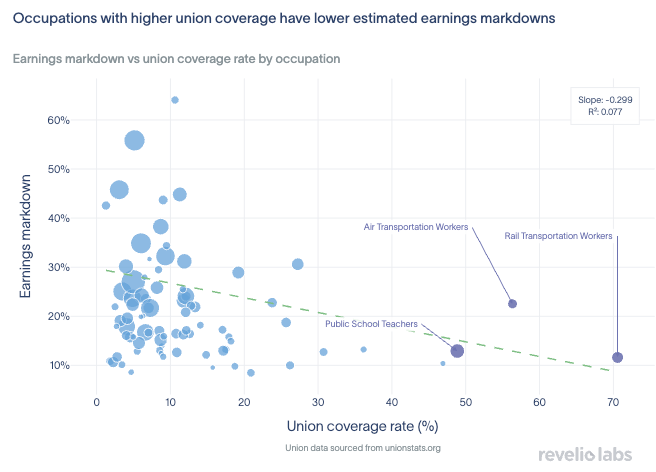
To examine what drives these differences in employer wage-setting power, we turn to two external correlates: union coverage and AI exposure. The relationship between monopsony and unionization is particularly interesting. If our markdown estimates genuinely capture employer wage-setting power, we would expect occupations with stronger union representation to exhibit lower markdowns, since collective bargaining directly compresses the gap between wages and marginal product.
We use occupation-level data on unionization coverage from unionstats.com and correlate average coverage rates from 2016 to 2025 with markdowns. We observe a negative relationship: a 10 percentage point increase in union coverage is associated with a 3 percentage point decrease in the earnings markdown. Union coverage explains only part of the variation in markdowns, but the pattern is consistent with collective bargaining limiting employer wage-setting power.
Is AI shifting bargaining power toward workers?
Lastly, we evaluate one possible cause of the visible drop in markdowns beginning in 2023: the advent and popularization of generative AI tools.
The relationship between AI and monopsony power is theoretically ambiguous. Automation may displace workers from routine tasks, reducing their outside options and increasing employer wage-setting power. But automation may also enhance labor productivity or induce a reallocation of labor toward higher value-added tasks, raising workers' marginal product and strengthening their bargaining position—the mechanism emphasized in the task-based framework of Acemoglu and Restrepo (2018). These two forces operate in opposite directions, and their net effect is an empirical question.
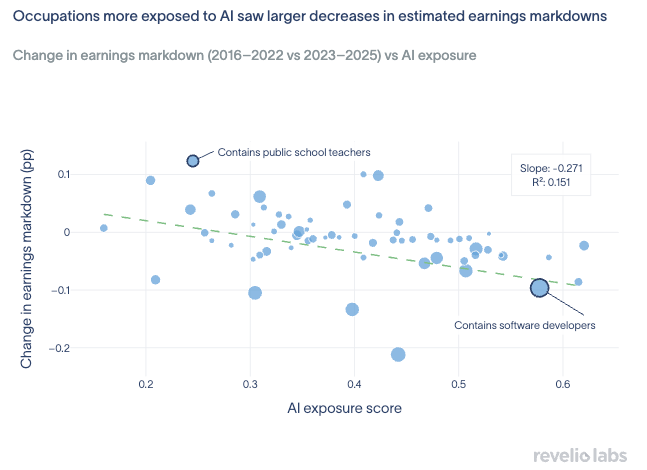
To assess the relationship between AI exposure and monopsony power, we split our sample into two periods—2016–2022 and 2023–2025—to capture the pre- and post-AI era. We estimate markdowns separately for each occupational group for each period and compute the change in markdown between the two. We then correlate this change with each occupation's average AI exposure score, a measure developed by Revelio Labs based on the share of job activities that could be automated by AI.
Interestingly, we observe a negative relationship between AI exposure and the change in markdowns from the pre- to post-AI period: occupations with higher AI exposure saw larger reductions in earnings markdowns after 2022. A 10 percentage point increase in AI exposure is associated with a 2.7 percentage point larger decrease in markdowns (p=0.006), though the relationship is noisy and the causal interpretation remains tentative.
This finding speaks to an active and unsettled debate on AI's labor market effects. Research has produced conflicting findings: Hosseini and Lichtinger (2025) and Brynjolfsson, Chandar, and Chen (2025) find that AI has reduced hiring of junior workers in exposed occupations, while Revelio Labs' own research finds that companies with the greatest AI investment have expanded their labor forces the most. Anthropic's Economic Index similarly finds that AI is used more for augmentation than automation across most occupations. Our result adds a new dimension to this discussion: AI appears to have shifted bargaining power toward workers in high-exposure occupations, though we caution that our pre/post comparison is descriptive, and disentangling the role of AI from concurrent macroeconomic shifts remains a direction for future work.
This newsletter establishes baseline estimates of employer wage-setting power across the US economy using Revelio Labs' workforce data. We find that monopsony is pervasive—the average worker's earnings are marked down by roughly 30% relative to a competitive benchmark—but also heterogeneous, varying substantially across industries and occupations, and dynamic, with markdowns dropping sharply since 2022 in the wake of the post-pandemic labor market tightening. Our evidence further suggests that AI exposure may have contributed to this compression in high-exposure occupations, adding a new dimension to ongoing debates about AI's labor market effects. These results are a starting point: future work will examine firm-level dynamics, labor market concentration, and AI's longer-run effects on employer wage-setting power as more data become available.
Free to reproduce with attribution and a link to reveliolabs.com.
Cite this article
- Plain text
- Revelio Labs, "Is worker power coming back? Monopsony in the US labor market," November 2, 2026.
- HTML
- Revelio Labs, "<a href="https://www.reveliolabs.com/news/macro/is-worker-power-coming-back-monopsony-in-the-us-labor-market">Is worker power coming back? Monopsony in the US labor market</a>," November 2, 2026.
- Academic
- Brounstein, J. (2026, November 2). Is worker power coming back? Monopsony in the US labor market. Revelio Labs.


