


Last night, the Tampa Bay Rays bested the Cleveland Guardians to advance to a World Series matchup with the Milwaukee Brewers starting this Friday. If that were not enough, the NBA season kicks off tonight as well. We take this opportunity to turn our attention to—as far as we are concerned—an almost equally exciting component of professional sports: the evolution of teams’ off-the-field workforce. Over the past few decades, professional sports competition has been decided by finer and finer margins. As the competition has heated up, teams have increasingly needed to find their edge at the organizational level.
One such competitive edge, popularized nearly thirty years ago by Billy Beane and the Oakland A’s, is the use of sports analytics, known in baseball as sabermetrics. Since the boost in on-field performance that Beane and the A’s achieved with their “moneyball” approach, teams across numerous professional sports leagues have honed their skills in collecting, analyzing, and leveraging data to drive both on- and off-the-field decisions.
To understand how different teams and sports have approached data-driven competition, we explore the evolution of their workforces through Revelio Labs data.
How common is data analytics in sports?
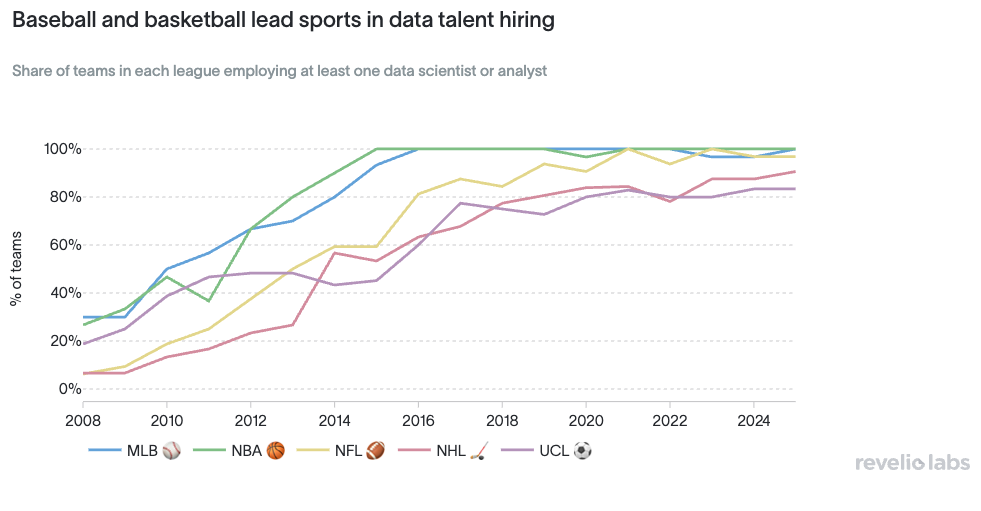
If Beane and the A’s were the data trailblazers, the effectiveness of their quantitative approach did not go unnoticed for long. Their story inspired a renowned book and Oscar-nominated film Moneyball. More importantly, the rest of baseball took note. We find that by the start of Revelio Labs’ own historical data, Major League Baseball (MLB) had the highest share of teams with at least one data role in their workforce. The National Basketball Association (NBA), however, was tight on MLB’s heels and the first league to hit 100% of teams with at least one data professional, in 2015. The National Football League (NFL) and National Hockey League (NHL) were the slowest out of the gate, with the NFL finally catching up to the frontrunners almost 15 years later. Soccer’s European UEFA Champions League (UCL), while originally middle-of-the-pack, has recently fallen behind in terms of overall share.
Does sports analytics help teams win?
Given the expansion of teams with data professionals in their off-field headcounts, we next analyze how these new quantitative capabilities may have translated to on-field performance. To do so, we conduct a staggered difference-in-differences analysis, comparing teams’ actual win percentages in the three seasons before and after their first data hire with their three-season pre-hire average performance. We control for team performance as well to ensure we do not capture unrelated trends.
The changes in performance vary markedly by sport. Although the league with the lowest team adoption, the Champions League demonstrates the greatest improvement after an initial data hire (note that we compare teams’ win percentages in their respective domestic leagues, not the Champions League). MLB teams exhibit an almost equally large improvement. Conversely, the NBA shows a decrease in win percentage over the next three seasons.
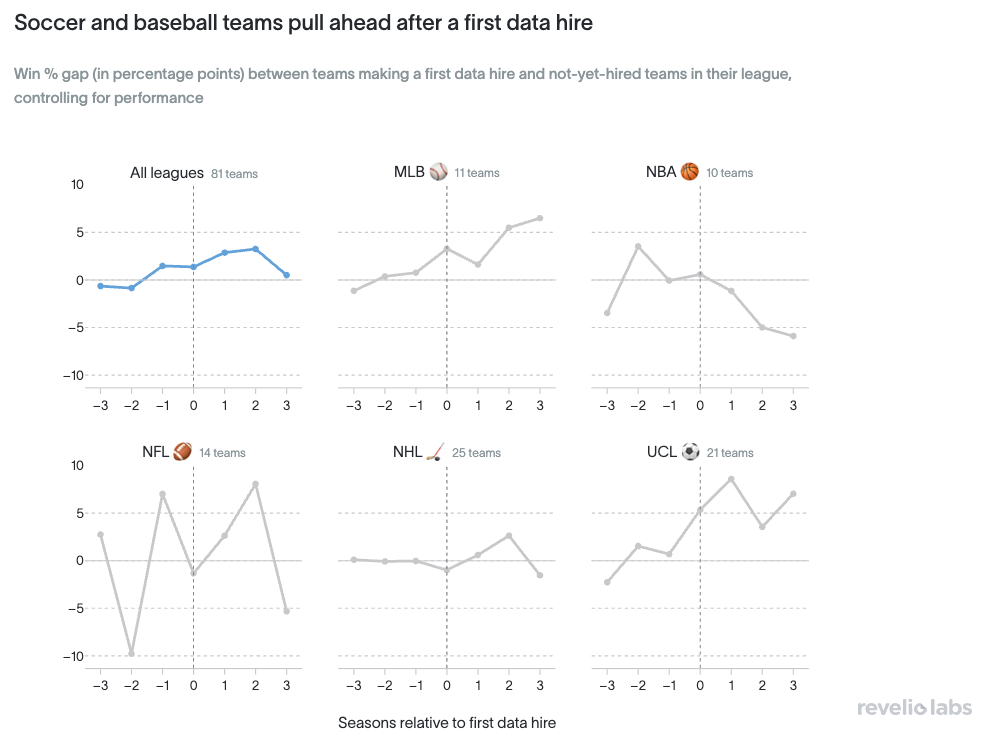
From the perspective of competition, while at first surprising, this result ultimately seems to make sense. Adoption speed in the NBA may have reduced the marginal gain in competitive advantage from a data hire since other teams were hiring for sports analytics capabilities at the same time. On the other hand, soccer’s slower adoption rate—potentially the result of the technical limitations in processing the sport’s data—may suggest that there remains marginal competitive advantage to be gained. Interestingly, we find notable performance improvement among baseball teams despite the league’s equally quick adoption, which hints at just how much of a potential edge analyzing baseball data effectively may provide.
Which teams gained the most from their first data hire?
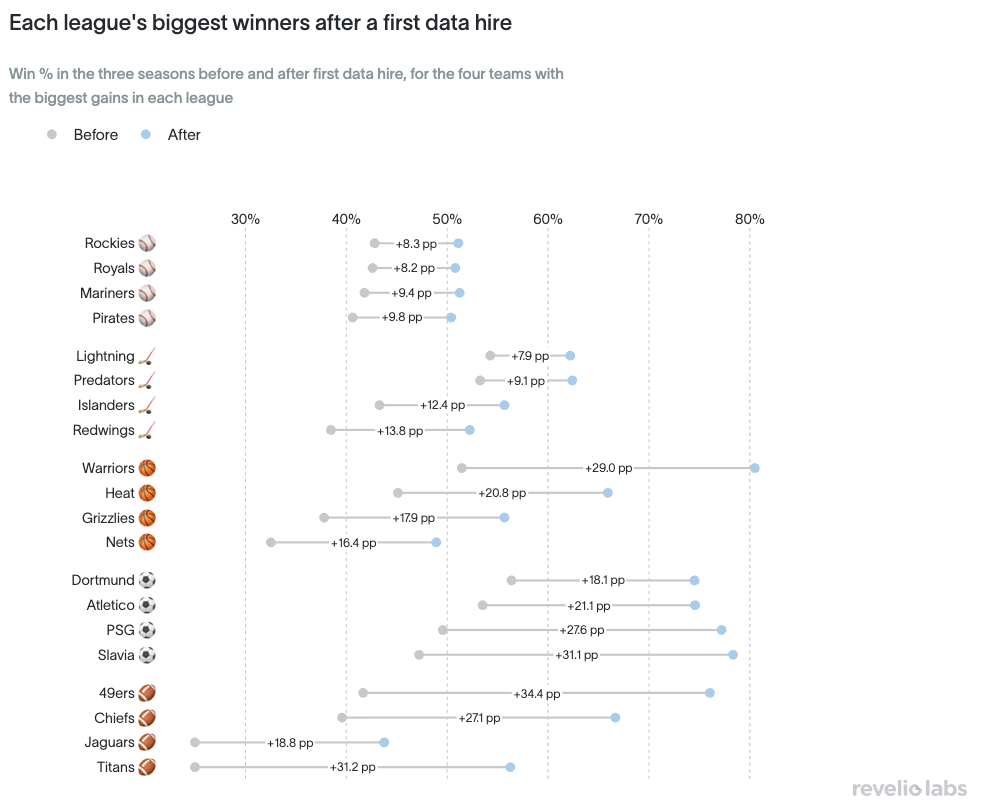
That being the case, how do individual teams compare in terms of performance improvements after calling up a data pro? Within the top 20 teams exhibiting the greatest boost in win percentage, we find a relatively even representation of sports. The NFL’s 49ers (2010) and Titans (2016), Champions League’s Slavia Prague (2016) and Paris Saint-Germain (PSG, 2010), and the NBA’s Warriors (2014) show the largest increase in win percentage after their first data hire.
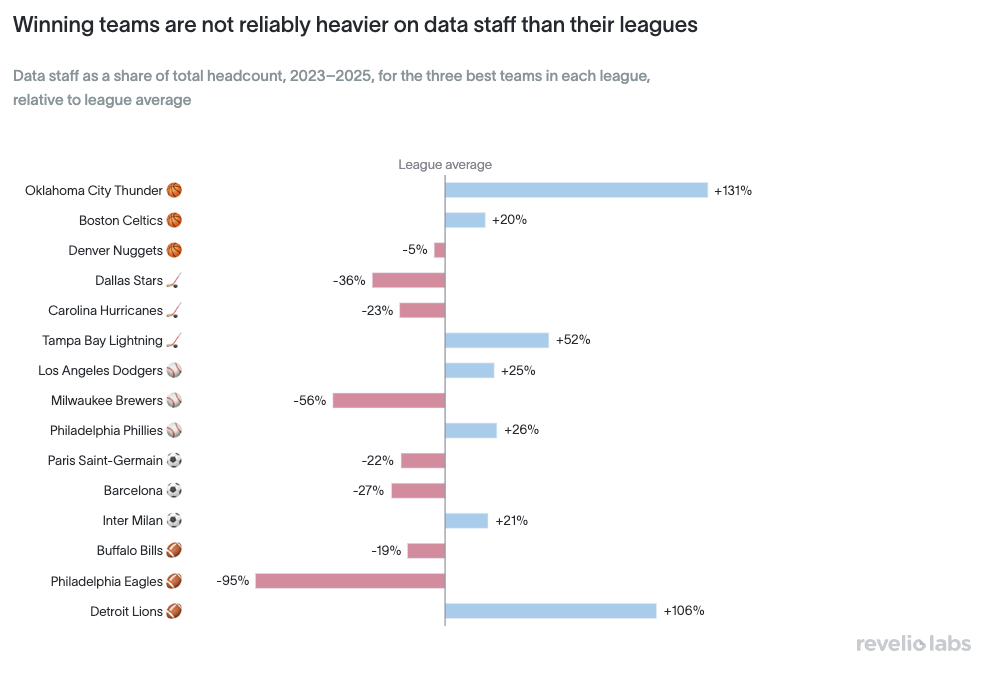
While we do see some noteworthy performance improvements among teams after recruiting a data pro, how do the best-performing teams’ data headcounts stack up? We compare the top three winningest teams in each sport (based on domestic league performance for Champions League teams) to their respective league’s average. We calculate the share of data pros within teams’ total headcounts. We find that among the top-performing teams, there is no clear trend towards relatively higher shares of data staff within the workforce. What this means is that while adding a data pro may be associated with boosts in performance (depending on the sport), relatively higher reliance on sports analytics is not what sets the best teams apart.
What data skills are sports teams hiring for?
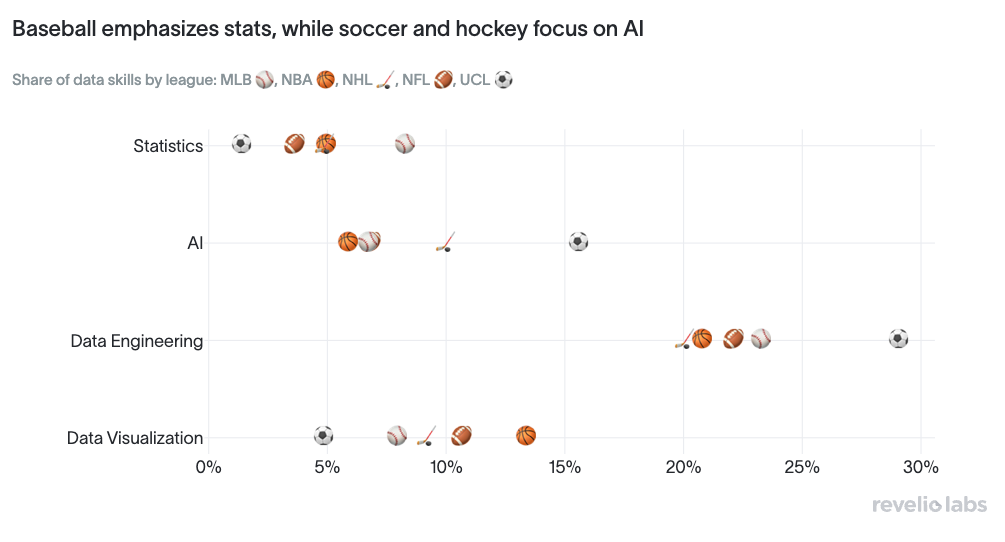
As varied as the evolutions in both performance and workforce appear, the quantitative approaches each sport has applied vary even more. To understand how each sport is focusing on gaining an edge through data, we compare teams’ current demand for relevant skills in Revelio’s unified job postings dataset.
Here, the distinction between the sports and how they aim to leverage data becomes more clear, especially between the two most dissimilar sports: baseball and soccer. Baseball demonstrates the highest demand for statistics. Soccer teams are seeking AI and data engineering capabilities.
Given each sport’s underlying mechanics and the data they generate, this divergence makes sense. Baseball operates in discrete steps, which have long been quantified and on which statistical analysis can be applied quite intuitively. Soccer’s fluidity, however, had posed more complex challenges, which seemed computationally insurmountable—until recently with the advent of machine learning and artificial intelligence. Now, with machine learning and artificial intelligence as well as the data engineering required to ingest, process, and extract insights from complex datasets, soccer teams can more readily apply quantitative methods in their strategy.
Of course, a discussion of performance improvement in modern-day professional sports generally merits mentioning money’s increasingly prevalent role in on-field success. We cannot disentangle money’s effects from the trends we observe, and indeed, teams’ deeper pockets can directly determine their willingness to invest in data capabilities. Nonetheless, our results demonstrate that data in sports is here to stay. Considering how the remaining teams in the MLB playoffs have some of the lowest on-field payrolls, there may still be marginal gains to achieve. Should any of the remaining teams effectively leverage their data pros to find that competitive edge, quantitative methods will no longer be a story of the comeback kids but, rather, the champions.
Free to reproduce with attribution and a link to reveliolabs.com.
Cite this article
- Plain text
- Revelio Labs, "Sports Analytics Is Universal. Its Payoffs Aren’t.," October 20, 2026.
- HTML
- Revelio Labs, "<a href="https://www.reveliolabs.com/news/business/sports-analytics-data-hires-win-rates">Sports Analytics Is Universal. Its Payoffs Aren’t.</a>," October 20, 2026.
- Academic
- Lawrence, N., & Boerner, D. (2026, October 20). Sports Analytics Is Universal. Its Payoffs Aren’t. Revelio Labs.


