


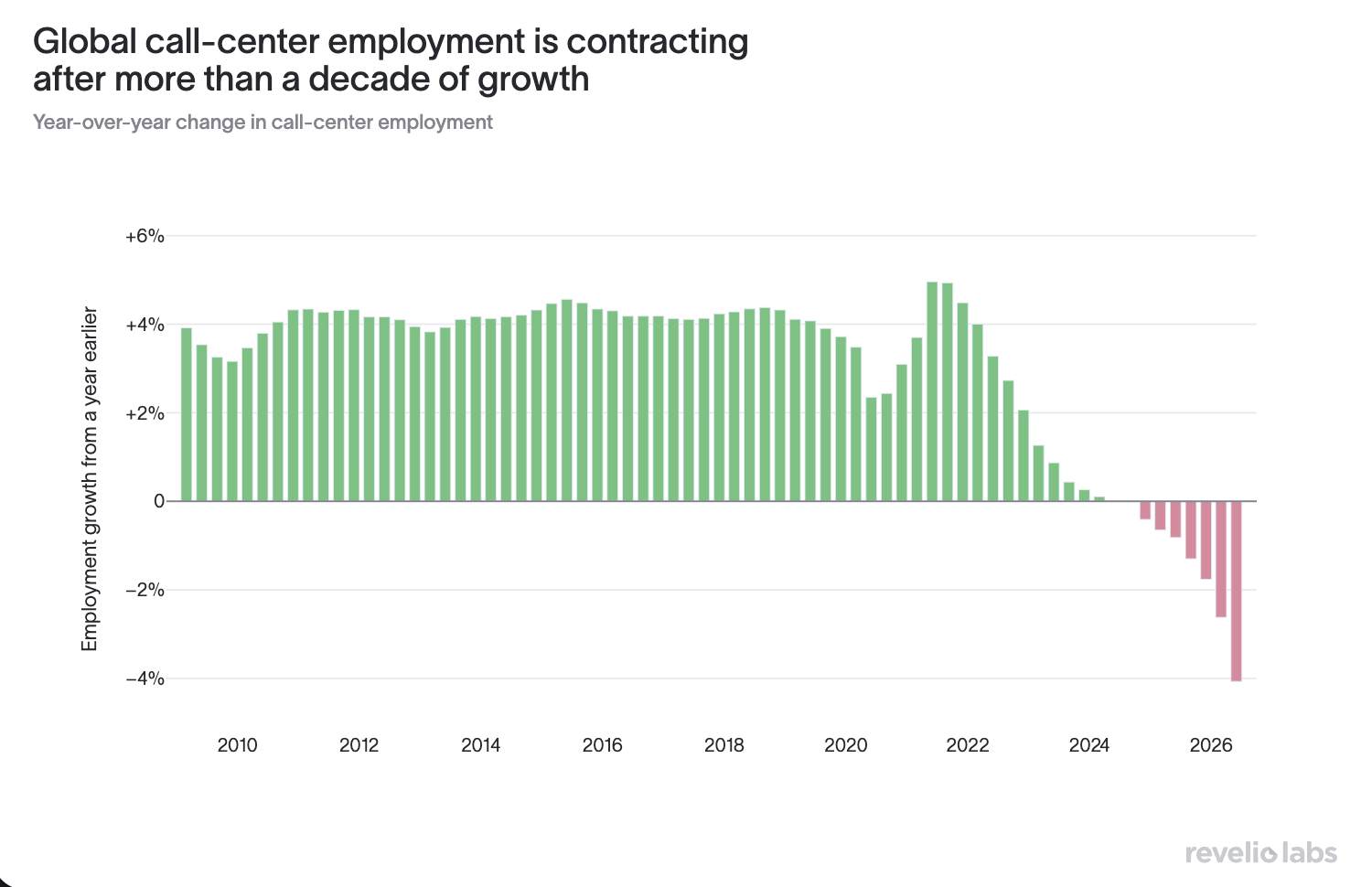
For more than a decade, call centers were one of the most reliable ways into formal office work in middle- and lower-income countries. That route is now shrinking. Revelio Labs' global headcount data shows call center employment is 5.3% below its December 2023 peak.
Major operators are already pursuing AI-driven efficiency. Global call center operator TP is targeting €150 to 170 million in annual savings from an AI and cost-reduction program, while TaskUs's CEO has said agentic AI could cut customer support costs by 25 to 50%.
A recent International Labour Organization (ILO) working paper points out that in lower-income countries, while the jobs most exposed to automation represent a small share of employment, they also are disproportionately the entry-level office roles that have provided women and young workers pathways into sustained decent work. Call centers have been one of those pathways.
Call-center employment is falling worldwide
Of the 70 quarter-end readings since 2009, headcount fell from a year earlier only eight times, and all eight have come in the last eight quarters. The declines have also deepened, with the most recent quarter showing the steepest drop yet.
The decline started in high-income countries and worked down the income ladder
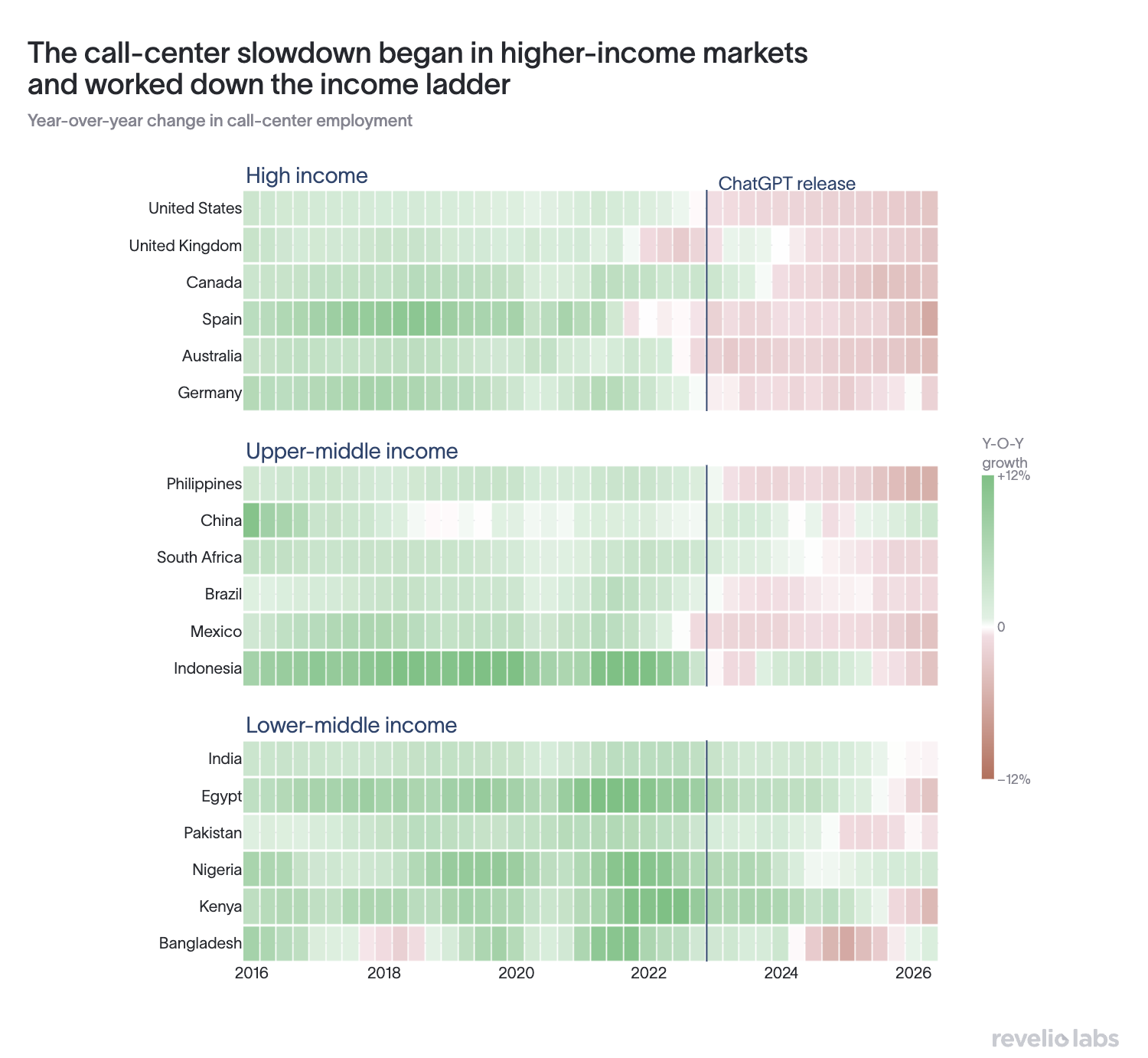
The timing of this decline has not been uniform across geographies. Rather, the trend has rippled from higher- to lower-income economies. Comparing the largest call-center countries, we see the decline first appearing in higher-income countries, progressively spreading to middle- and then lower-income countries. That said, we also find that certain countries, like China and Nigeria, still show growth.
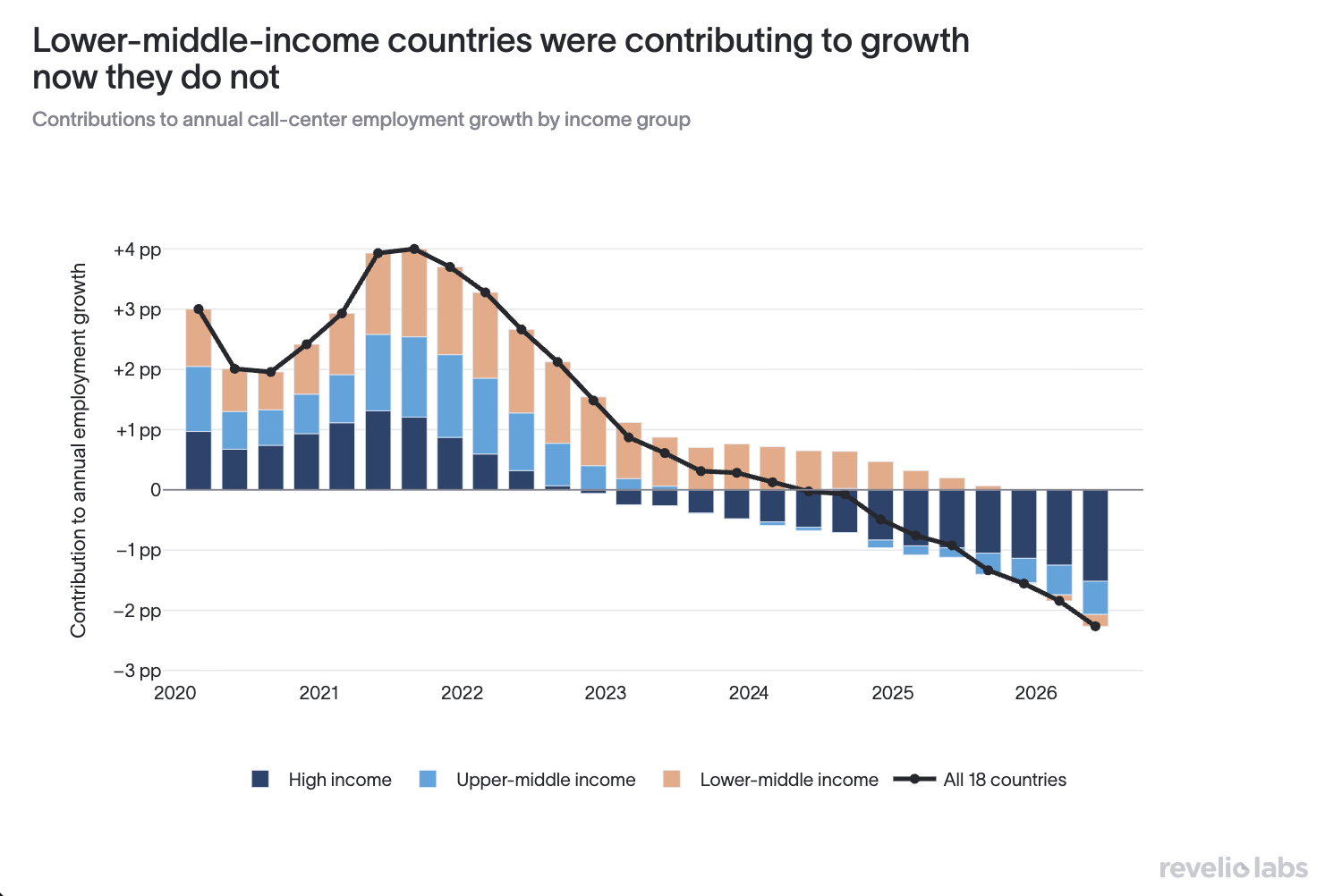
Decline aside, the overall shift in call-center employment from higher- to lower-income countries is not surprising. Companies certainly had a clear reason to relocate operations to lower-income countries. Revelio wage data shows average pay of $5.44 per hour in upper-middle-income countries and just $2.32 in the six lower-middle-income countries—relative to $22.52 in high-income countries.
Offshoring to lower-cost countries, however, no longer seems to buoy the call-center market. Since 2020, lower-income countries have increasingly driven call-center headcount growth amid declines already occurring in high-income markets. By mid-2024, however, the global growth rate turned negative, with all markets experiencing declines by the fourth quarter of 2025.
Is AI behind the call center decline?
The decline is surely multifaceted. It could in part be a correction from the hiring boom that followed the COVID pandemic, or general corporate cost-cutting driven by higher interest rates.
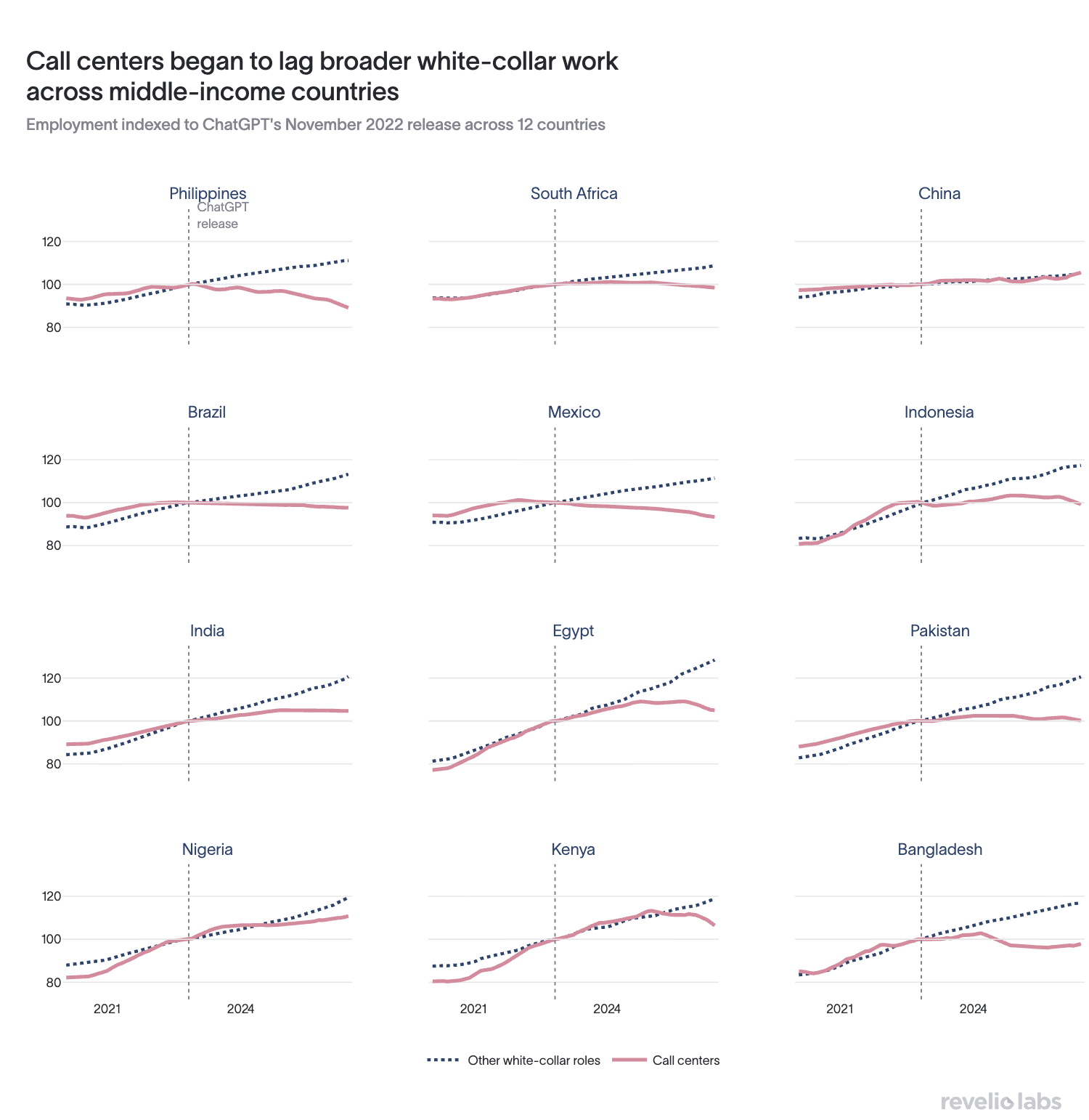
But those explanations should hit office work broadly, and they don't. Across the 12 middle-income countries, the pattern is recognizable: in the pre-ChatGPT era, call-center headcount generally kept pace with other office and administrative, "white-collar" roles. In the post-ChatGPT era, we see sluggish growth or outright declines in call centers—even as the rest of white-collar work looks fairly robust. So, although we cannot observe which firms replace people with chatbots, this divergence in headcounts between call centers and the rest of their labor markets makes AI’s potential role in this trend hard to wave off. Moreover, call centers’ high-volume, scripted work is exactly the profile the ILO flags as most exposed in these countries.
The better-paid white-collar jobs are the ones still growing

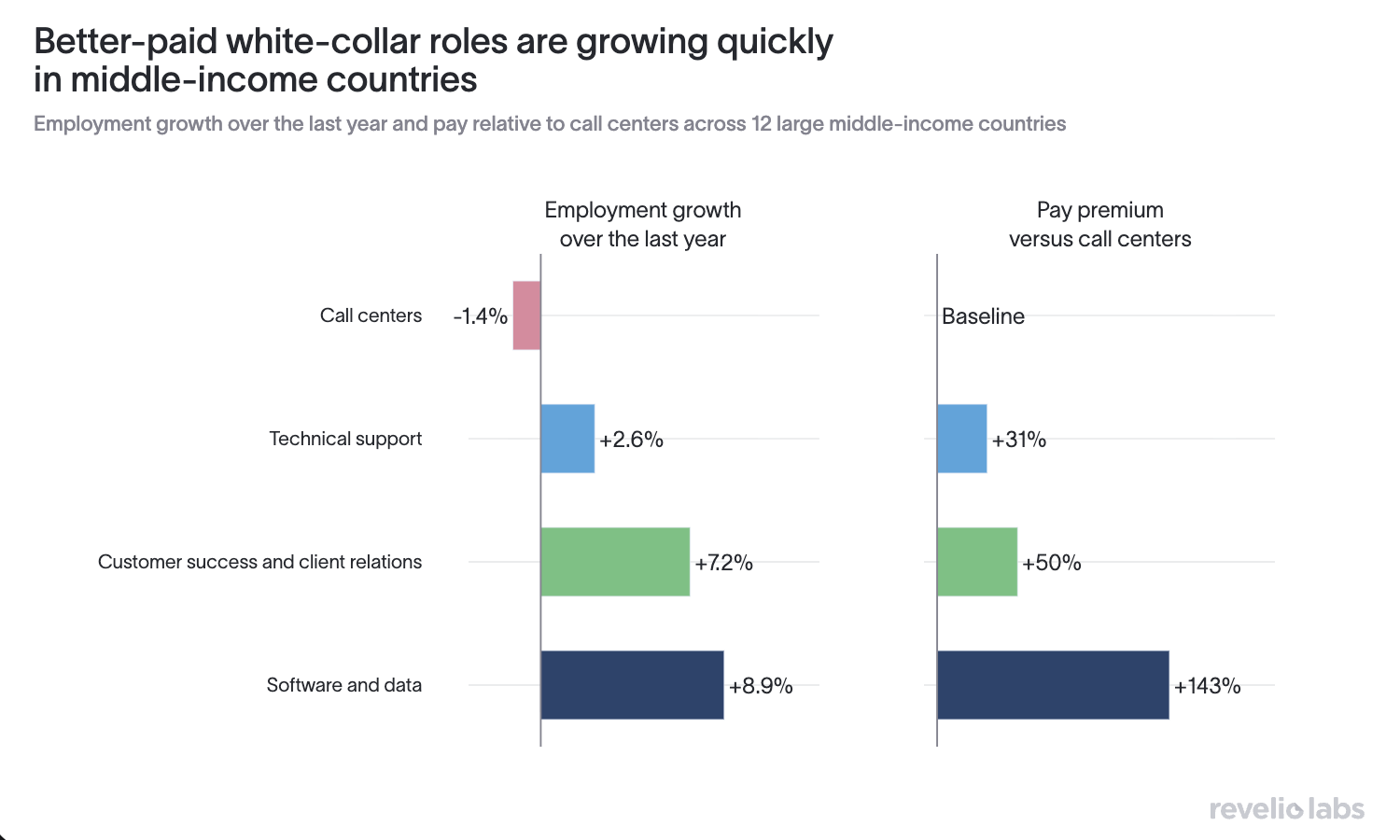
The good news is that, so far, this has not meant a decline in white-collar work in these economies. Across those same 12 countries, the work that is still growing is the better-paid work. Software and data pays more than double the hourly rate of a call-center job and grew 8.9% over the last year. Customer success and client relations, the less routine and more relational end of customer service, carries a 50% premium and grew 7.2%. Technical support, which pays 31% more, also expanded 2.6%. Call centers, the lowest-paid of the four, are the only ones contracting. That is the part of the ILO's warning that hasn't materialized. The office economy in these countries is still expanding, and for workers who successfully make the move, the gains are real. Same-country movers at unchanged seniority saw median pay changes of +11.4% into technical support, +7.1% into customer success and +12.7% into software and data.
Where do call-center workers go next?
So who is absorbing the contraction? It is mostly not people being pushed out. Across the 12 middle-income countries, the entry rate into call-center work fell from 25.1 to 17.2 per 100 workers since November 2022, while the exit rate also fell, from 22.3 to 18.5. Entries fell faster than exits and eventually dropped below them. The industry is shrinking because hiring slowed, not because separations picked up.
To understand the ramifications of this decline for call center employees and the broader market, we use Revelio's transitions data to track where individuals find new employment. We find that despite the otherwise growing, thriving office economy in their respective countries, most call center employees are not landing in these high-paying, growing roles.
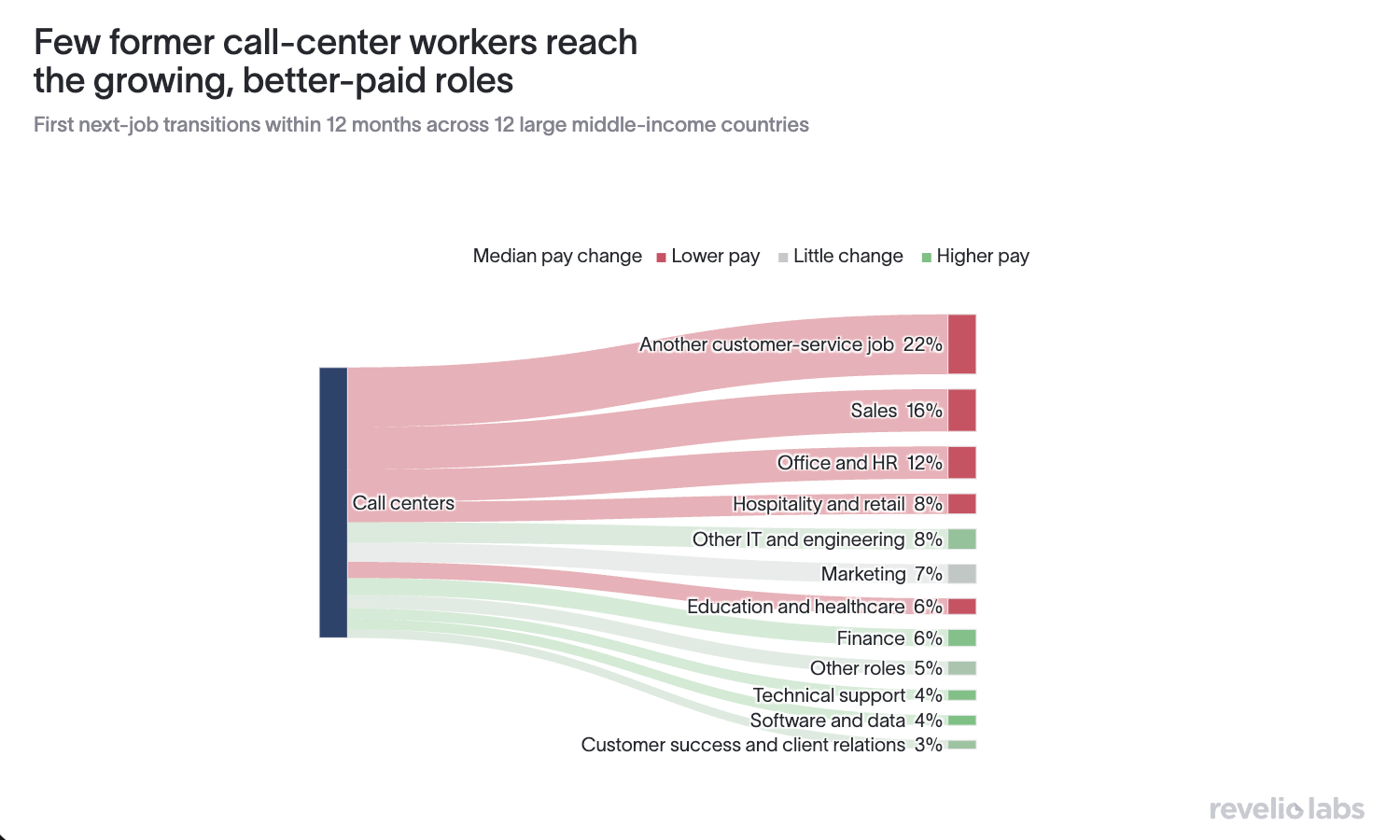
Half of observed movers, 49.7%, go sideways: another customer-service job, sales, or office and HR work. More notably, a mere 10.8% reach higher-paying technical support, customer success, or software and data roles.
Most workers leaving call centers don't reach the growing roles
The ILO paper calls the underlying risk a white-collar bypass: the office jobs that carried a generation into the middle class in higher-income countries may not fully materialize in today's lower-income economies. The broader version of that story is not yet visible in the headcount data. White-collar employment in these countries is not only growing but paying well. Nevertheless, the decline in call centers in middle- and lower-income countries may be a harbinger of what is to come, since the occupation that best fits the description of the exposed, entry-level, formal office job is indeed the one disappearing so quickly and so broadly after the release of ChatGPT.
Should call center jobs go away, it would not be the first case of an occupation that was replaced by technology. The classic case is the switchboard operator, connecting telephone calls by hand. At the peak, hundreds of thousands of young women did such work, for many of them the first paid work outside the home. When automatic switching ended it, these women transitioned to other occupations, and today, nobody mourns the switchboard operator.
The question now is whether the next generation of workers in middle-income countries finds another way into office work. The office economy there is still growing, but one of its main entry points is shrinking, and most people leaving it are not reaching the roles that are expanding. The next few years of transitions data will show whether that gap closes or becomes permanent.
Free to reproduce with attribution and a link to reveliolabs.com.
Cite this article
- Plain text
- Revelio Labs, "After a Decade of Growth, Global Call Center Employment Is Shrinking," October 6, 2026.
- HTML
- Revelio Labs, "<a href="https://www.reveliolabs.com/news/ai-and-work/after-a-decade-of-growth-global-call-center-employment-is-shrinking">After a Decade of Growth, Global Call Center Employment Is Shrinking</a>," October 6, 2026.
- Academic
- Wilkie-Rogers, C. (2026, October 6). After a Decade of Growth, Global Call Center Employment Is Shrinking. Revelio Labs.


