


The job market for new economics PhD graduates has undergone notable shifts in recent years. While career paths in economics have traditionally included research-intensive roles in academia and policy, new opportunities in industry, particularly in tech, have expanded the types of positions available to graduates. In a 2019 article for the Journal of Economic Perspectives, for example, Susan Athey and Michael Luca outlined the emerging role of economists in tech companies.
However, in recent years, reduced academic funding, fluctuating government demand, and changing private-sector needs have raised concerns about the job market outcomes of new economics PhDs, with many reporting difficulties finding work after completing their degrees. Given the Revelio Economics team’s own backgrounds, the economics PhD job market is of perennial personal interest to us as well. Using our data on online professional profiles, we can document patterns in employment outcomes for new graduates of economics PhD programs and show how the job market has evolved over time.
The number of graduates from US economics PhD programs remains steady
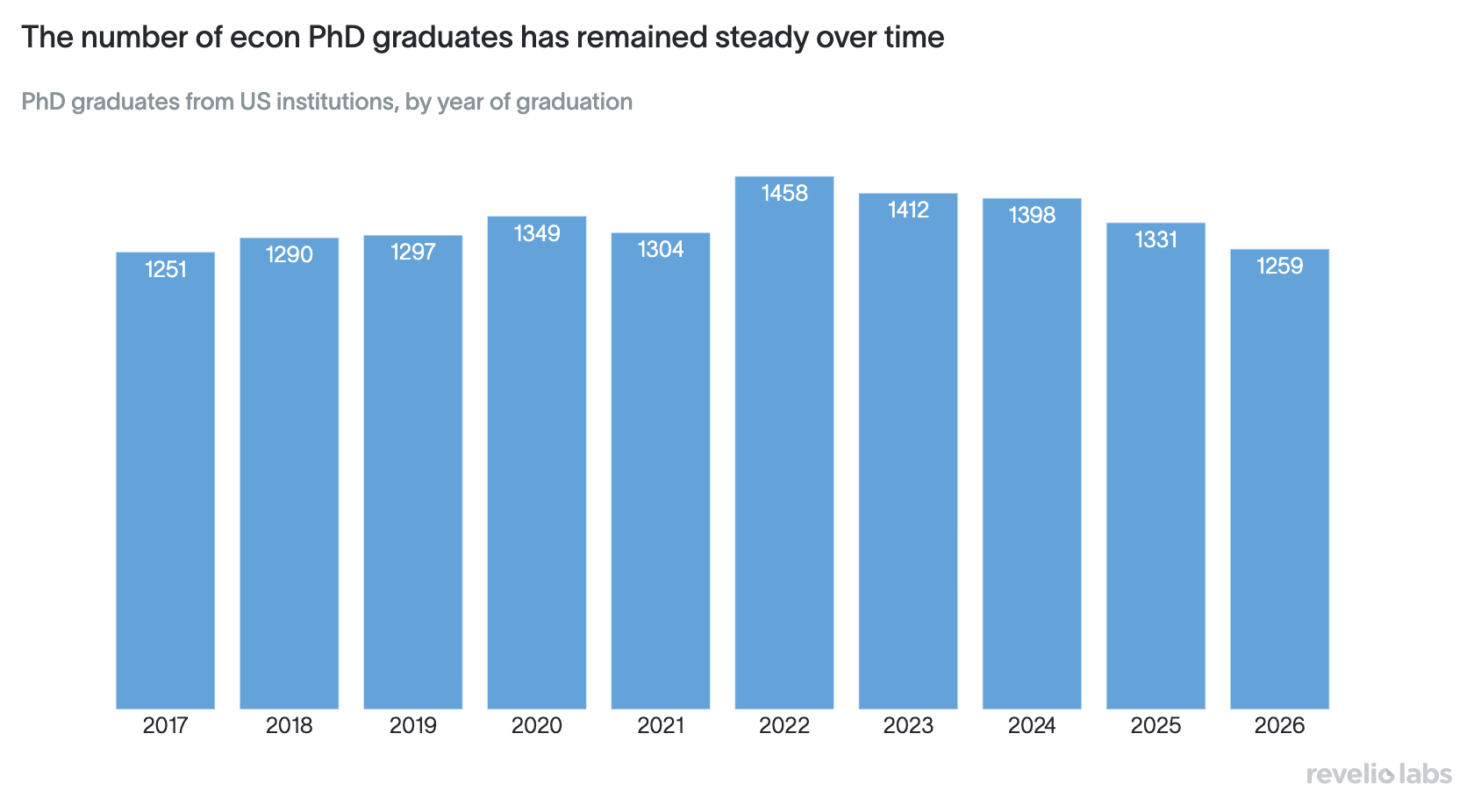
We begin by looking at the number of graduates from US economics PhD programs in our data by year of graduation. In 2025, roughly 1.3 thousand individuals report receiving a PhD in economics from a US institution. Aside from a modest dip and subsequent rebound due to the COVID-19 pandemic for the 2021 to 2023 graduation cohorts, the number has remained relatively steady over the past decade. Our counts, derived from Revelio’s data on online professional profiles, are consistent with the levels reported in the NSF 2024 Survey of Earned Doctorates (allowing for its 91% survey response rate), while also extending the picture with more recent data from the 2025 and 2026 cohorts.
However, despite the number of graduating students remaining steady over time, recent cohorts have reported experiencing a tougher job market and fewer job opportunities. This phenomenon also appears in our data: The number of economics PhD graduates reporting employment after graduation on their online professional profiles remained nearly unchanged from 2017 to 2021 and even increased in 2022 amid a private-sector hiring boom, but has declined for the 2024 and 2025 cohorts. While some of the decrease in our data could be attributed to reporting lags from the 2025 and 2026 graduating cohorts, this trend is nevertheless consistent with observations from other sources, such as the record-low number of new job listings observed by Paul Goldsmith-Pinkham and others on the American Economics Association’s Job Openings for Economists board. The number of positions reported has declined across all sectors, including academia, policy, and industry.
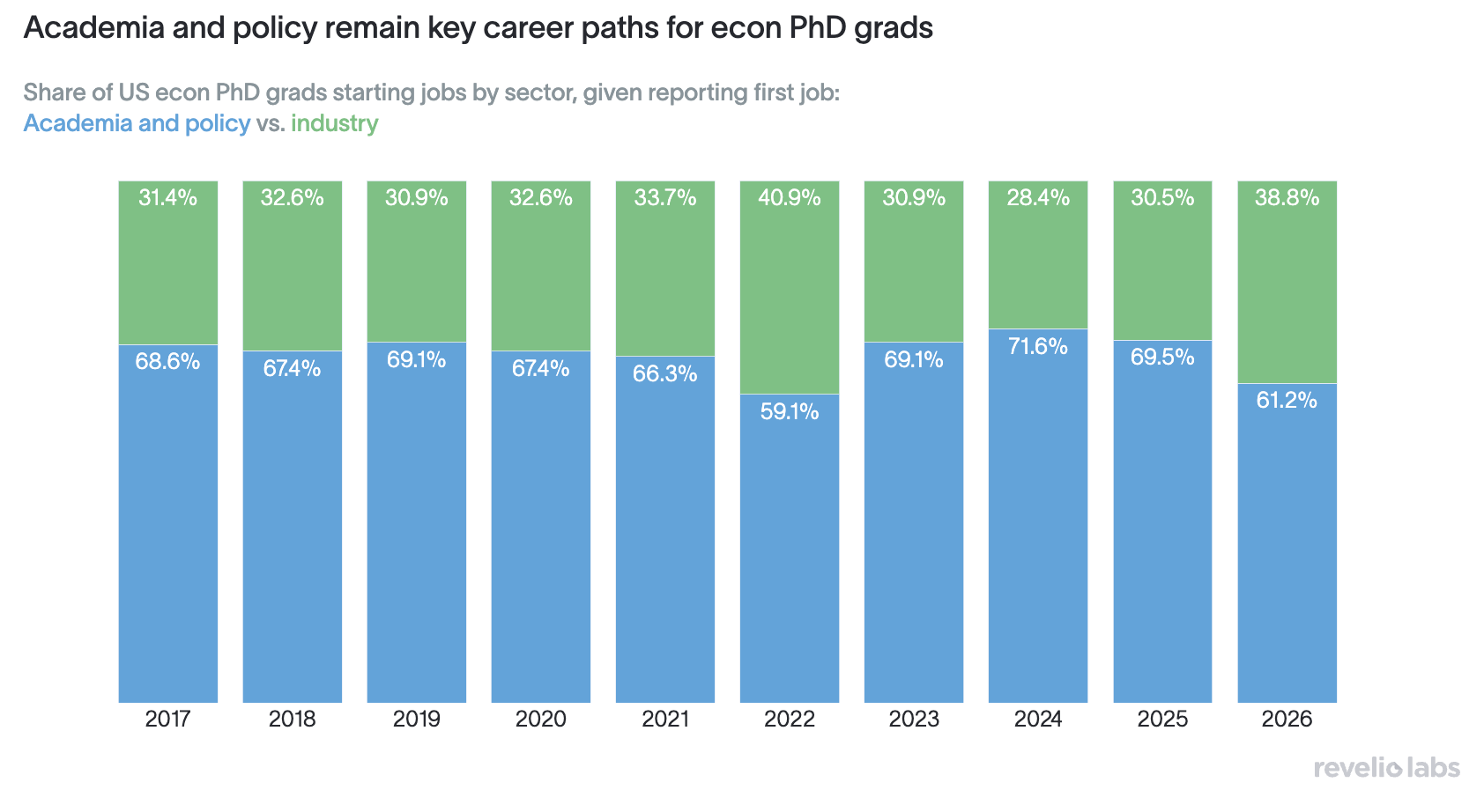
We next examine career outcomes for graduates who report finding a position. Academia and policy remain the largest destinations for economics PhDs, with around 60% of graduates in 2026 who report a new job entering these sectors. The private sector experienced a hiring boom in 2022, with a record high of 41% of new graduates entering industry roles, but regressed in 2023 to its former level of around 30%.
More economics PhD graduates are starting postdocs
We first focus on job market outcomes for graduates who report entering academic and policy jobs. We notice two recent trends: First, an increasing share of graduates are taking postdoctoral positions as their first job after graduation rather than entering the tenure track directly, rising from around 14% of all graduates in non-private-sector jobs in 2017 to nearly 25% in 2025. This could be one potential sign of an increasingly difficult job market for those on the academic path.
Economics PhD graduates tend to take postdoc positions for two main reasons. Some may already have a tenure-track position lined up and choose to take a postdoc position first to have more time to focus on their research without the obligations of teaching; others may be unable to find a tenure-track position before graduation and take a postdoc with the intention of reapplying for more permanent positions in the following year. Still, either situation could be an indication of tougher times for academics—whether in the form of higher standards or publication requirements for securing tenure-track positions or an increasing scarcity of permanent academic positions in the first place.
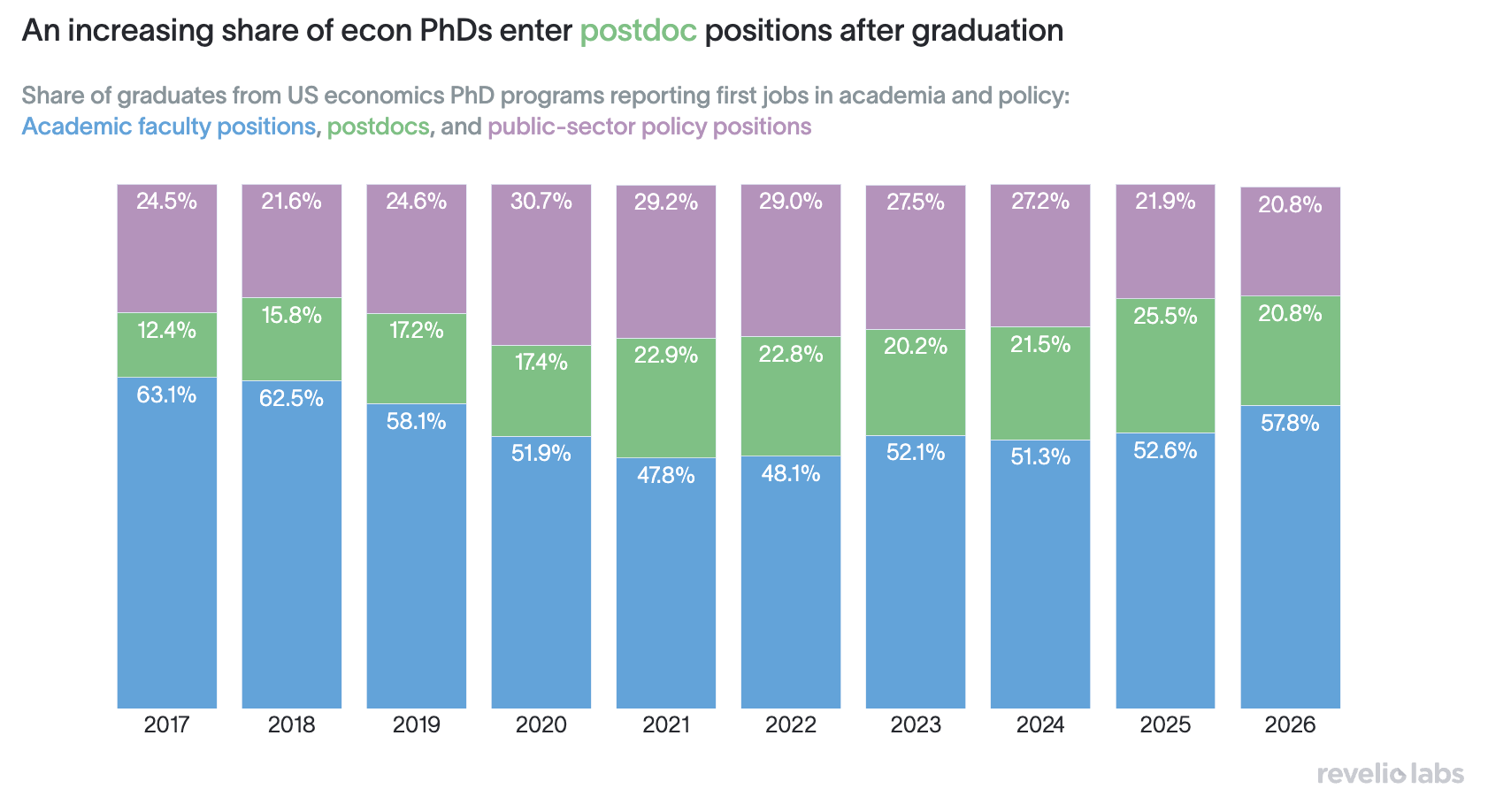
Second, we also observe a declining share of new graduates entering policy positions in 2025, after a relative increase during COVID (particularly among the 2021 graduation cohort) when academic hiring was on pause. This recent decline in the number of policy positions may reflect an overall decrease in government hiring under the Trump administration, especially amid planned restructuring at agencies that traditionally employ economists, such as the BLS and the CFPB. This slowdown in government hiring could potentially persist through the end of Trump’s term in 2029.
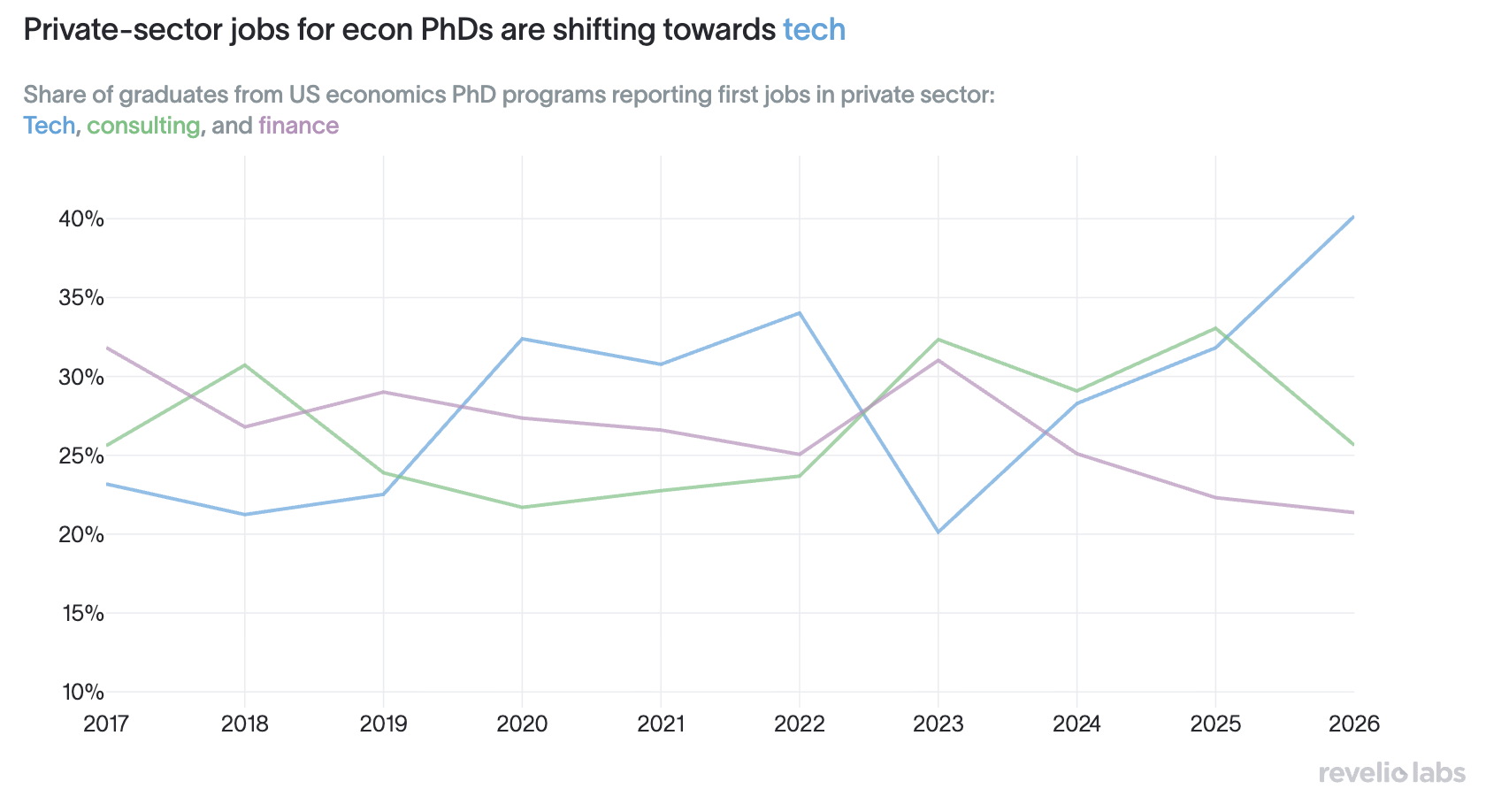
Next, we examine the job market outcomes of PhD economists who enter the private sector. The tech sector has become a recent major employer of economists: The share of graduates entering the private sector who had first jobs at tech firms grew from 23% in 2017 to 40% in 2026, despite a hiring boom in 2022 and a subsequent hiring freeze in 2023. The growth of tech-sector opportunities is even more pronounced when looking back to 2010, when finance and economic consulting made up the majority of new-grad positions and fewer than 20% of graduates in industry started their careers at tech firms.
Private-sector jobs for econ PhDs are shifting towards tech
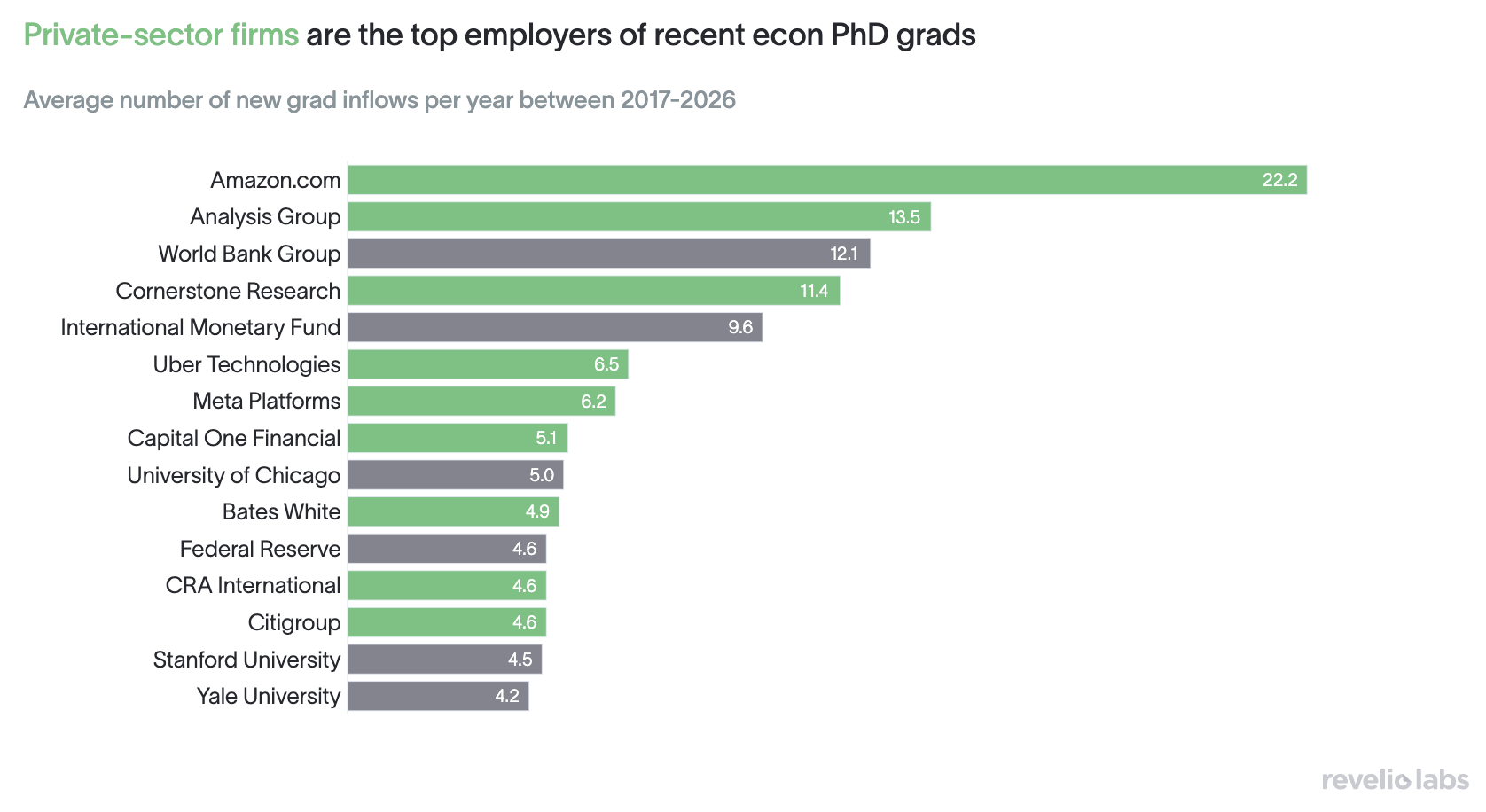
Looking across all industries, we see that private-sector companies account for nine of the top fifteen employers of econ PhD graduates over the past ten years. Amazon in particular has become the largest single employer of PhD economists, having hired over 200 PhD economists since 2017—on average nearly 23 per year. In contrast, academic institutions such as the University of Chicago and Stanford each hire only around 4 to 5 new graduates per year.
Economics PhDs in industry perform various roles. At tech firms, for example, the responsibilities of economists may range from working on pricing and market design to designing auctions and analyzing and interpreting the effects of new platform features using natural experiments and causal inference. Others may be more focused on research, helping shape research agendas at AI firms on topics such as the impact of AI on the labor market.
In conclusion, we show that the job market for PhD economists has indeed become more difficult in recent years. While the overall number of economics PhD graduates has remained steady, their initial job outcomes suggest growing frictions, particularly in academia and policy, where postdoctoral positions are becoming more common and hiring for more permanent positions appears to be slowing. These patterns are consistent with a more competitive and uncertain environment for traditional career paths in economics.
At the same time, the private sector, especially the tech industry, has emerged as an increasingly important destination for new graduates. Economists in these roles are applying their training to a wide range of problems, from market design to causal inference, reflecting the expanding relevance of economic methods beyond academia.
Looking ahead, the balance between these sectors will likely continue to evolve, shaped by macroeconomic conditions, government hiring priorities, and the ongoing integration of economic expertise into tech firms. Understanding these dynamics will be critical for both prospective PhD students and institutions as they navigate a changing landscape for economic research and careers.
Finally, a shameless plug for our own company: Revelio Labs is looking for talented PhDs to join our economics team! If you are interested in applying economic research to real-world questions about labor markets, firms, and the future of work, we would love to hear from you.


