Finance is one of the most AI-exposed sectors in the economy. Reports have circulated that banks are cutting incoming junior analyst classes by as much as two-thirds. JPMorgan’s CEO has said bluntly that AI will eliminate jobs, and Citigroup’s CEO has signaled job cuts for 2026. Goldman Sachs’ president said he often describes the bank as a “human assembly line” ripe for automation; though he was also careful to add that this wouldn’t mean mass layoffs.
We wanted to know whether the data backs up the headlines. The question feels especially worth asking in banking, an industry highly exposed to AI and that has long worked as an apprenticeship business. Today’s managing directors were once junior analysts building models overnight, and much of the experience senior bankers rely on came from that grind. If entry-level roles are shrinking or the work inside them is being hollowed out, the open question is whether the next generation of bankers gets the same chance to develop that experience and judgment.
Banks are also a major part of white-collar employment. They make up 22% of the US white-collar workforce and have accounted for about 18% of its growth over the past decade. They also face much greater exposure to AI than the rest of the economy, as we show later. That makes banks a useful window into how jobs are changing in the AI era, so in this week’s newsletter, we analyze the trends in US banks’ workforce in detail, using Revelio Labs workforce data.
Junior roles are shrinking while senior roles keep growing
In the decade before ChatGPT launched in November 2022, US banks were adding an average of 99,200 jobs year over year. Shortly after the launch, that pace slowed, bottoming out at 21,600 in September 2024. While it has since recovered to around 62,500 in June 2026, these overall numbers hide a different story by seniority. As the figure below shows, junior roles in US banks have been shrinking and are now 4.7% below their October 2022 level. In the rest of the economy, junior headcount has also declined since peaking in 2024, but later and by a smaller margin than in banks. Senior roles in banks, meanwhile, have kept growing, at roughly their pre-ChatGPT pace, or even slightly faster in some banking sectors. Notably, the junior decline is specific to banking rather than finance as a whole. In the insurance sector, junior headcount has continued growing.
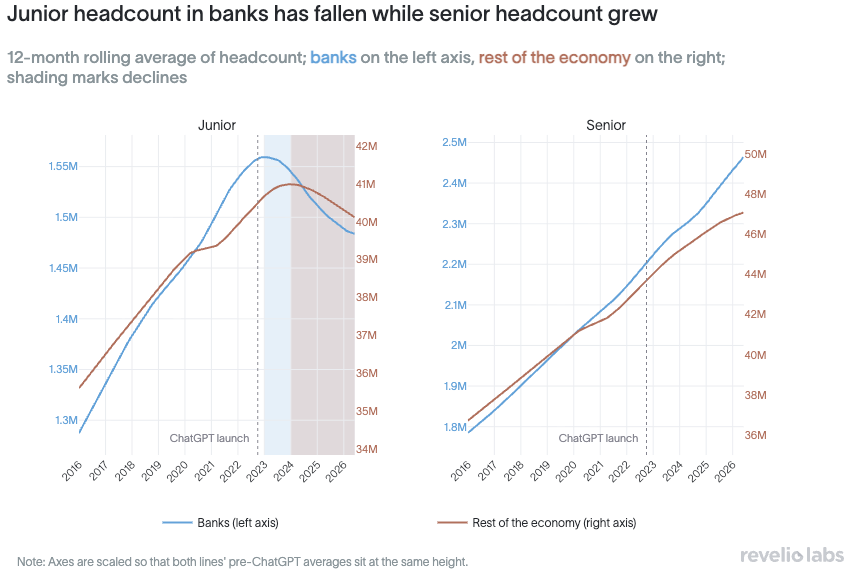
We define junior workers as early-career staff past entry level but not yet in senior or supervisory roles, such as bank analysts. Our rest-of-economy comparison excludes non-bank finance, like insurance, whose roles closely overlap with banking.
The squeeze is sharpest in Commercial and Retail banking
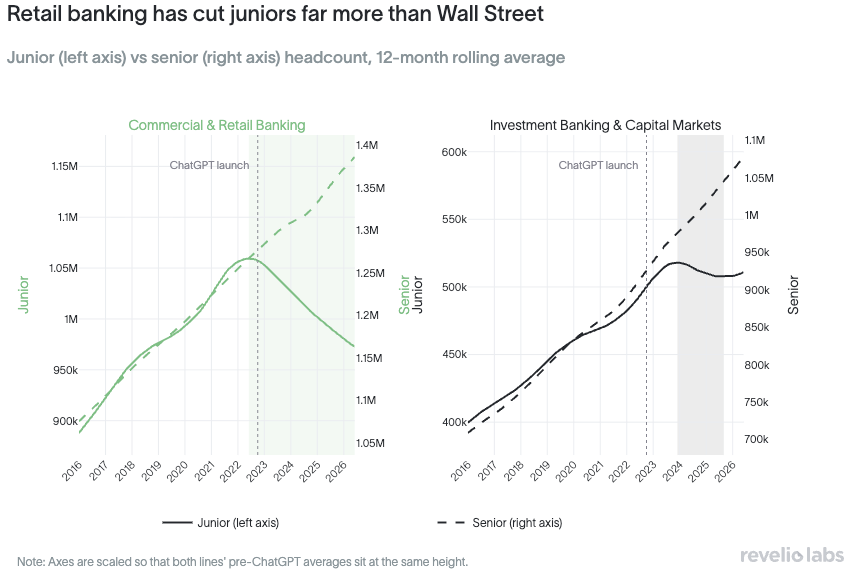
In the years before ChatGPT, senior and junior headcount in banks grew hand-in-hand. Since its launch in November 2022, the pyramid has been narrowing, and the gap in headcount has widened in favor of senior roles. Splitting banks into Commercial and Retail Banking and Investment Banking and Capital Markets shows that junior roles are falling in the former, while they have experienced a delayed and much more modest decline in the latter. At the same time, senior roles keep growing at a similar or even slightly faster rate than before, especially in Investment Banking and Capital Markets.
Importantly, the drop in junior bank headcount isn't because more juniors are leaving. Junior attrition rose briefly in 2023 but has since returned to its usual range. Instead, junior hiring fell from about 10.5% of junior headcount a year before ChatGPT to around 8.5% in 2024 and 2025, before recovering in 2026. The timing also lines up with the 2022 interest rate cycle, which likely played a role in the slowdown. Most senior roles (around three quarters) are filled from within, raising the question: who will fill senior roles in the future?
How exposed are banking jobs to AI?
Banks are more exposed to AI than the rest of the economy. And as we’ve documented before, AI impact breaks from past waves of automation, which mostly displaced manual, lower-wage work. This time, the highest-exposed jobs tend to be the highest-paid ones. Still, exposure doesn't explain which junior roles are shrinking: headcount in the most and least AI-exposed junior roles has moved similarly since ChatGPT's launch.
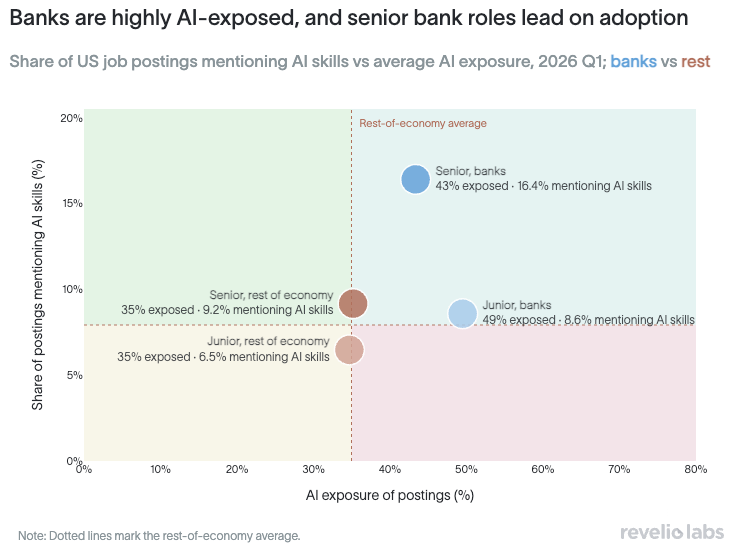
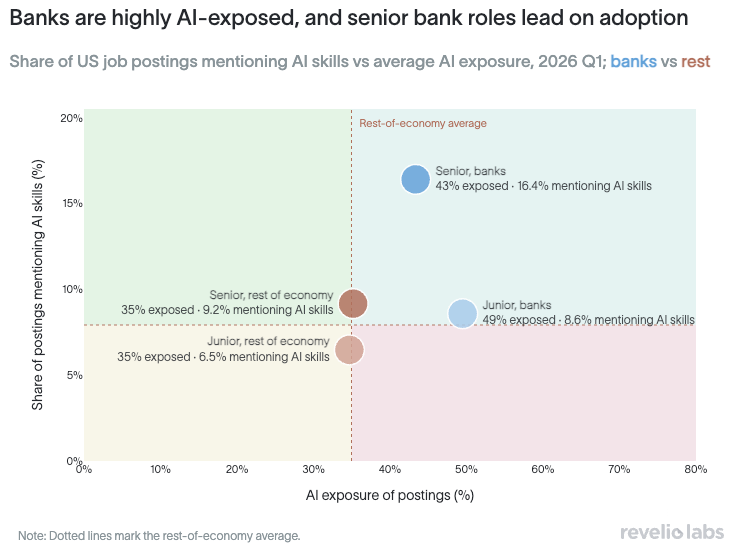
The plot below compares AI exposure and AI adoption in job postings by seniority for banks and the rest of the economy in the first quarter of 2026. We measure AI exposure as the share of a posting’s activities that AI could help perform, and AI adoption as the share of postings that explicitly mention AI-related tools, techniques, or workflows. We find that bank postings are far more exposed than those in the rest of the economy: 49% for junior roles and 43% for senior roles, against 35% elsewhere. The gap is largest among junior roles.
AI adoption, however, tells a different story. Junior bank roles are only slightly ahead of their counterparts in other industries, with 8.6% of postings mentioning AI against 6.5% in the rest of the economy. Senior bank roles, by contrast, lead in adoption at 16.4% versus 9.2% for senior roles elsewhere. Adoption is highest at the senior level, the part of the workforce in banks that is still growing.
Which banking roles are growing and which are shrinking?
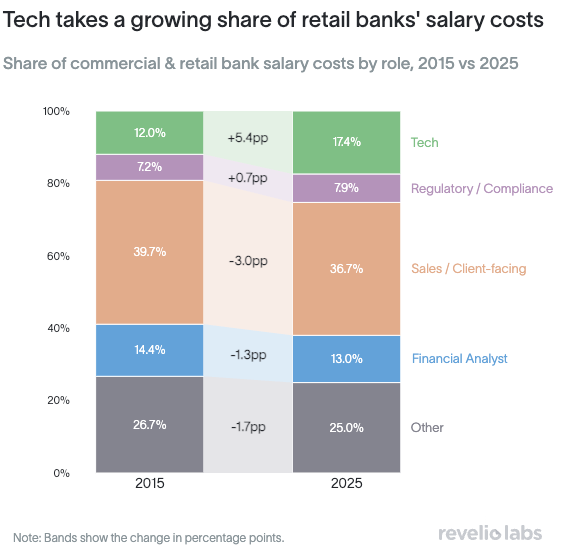
Banks’ total labor costs have grown steadily over the past decade, in line with the rest of the economy, but institutions are changing their hiring priorities. Tech roles have gained the most. In Commercial and Retail, their share of the labor cost rose from 12.0% in 2015 to 17.4% in 2025, a decade-long shift consistent with banks’ push toward digitalization. The change is smaller but in the same direction for Investment Banking and Capital Markets. Client-facing sales roles, on the other hand, have lost ground in Commercial and Retail, driven by a decline in sales staff. As customers move to apps and online channels, banks need fewer people in branches and more people building the platforms. Financial analysts’ share of the labor cost has also slipped, falling 1.3 percentage points in Commercial and Retail banking. The share of labor costs for regulatory and compliance roles rose slightly.
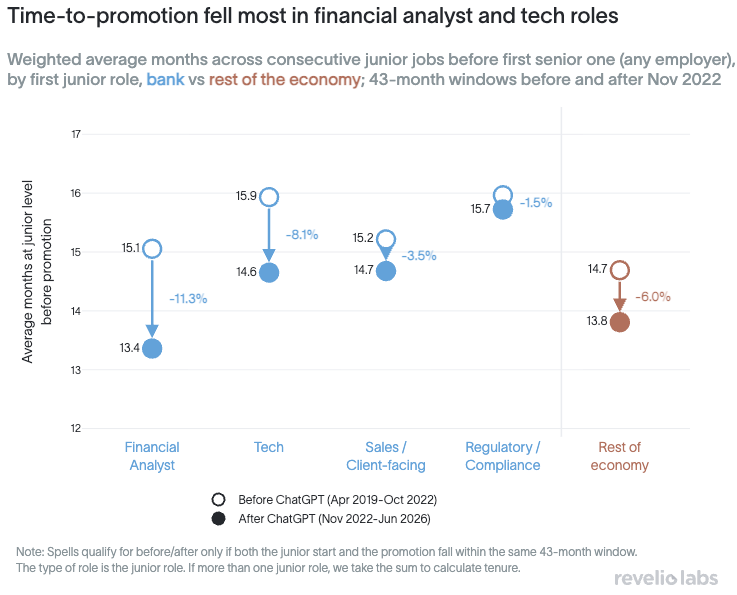
While banks’ workforce compositions have shifted, the path up their organizational ladder has also changed. The figure below shows how much time people spend, on average, in junior roles before reaching a higher seniority level, whether they were promoted internally or hired from another employer. Since ChatGPT’s launch, that time has fallen most in Financial Analyst roles, where it has dropped by 11.3%, followed by Tech roles (-8.1%), compared with about 6% across all roles for the rest of the economy. Sales and compliance roles, though, have barely changed (-3.5% and -1.5%). This finding aligns with the idea that if juniors spend less time at junior level before moving up, they have less time to build the experience senior bankers rely on.
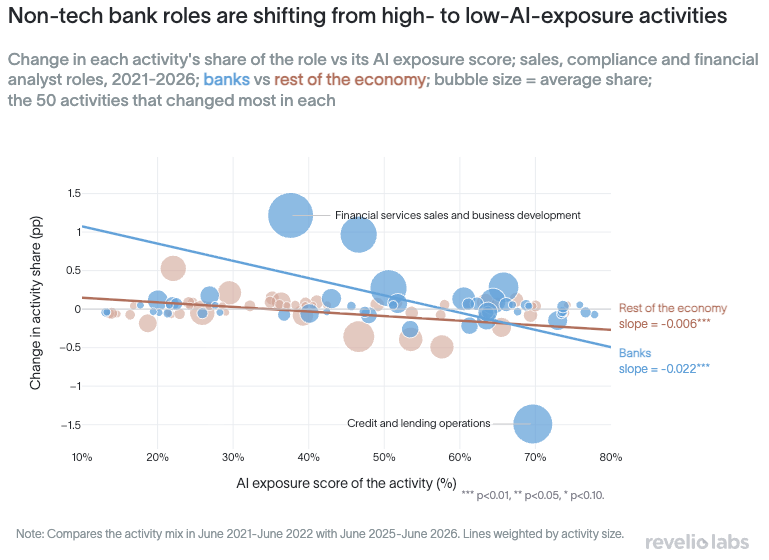
Further, within bank jobs, the work itself is changing. We observe this trend in the figure below, focusing on non-tech roles (sales, compliance, and financial analysts), since tech’s growing headcount would otherwise skew the overall results. Each bubble is an activity, and we plot its AI exposure score against how much of its share of the work changed between 2021 and 2026. In both junior- and senior-level roles at banks, the more AI-exposed activities are losing ground to less exposed ones. The same happens in the rest of the economy, but the shift in banks is about three times steeper. This is a pattern we’ve seen before: AI often reshapes what a job involves rather than eliminating it.
Across sales, compliance, and financial analyst roles in banks, work is shifting away from the most AI-exposed activities. Credit and lending operations, about 6% of their work and roughly 70% exposed to AI, shrank the most, while financial services sales and business development, only about 38% exposed, grew the most. Within this group, financial analysts, whose overall headcount share barely moved, are moving from accounting and operations toward capital markets, planning and risk analysis.
In sum, banks seem to be restructuring around AI rather than being automated by it. Their hiring priorities seem to have shifted. There are fewer junior roles, driven by reductions in sales and client-facing roles in Commercial and Retail banking, and more senior and Tech roles. The decline isn’t concentrated in the most AI-exposed roles. This looks less like generative AI replacing junior bankers and more like a continuation of the long-running shift to digital banking. Still, for roles whose headcount has barely moved, the work itself is shifting away from automatable tasks.
Ultimately, the shift toward Tech suggests a structural change rather than just a cyclical one. That said, if banks hire fewer juniors, fewer bankers will build the judgment senior roles rely on. Whether junior roles return or banks find new sources of senior talent remains an open question.
Free to reproduce with attribution and a link to reveliolabs.com.
Cite this article
- Plain text
- Revelio Labs, "Banks Are Losing Interest in Junior Talent in the AI Era," October 13, 2026.
- HTML
- Revelio Labs, "<a href="https://www.reveliolabs.com/news/ai-and-work/ai-junior-bankers-hiring-data">Banks Are Losing Interest in Junior Talent in the AI Era</a>," October 13, 2026.
- Academic
- Galeano, L., Oliver, E., & Simon, L. K. (2026, October 13). Banks Are Losing Interest in Junior Talent in the AI Era. Revelio Labs.