


Artificial intelligence has been reshaping nearly every corner of the economy, but AI’s impact on the labor market has drawn particular scrutiny. Since the launch of ChatGPT in late 2022, a number of companies have announced layoffs and cited AI as the reason.
These cases have varied in timing and scale. Duolingo, an early mover, laid off roughly 100 contractors in January 2024, citing the automation of its content creation by ChatGPT. Block, on the other hand, announced in February 2026 that it was cutting its workforce nearly in half as AI allowed the company to automate more work. Block’s share price initially jumped 24% on the announcement.
Given the positive impact that AI-driven layoffs can have on investor perceptions, doubts have arisen over just how much these companies’ layoffs are truly the result of a shift toward more AI-driven operations and resulting productivity gains. Could companies instead be blaming AI for layoffs as a way to appear innovative while really just cutting costs or reversing overzealous hiring?
To understand the underlying dynamics behind companies’ announced AI-layoffs, we partner with System2, a research consultancy for investors, to identify companies that publicly attributed their layoffs to AI in the news and analyze their workforce trends with Revelio Labs data. This cohort includes both tech companies like Meta and Amazon as well as others not traditionally associated with technological innovation, such as General Motors, The Washington Post, UPS, and McKinsey.
While we cannot directly observe any internal productivity gains from artificial intelligence that would facilitate companies’ layoffs, analyzing the evolution of their workforce provides a signal about how these firms were implementing AI and adjusting their operational strategies.
Were companies preparing their workforces for a strategic shift to the AI Era?
First, we examine whether companies that announced AI-driven layoffs demonstrated strategic shifts in their workforce compositions prior to the announcement. Specifically, were AI-layoff companies shifting their workforce toward roles that can integrate AI into their operations?
We compare the headcount growth of AI and non-AI roles among companies’ workforces to that of their matched industry peers. Overall, we find that while “layoff companies” did grow AI roles, they actually trailed their industry peers in terms of growth. At the same time, though, they had been cutting non-AI roles much more than their industry peers prior to the AI layoffs. Despite this, layoff companies growing AI headcounts at a median rate of over 11% in the previous two years, their size-matched industry peers had grown their AI headcounts by more than 13%. At the same time, though, the industry peers kept non-AI headcounts flat, while layoff companies reduced theirs by more than 3%.
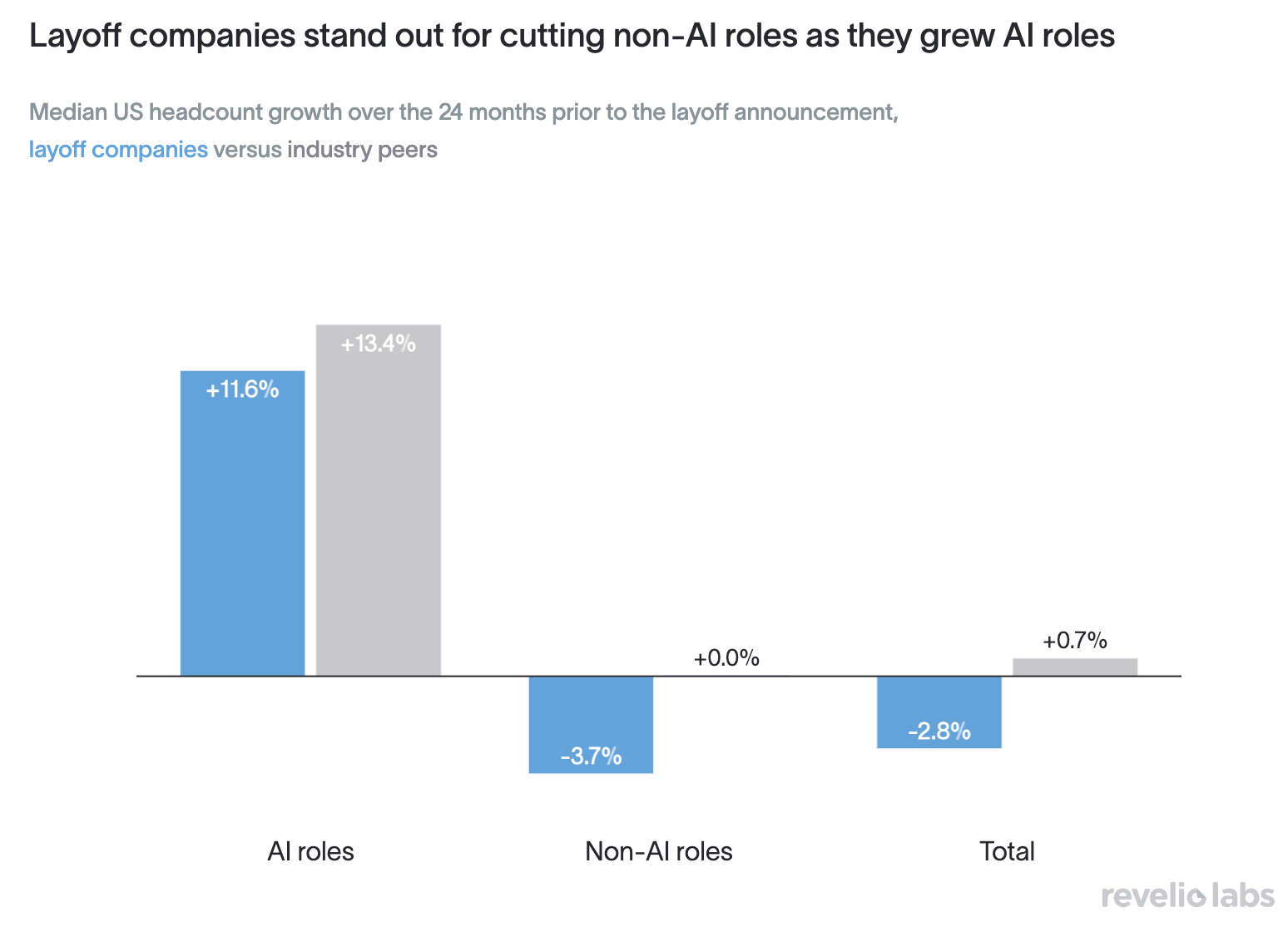
This divergence does suggest a shift toward AI-based work. Layoff companies were growing roles that could develop and integrate AI systems, while simultaneously reducing headcount in non-AI jobs.
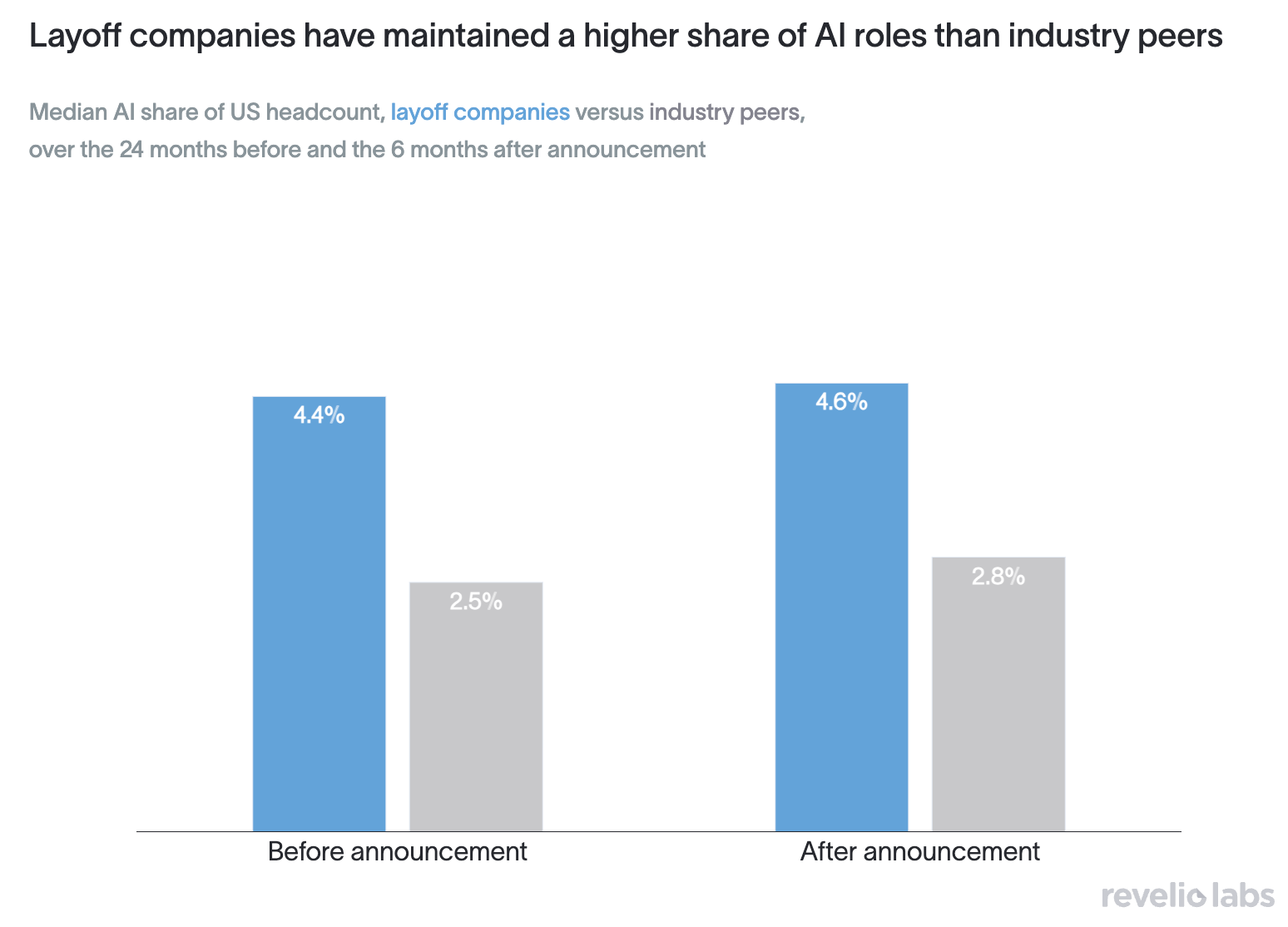
Further, we find that layoff companies not only had a higher share of AI roles in their workforce prior to announcement than their respective industry peers, but maintained this advantage six months afterward as well. Comparing the percentage of AI roles in each company’s total headcount to their matched industry peers, we find the median share to be nearly double—both before and after layoff announcement. As noted above, this trend comes as companies cut non-AI roles. Nevertheless, the persistence of this difference reflects how layoff companies have adhered to their strategic shifts towards AI operations.
How were companies with AI-driven layoffs adjusting their workforces for AI?
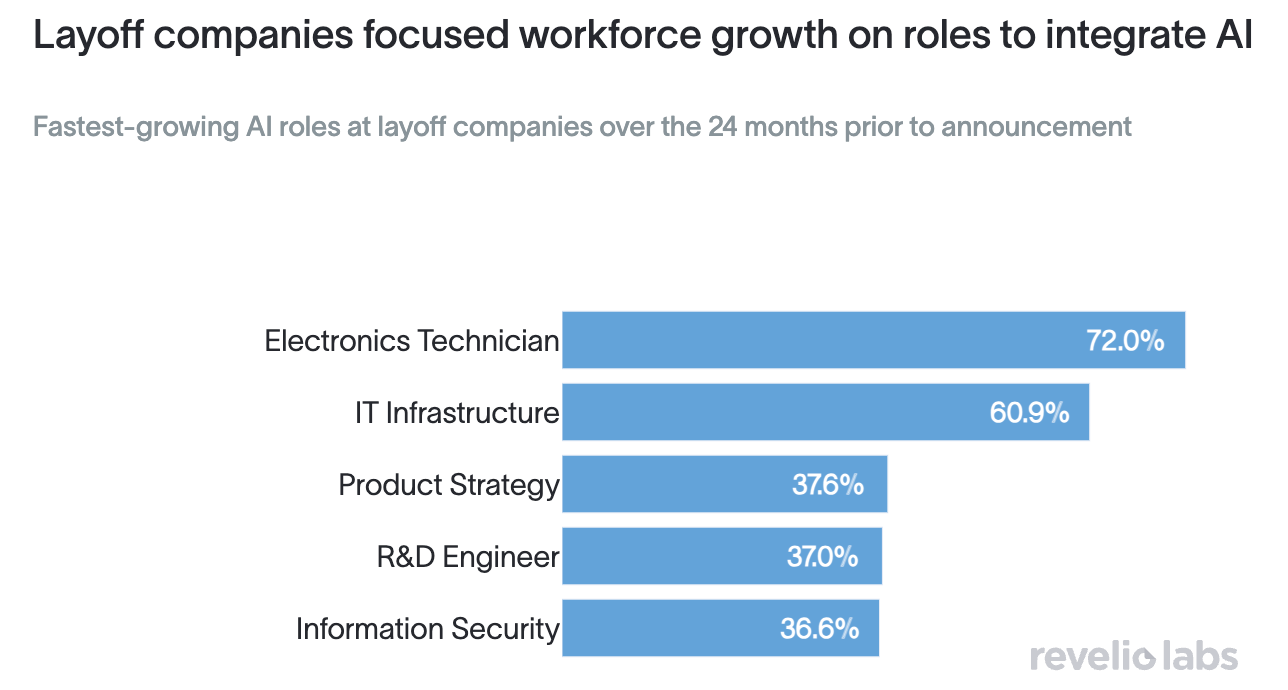
That being the case, what AI roles were the layoff companies hiring as they prepared for these strategic shifts? Over the 24 months before their announcement, we see that layoff companies focused their hiring on roles capable of building the systems needed to integrate AI into their operations: electrical and IT infrastructure, product strategy, research and development, and cybersecurity. Additionally, we find that layoff companies grew headcount in these areas more than their industry peers, suggesting they were better positioning themselves for a broader strategic AI shift.
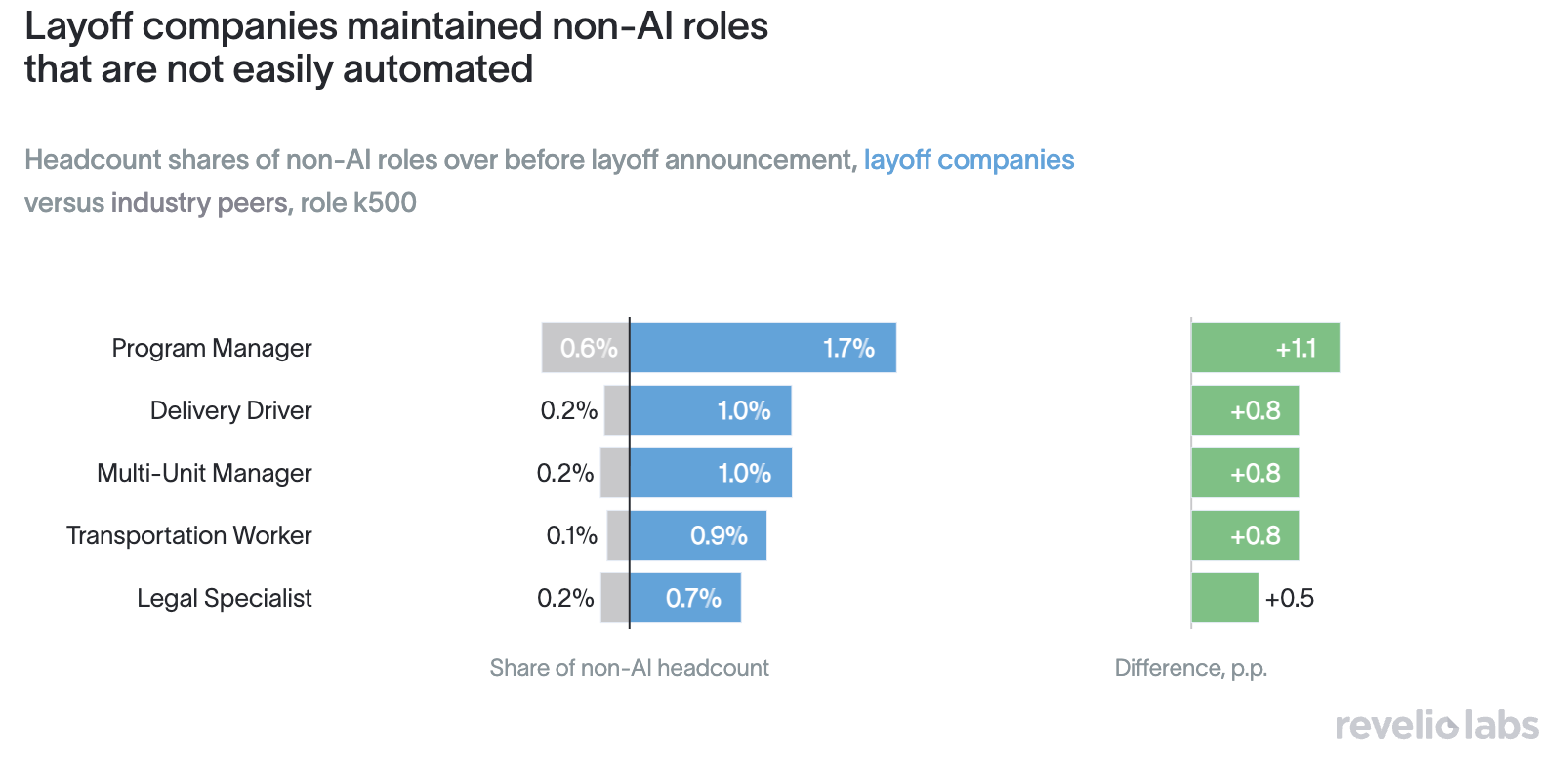
In addition to growing their AI-related headcounts, layoff companies appear to have reshaped their non-AI workforces. Compared to their industry peers, by the time they announced layoffs, layoff companies’ non-AI workforces had shifted toward the areas where artificial intelligence remains far from reliable: managing large-scale operations, physically transporting goods, and providing legal counsel.
Which companies were actually positioning themselves for a shift toward AI investment?
Nonetheless, these trends are at the aggregate level. To what degree did layoff companies demonstrate strategic shifts toward AI individually? For each company that has announced a round of AI-related layoffs, we compare how its AI and non-AI workforces changed in the 24 months prior. From this perspective, we find that companies fall into four distinct patterns: shifting toward AI; expanding their overall workforce; shrinking their workforce; or, counterintuitively, shifting away from AI.
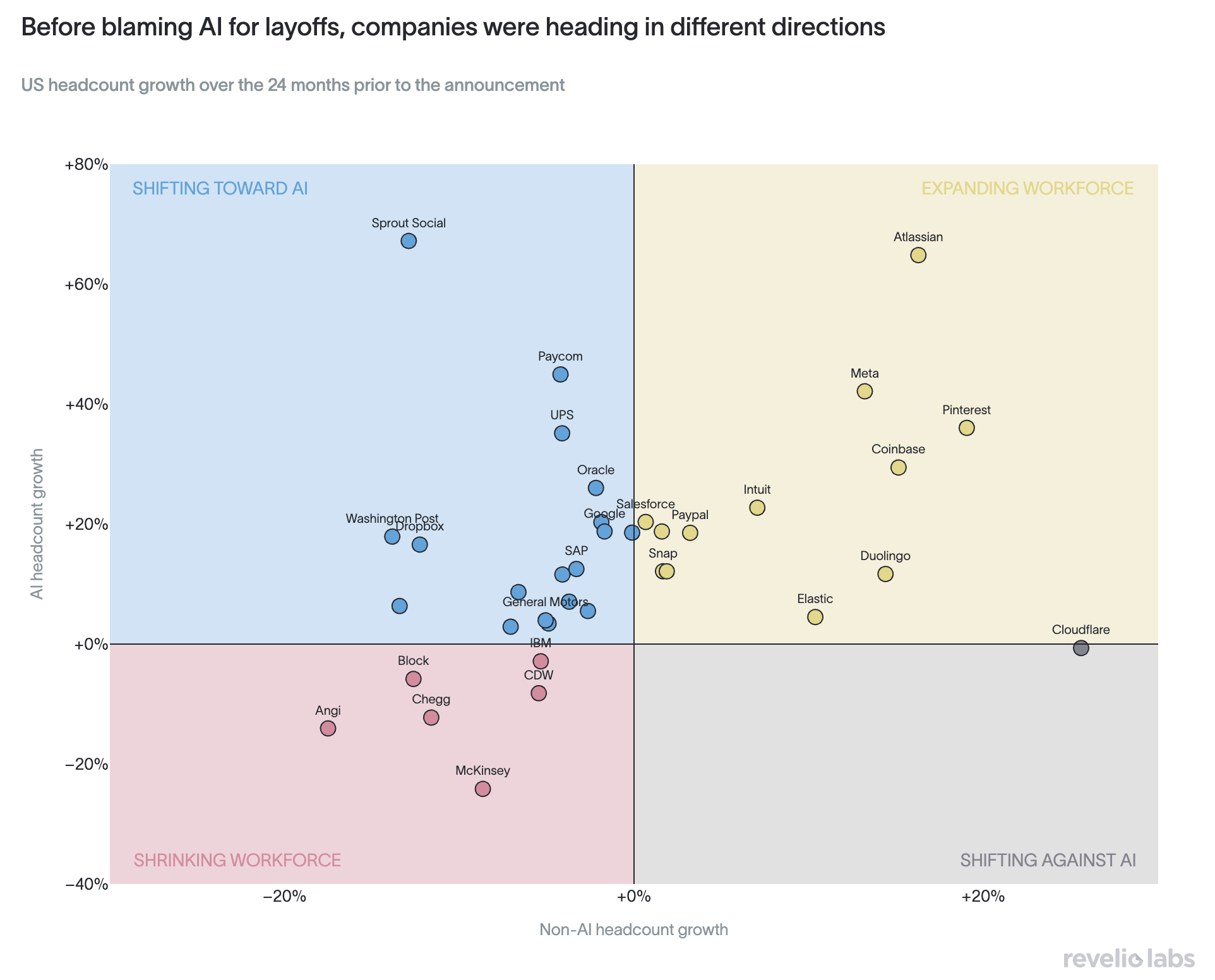
Before their announcements, Atlassian, Meta, and Coinbase were growing their workforces, suggesting that while they may have increased their AI headcounts, their decisions to lay off thousands of people could also have been influenced by overhiring during the preceding two years. Layoff announcements by companies like Block and McKinsey came after two-year periods of headcount reductions, which might also contradict a narrative that they were undergoing strategic shifts driven by AI innovation—not to mention Cloudflare’s apparent shift away from AI. That said, nearly half of layoff companies do demonstrate shifts in their workforces toward AI, including the Washington Post, Dropbox, and even UPS.
Companies that did not grow their AI workforces before layoffs have experienced slower AI adoption than the rest of their industry
Perhaps most indicative of a strategic shift toward AI-driven operations is whether the layoff companies have adopted AI more than their peers. We utilize our AI adoption rate, based on the percentage of job postings for roles that can either build AI systems or leverage AI tools. When comparing the different categories of layoff companies, we find that those that shifted toward AI or expanded their workforces have indeed adopted AI at higher rates than the rest of their industries. On the other hand, companies who shrank their workforce (or shifted away from AI) have actually trailed their industries in AI adoption—further countering their narrative of layoffs being driven by AI innovation.
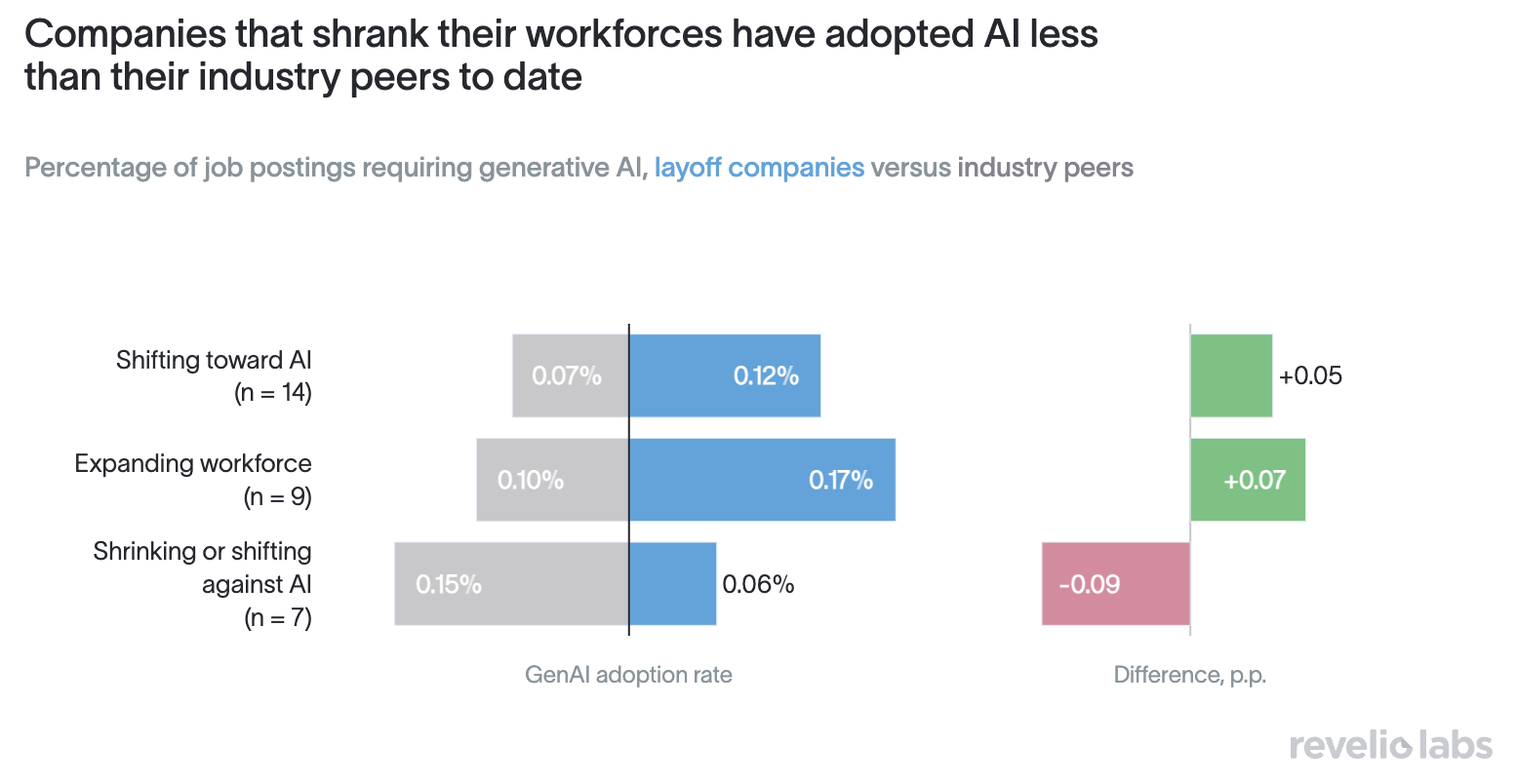
Taken together, these results reveal important nuances to companies’ narratives about their AI-driven layoffs. While many voices have questioned whether this narrative is more Wall Street-directed PR than operational strategy, more than half of firms attributing their layoffs to AI did show strategic shifts in their workforces, growing their AI-related headcounts and often reducing their non-AI roles as well. Moreover, they have since shown greater AI adoption than the rest of their respective industries.
A notable portion of companies, however, have exhibited the opposite pattern: reducing their AI workforces and ultimately falling behind their peers in terms of AI adoption. Ultimately, this divide suggests that while AI is already reshaping the labor market, it may also be providing some companies with a novel spin on the traditional practice of cutting costs and aligning with shorter-term shareholder interests.
Free to reproduce with attribution and a link to reveliolabs.com.
Cite this article
- Plain text
- Revelio Labs, "Is AI Just a Scapegoat For Layoffs?" August 25, 2026.
- HTML
- Revelio Labs, "<a href="https://www.reveliolabs.com/news/ai-and-work/is-ai-just-a-scapegoat-for-layoffs">Is AI Just a Scapegoat For Layoffs?</a>" August 25, 2026.
- Academic
- Lawrence, N. (2026, August 25). Is AI Just a Scapegoat For Layoffs? Revelio Labs.


