Your Company’s Promotion Intensity Can Have a Major Impact on Your Career
Internal promotions are slowing, but firm promotion culture matters



Internal promotions are slowing overall, but firms are diverging sharply in how much they still promote. Since 2022, promotion rates across the S&P 500 have declined, yet some firms continue to promote 10–12 employees per 100 per year while others promote only 1–3, reflecting durable differences in promotion culture rather than firm size or age.
Promotion outcomes follow a clear timing and momentum pattern. Promotions are strongly front-loaded early in a role and highly path-dependent: Workers who have been promoted before are substantially more likely to be promoted again, pointing to persistent fast-track dynamics within firms.
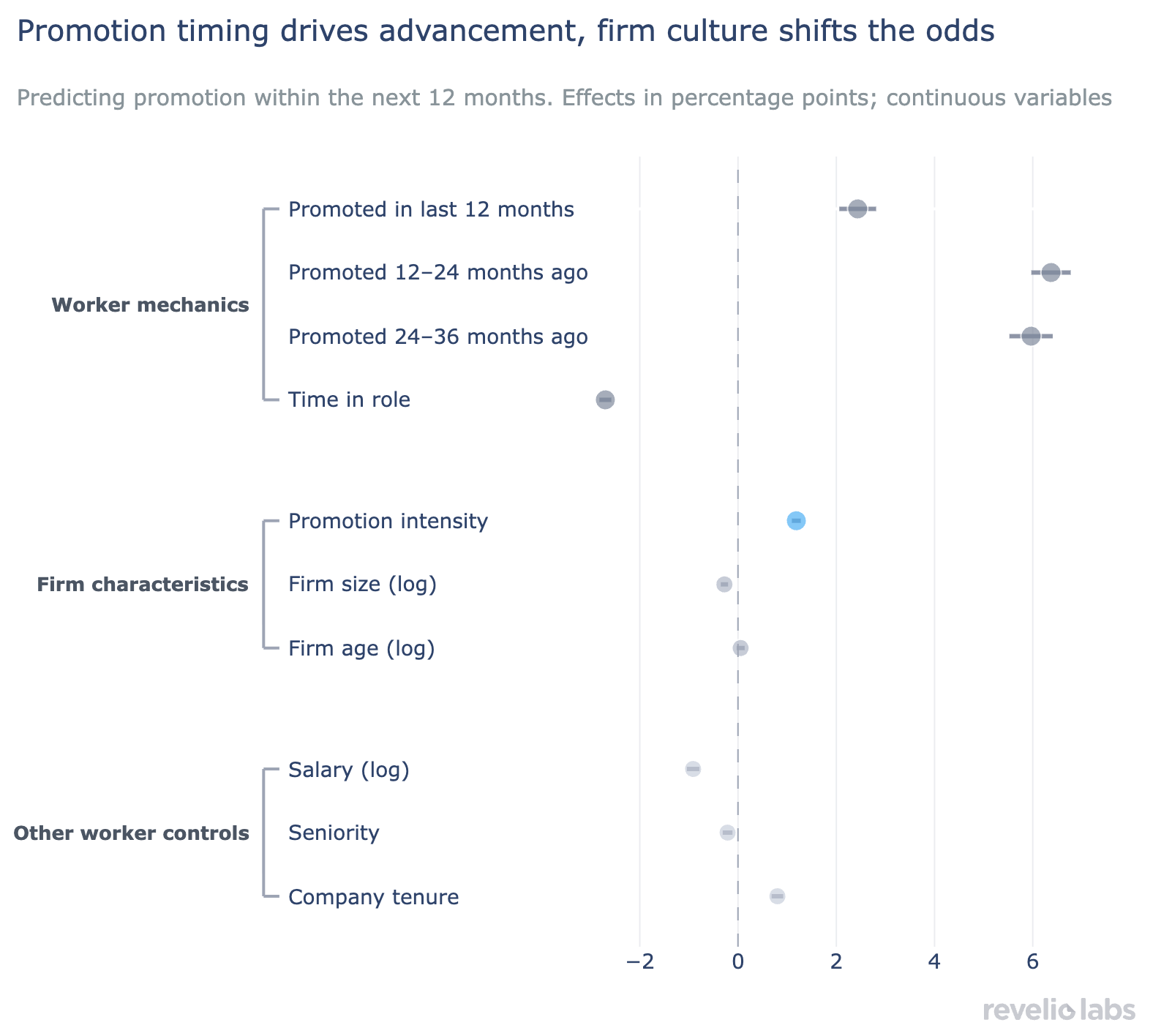
Firm promotion culture shifts the odds on top of these patterns. Even after accounting for role, industry, pay, seniority, firm size, firm age, and promotion history, a one standard deviation increase in promotion intensity raises the probability of promotion by approximately 1.2 percentage points, underscoring the substantial role of employer choice in shaping career progression as external mobility slows.
One of the defining labor market shifts of the past two years has been a sharp slowdown in hiring. As job postings have fallen and firms have grown more cautious, the question has been whether workers can still change employers at all. Far less attention has been paid to what happens after workers are hired: whether firms are still creating pathways for internal advancement, or whether career progression is quietly stalling.
This distinction matters. When external mobility slows, internal promotions become the primary channel through which workers advance. In this environment, differences in how firms structure internal mobility can meaningfully shape workers’ career progression. Some employers continue to promote aggressively from within; others do not. As we show below, those differences are not cosmetic—they meaningfully shape who gets ahead.
To study internal advancement, we introduce a firm-level promotion intensity measure that captures how frequently companies promote workers internally. We define promotion intensity as the annualized number of internal promotions per 100 employees, calculated as the total number of internal promotions over the past 12 months divided by the firm’s average headcount over the same period.
Measured this way, promotion rates rose sharply during the 2021–2022 hiring surge, when firms competed to retain workers, then declined steadily through 2023–2025 as labor markets cooled. The shaded region below highlights this surge period. But the aggregate slowdown masks a more important story: Even in the same macroeconomic environment, firms continue to differ sharply in how often they promote from within.

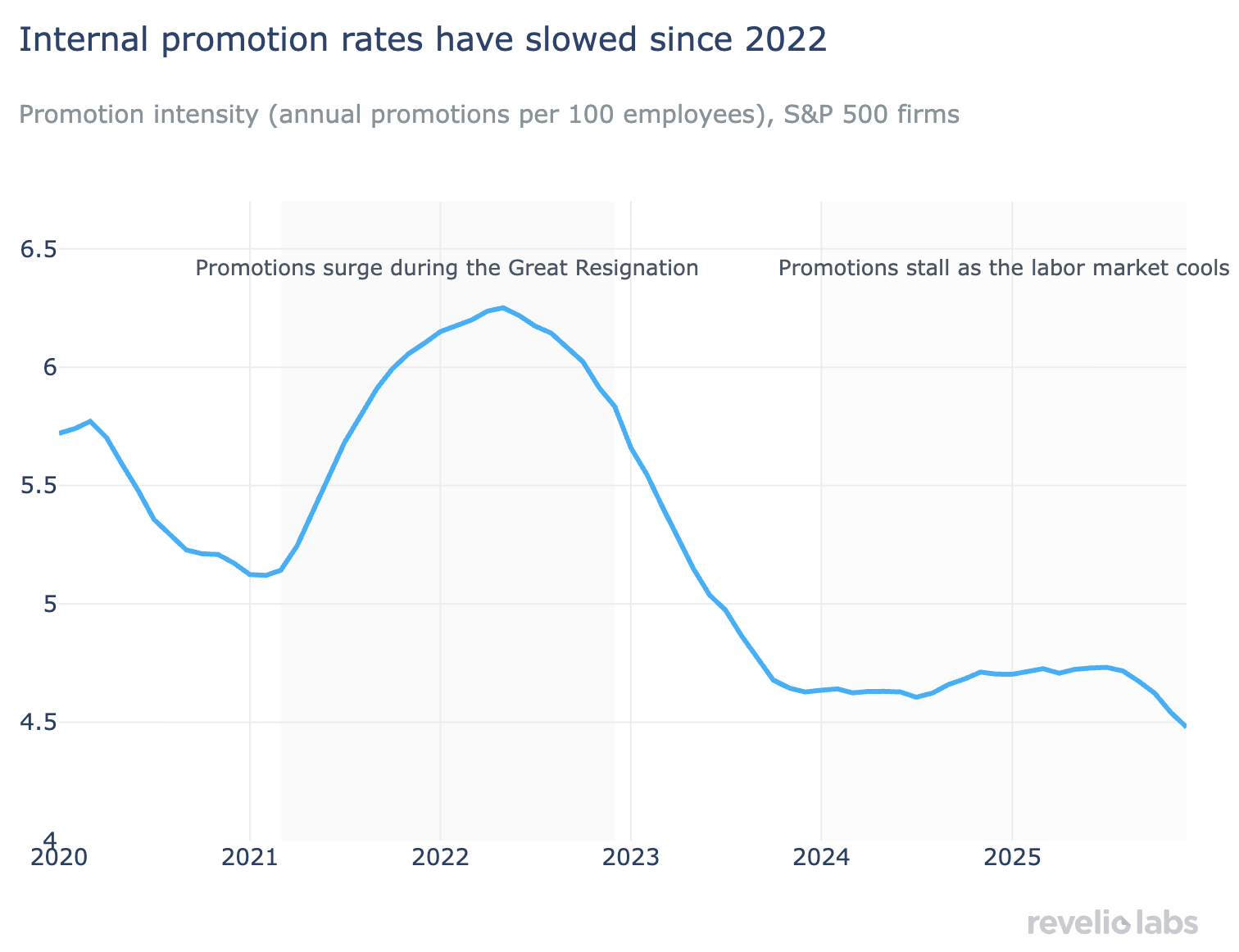
The differences across firms are substantial. Across the S&P 500, promotion intensity ranges from roughly 1–3 promotions per 100 employees per year at the low end to 10–12 at the high end. These gaps persist even among similarly sized firms, showing that internal promotion is not simply a byproduct of scale but a deliberate organizational choice.
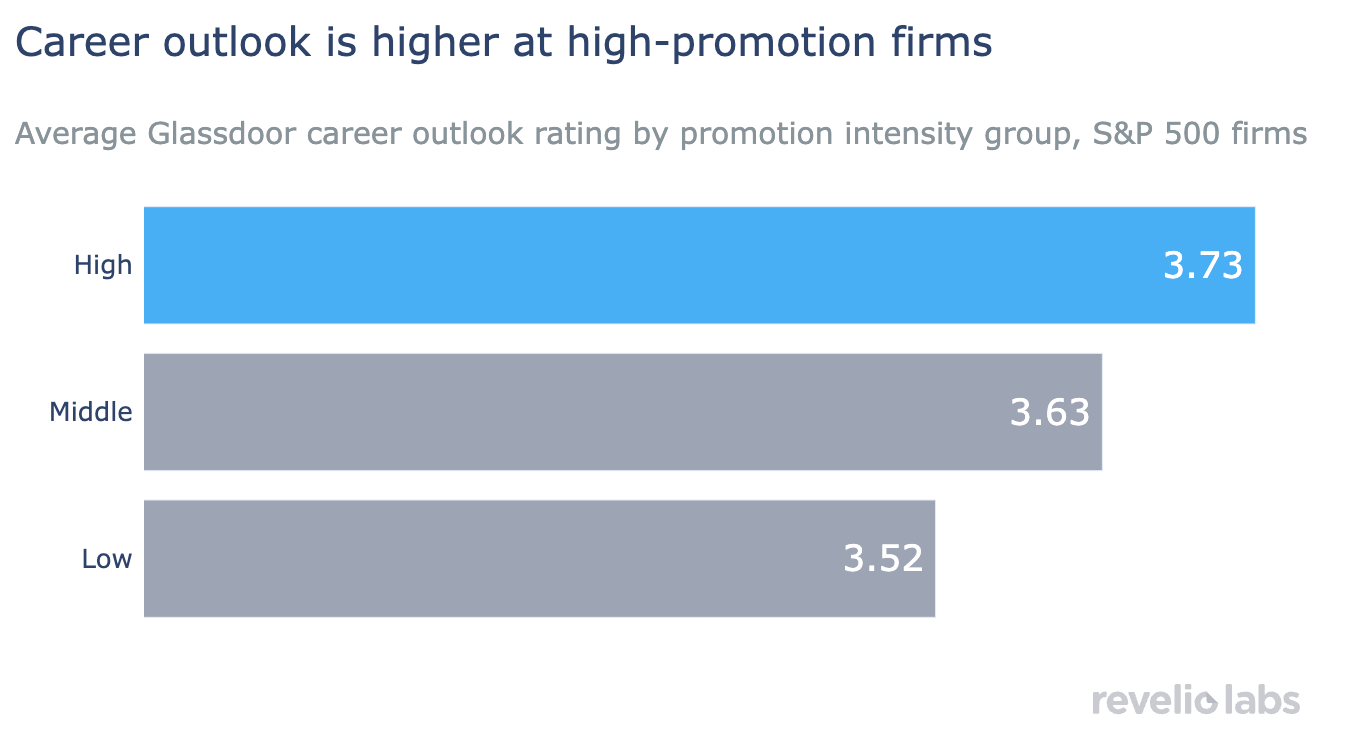
Workers recognize these differences. Firms in the bottom third of promotion intensity report materially lower career outlook ratings on Glassdoor than those in the top third. On average, employees at low-promotion firms rate their career prospects around 3.5, compared with roughly 3.7 at high-promotion firms. The pattern follows a clear gradient: Firms in the bottom third report the lowest career outlook ratings, those in the middle third sit in between, and firms in the top third report the highest. This progression reinforces that internal mobility is not abstract but directly shapes how workers perceive their long-term opportunities.
Sign up for our newsletter
Our weekly data driven newsletter provides in-depth analysis of workforce trends and news, delivered straight to your inbox!
These differences translate directly into advancement outcomes. Workers at low-promotion firms face only a 2.8% chance of being promoted over the next 12 months, compared with 4.2% at middle-promotion firms and 6.2% at high-promotion firms, irrespective of their role or tenure. In raw terms, workers at high-promotion firms are more than twice as likely to advance as those at firms with weak internal mobility. The key question is whether this gap reflects who works at these firms or how these firms operate. To answer that, we estimate a worker-level model predicting promotion within the next 12 months, controlling for role, industry, pay, seniority, firm size, firm age, and detailed promotion history.
The regression results show how promotions actually occur within firms. Promotion timing and prior advancement dominate individual outcomes: Promotions are strongly front-loaded early in a role, and workers who have been promoted before are substantially more likely to be promoted again, reflecting persistent career momentum within firms. Firm promotion culture operates on top of these mechanics. Even after accounting for these factors, a one-standard-deviation increase in promotion intensity raises the probability of promotion by approximately 1.2 percentage points. Once timing and momentum are accounted for, traditional firm attributes like size and age contribute little on their own.
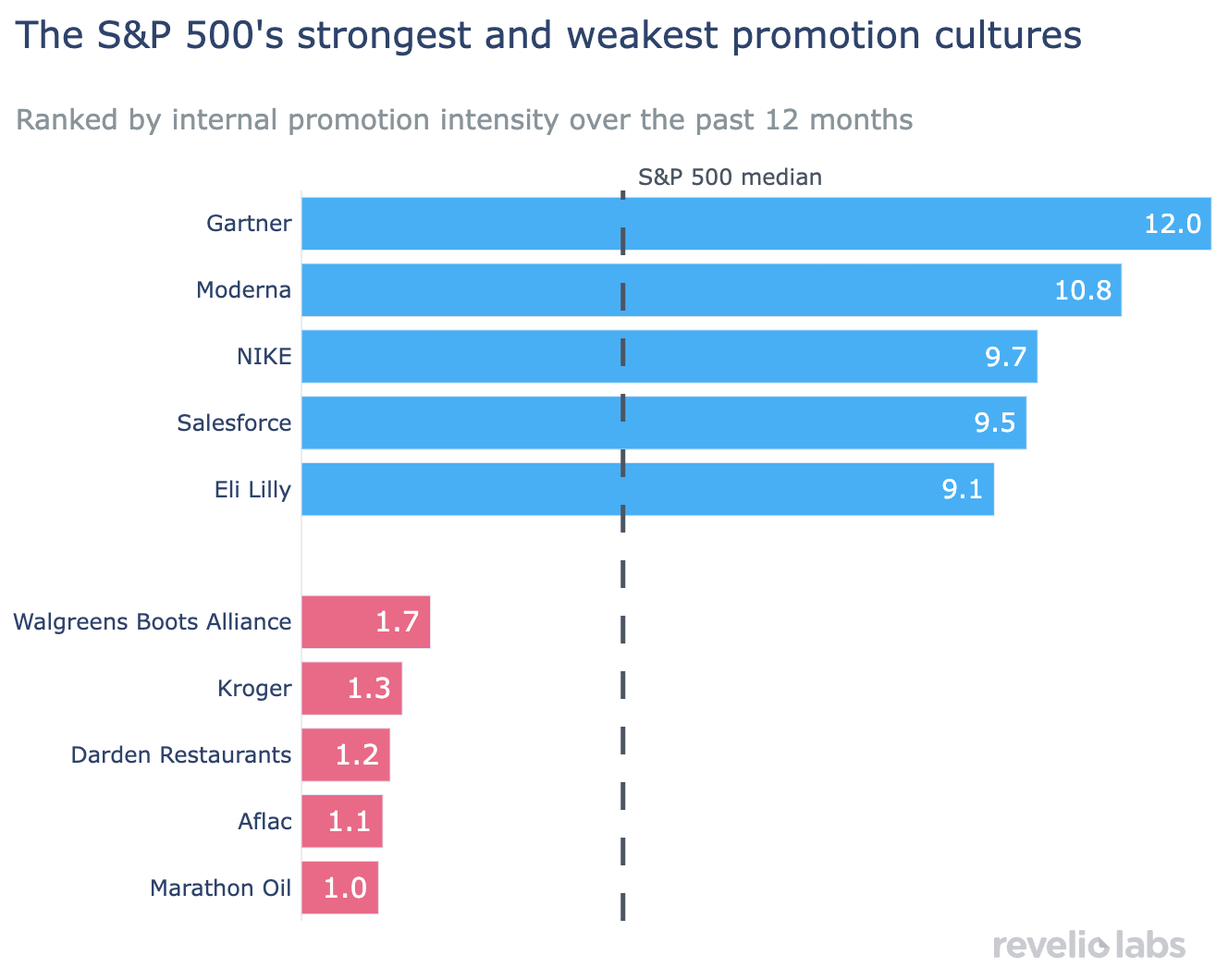
A small set of firms stands out for internal advancement, while others sit at the opposite end of the spectrum. Companies such as Gartner, Moderna, Eli Lilly, Salesforce, and NIKE promote internally at rates far above the S&P 500 median, whereas firms including Marathon Oil, Aflac, Darden Restaurants, Walgreens Boots Alliance, and Kroger promote at only a fraction of that rate. The contrast is not simply about growth or scale. High-promotion firms tend to operate in knowledge- and capability-intensive environments with layered internal career ladders, while low-promotion firms are more often structured around operational scale or flatter hierarchies. Together, they underscore that internal mobility is not dictated by macroeconomic conditions alone, but reflects deliberate choices about how organizations develop talent and fill senior roles.
Taken together, these findings reveal a consequential divergence across firms in how careers unfold. For workers, early promotions and employment at firms with strong internal labor markets can compound over time, while stagnation at low-promotion firms risks slower career progression. For employers, promotion culture is not a side effect of growth but a strategic choice. Firms that continue to promote internally can retain talent and build institutional knowledge, while those that rely primarily on external hiring risk slower advancement and higher turnover when mobility tightens.