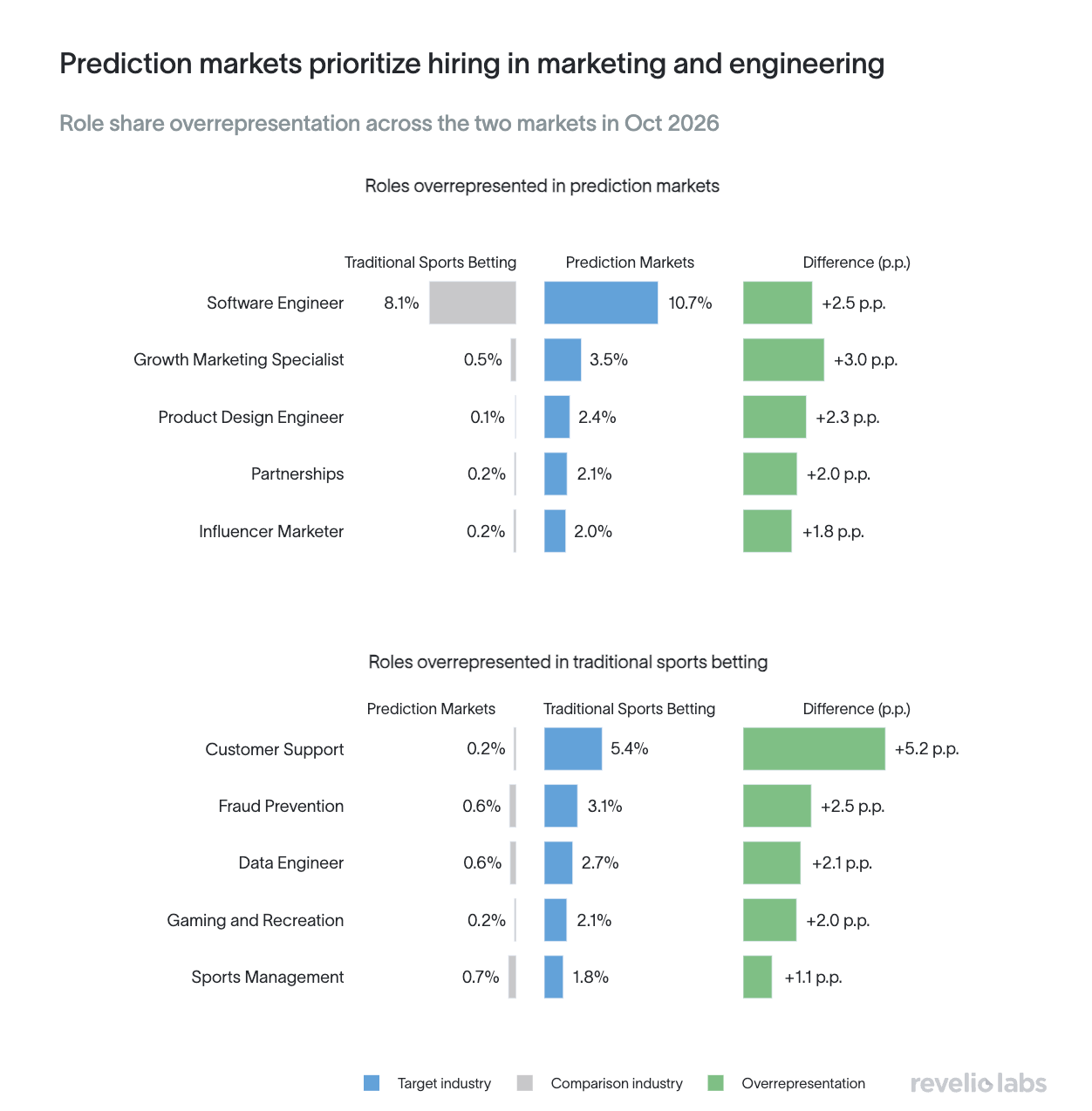
Prediction-market employment is booming. As these companies gain popularity and compete with traditional sports betting companies for customers, employment in the sector has doubled over the past year, far outpacing growth at their established competitors.
Prediction markets are hiring to build and grow, while traditional sports betting companies are staffed to operate at scale. Prediction-market workers are disproportionately concentrated in engineering, growth, customer acquisition, and trading, while traditional sports betting companies employ relatively more workers in customer support, operations, and risk control.
Specialized talent could become a bottleneck for prediction markets. Prediction-market talent is more geographically concentrated than that of traditional sports betting companies, consistent with a federally regulated model that allows firms to centralize more of their operations. Their reliance on specialized engineering, quantitative, growth, and trading skills may present a challenge: they face a tighter hiring market and compete with technology, finance, trading, and fintech firms for talent.
Football season is here and a new rivalry is playing out off the field. Prediction-market companies such as Kalshi and Polymarket are increasingly competing with traditional sports betting companies for sports-event activity, with recent media coverage highlighting surging trading volumes, aggressive customer acquisition, and growing pressure on established operators such as DraftKings and FanDuel.
While the two sectors can appear to offer different versions of the same product, they work differently. At traditional sports betting companies, customers bet against the company, which sets the odds and pays out winning bets. On prediction-market platforms, customers trade contracts with one another on whether a sporting outcome will occur, with the platform facilitating trades and collecting fees. The prediction-market model places greater emphasis on liquidity and trading infrastructure, though it remains at the center of ongoing regulatory and legal disputes.
This week, using Revelio Labs workforce data, we look beneath the product rivalry to see how these two models are being built in terms of talent. Our prediction-market group includes companies such as Kalshi, Polymarket, and Novig, while the traditional sports betting group includes DraftKings, FanDuel, and BetMGM, among others. The workforce evidence suggests that prediction markets are not just growing faster; they are also scaling with a different mix of talent, activities, and geographic concentration from traditional sports betting companies.
How are prediction markets scaling their teams?
The rise of prediction markets is visible not only in trading volume and public attention but also in their workforces. As the plot below shows, employment growth at prediction-market companies has accelerated sharply since 2025, outpacing that at traditional sports betting companies. Their employee count has nearly doubled over the past 12 months. The divergence suggests that these firms are moving from relatively small challengers toward organizations capable of supporting much larger products, customer bases, and trading volumes.
That hiring push also fits the broader expansion visible across the industry. Prediction-market companies are investing heavily in customer acquisition, adding distribution partners, and building out their executive teams. Polymarket, for example, recently appointed its first CFO as it prepares for its next phase of expansion.
What roles do prediction markets prioritize?
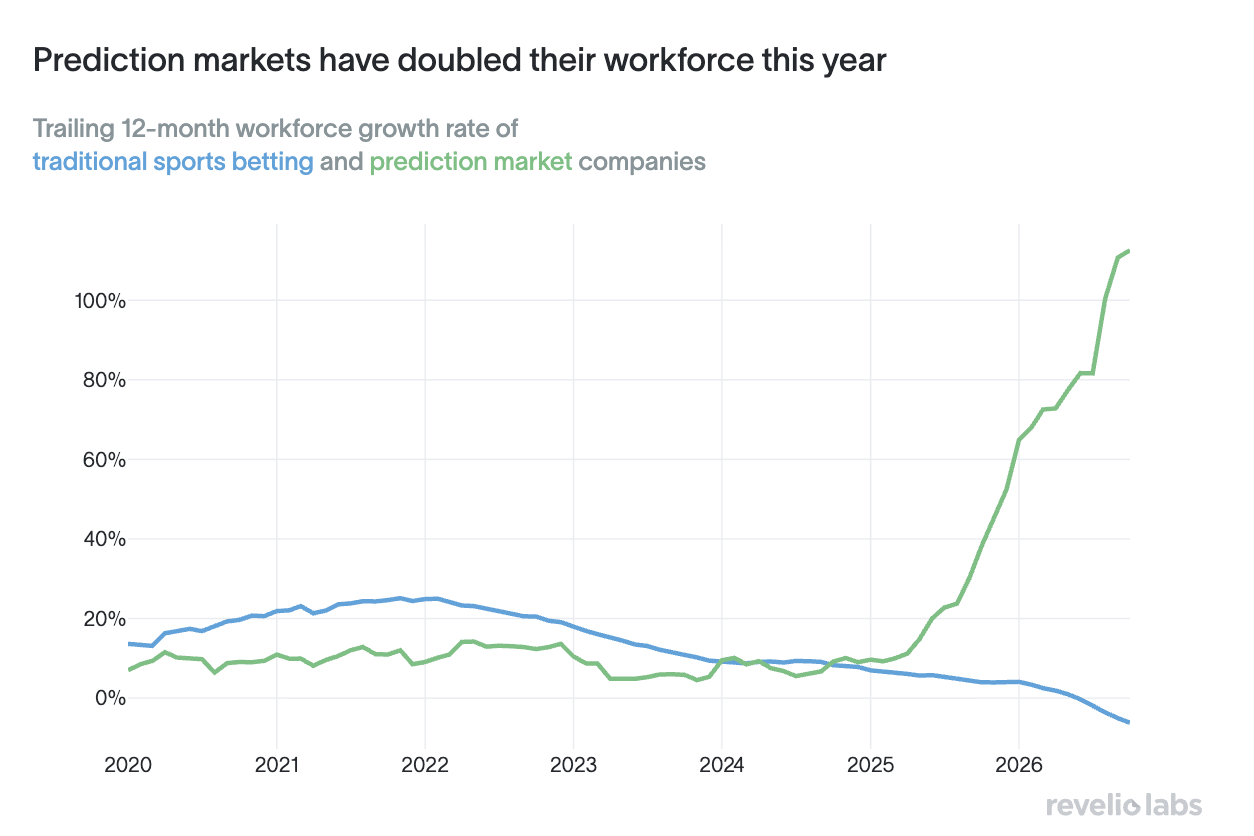
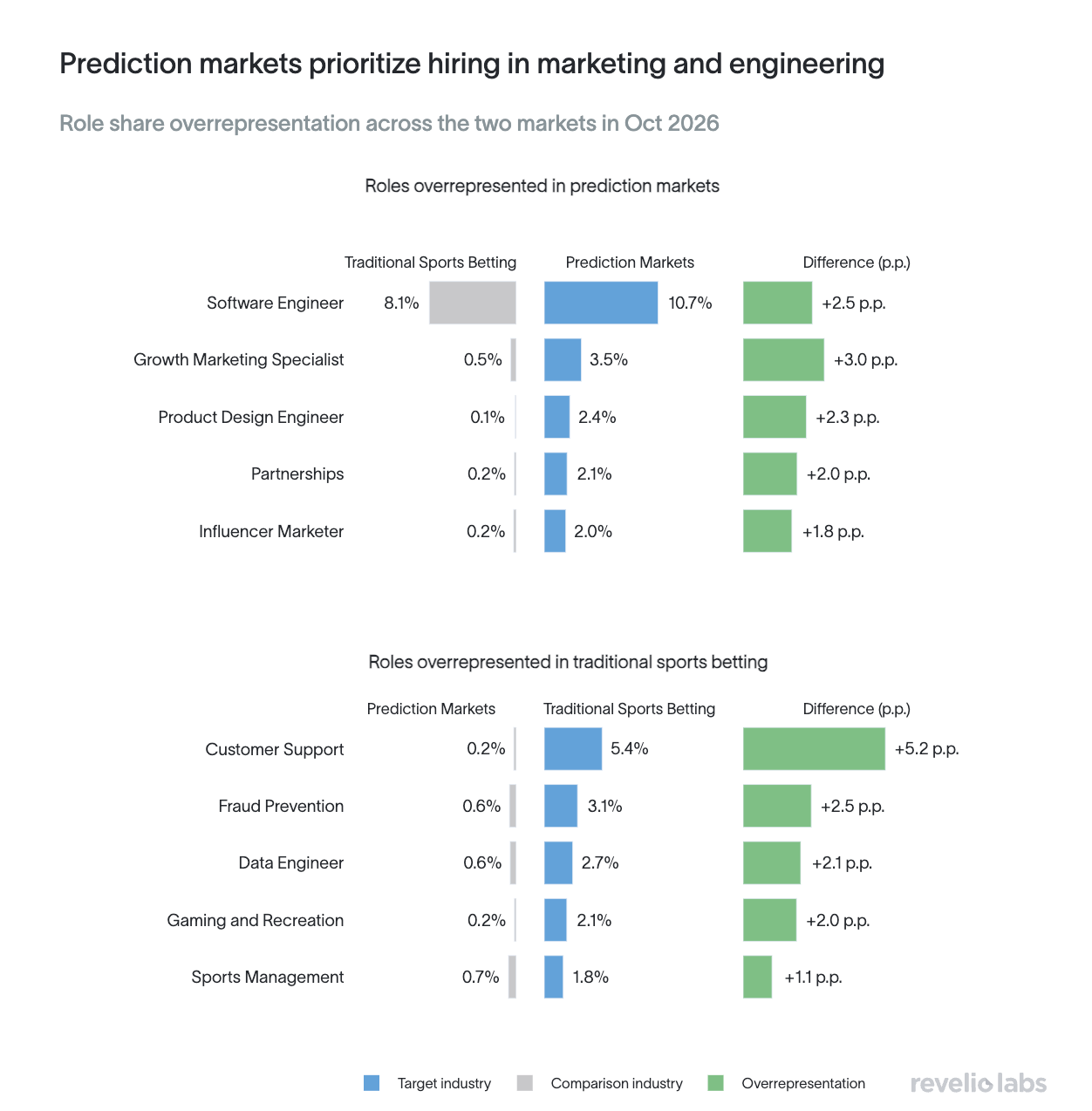
Growth alone does not explain how prediction markets are competing. The composition of their workforce does. The chart below shows which roles are overrepresented at each type of company. Compared with traditional sports betting companies, prediction-market workforces are more concentrated in engineering and growth-focused roles—functions closely associated with building products, attracting users, designing markets, and experimenting with new offerings.
Traditional sports betting companies, by contrast, have a workforce mix more consistent with operating a mature wagering business. Their organizations are relatively more oriented toward the functions required to maintain and support an established platform at scale.
The difference resembles what we might expect from firms at different stages of development. Prediction markets are still building products and competing for market share, while traditional sports betting companies have already spent years developing the infrastructure needed to operate large consumer wagering businesses.
Different business models produce different geographic footprints
The geographic distribution of workers provides another clue about how these businesses operate. Prediction-market employment is disproportionately concentrated in New York, while traditional sports betting companies’ employment is distributed across a wider range of states.
The pattern is consistent with differences in the business models and the regulatory frameworks around them. Traditional sports betting companies operate under state-by-state gaming rules, which can create a greater need for locally distributed regulatory, commercial, and operational talent. Prediction markets, by contrast, operate under a federal regulatory framework, which may allow more of their workforce to remain centralized around core product, engineering, trading, and growth functions. Their concentration in New York also aligns with a greater emphasis on technology, trading, and financial-market talent.
How difficult is it for prediction markets to source talent?
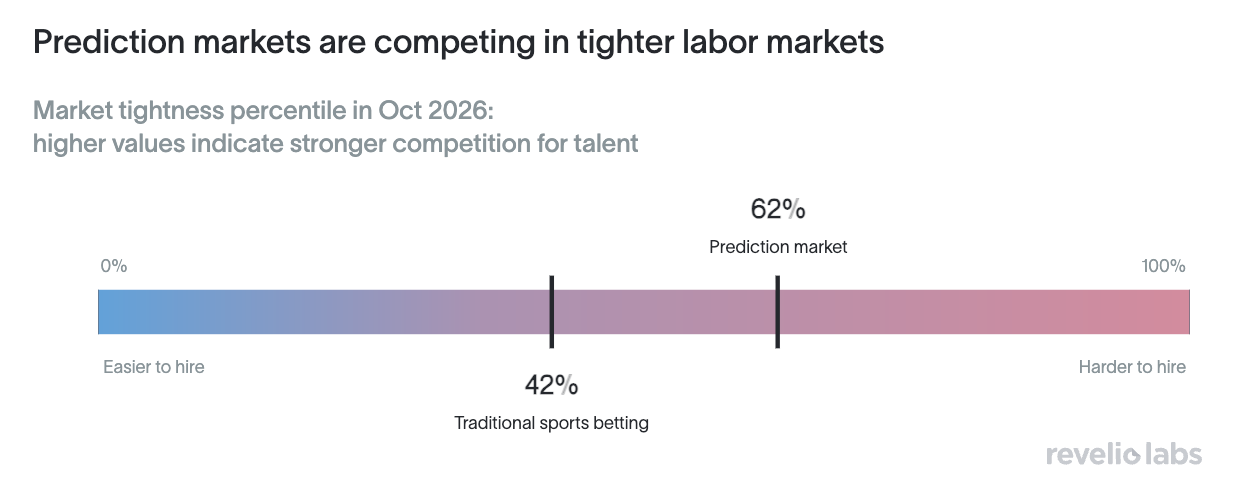
The same workforce strategy helping prediction markets expand may also make that growth harder to sustain. Our talent-market tightness index combines three measures of hiring pressure: labor supply relative to demand, time to fill open positions, and salary growth. Together, they show how difficult it is to recruit the talent each sector needs.
Prediction-market companies have a higher overall talent-market tightness score than traditional sports betting companies, suggesting that they are expanding in parts of the labor market where talent is comparatively harder to find. Their greater reliance on engineering, quantitative, growth, and other specialized roles puts them in competition not only with traditional sports betting companies but also with technology, finance, trading, and fintech firms seeking similar talent. As prediction markets continue to scale, access to specialized talent could become an increasingly important constraint on growth.
Is the rivalry moving into the talent market?
Prediction markets were once discussed largely as an alternative financial product, distinct from traditional sports betting in both structure and regulation. That line is becoming increasingly blurred as sports-event contracts grow in popularity. The 2026 World Cup showed that prediction markets can attract trading activity on sports events at a meaningful scale, and the NFL season is now testing whether that momentum can be sustained.
Growing competition in the product market masks important differences in the talent market. Prediction-market companies are building organizations oriented toward rapid product development, trading, and customer acquisition, while traditional sports betting companies retain the workforce structure of larger, more established wagering operators. Even as the two sectors increasingly compete for the same customers, their talent strategies have remained distinct so far.
These different talent strategies may also create new challenges. For prediction markets, the key question is whether rapidly expanding firms can recruit the specialized workforce needed to turn current momentum into sustainable growth. At the same time, traditional sports betting companies are beginning to respond to prediction markets’ success, with DraftKings and FanDuel developing prediction-market offerings of their own. As their products converge, competition between the two sectors could increasingly extend into the talent market as well.
Free to reproduce with attribution and a link to reveliolabs.com.
Cite this article
- Plain text
- Revelio Labs, "Prediction Markets Want Sports Betting’s Customers, Not Its Talent," November 17, 2026.
- HTML
- Revelio Labs, "<a href="https://www.reveliolabs.com/news/business/prediction-markets-vs-sports-betting-talent">Prediction Markets Want Sports Betting’s Customers, Not Its Talent</a>," November 17, 2026.
- Academic
- Yan, J. (2026, November 17). Prediction Markets Want Sports Betting’s Customers, Not Its Talent. Revelio Labs.