


The extent of requirements listed by companies in job postings has been a longtime point of interest, often for perceived extremes. In one, many employers have faced criticism for demanding several years of experience for even the most junior roles. In another, “laundry list” job postings requiring a litany of often disparate skills also draw negative attention.
One question is how these dimensions of job requirements are changing, especially in light of the recent drop in entry-level opportunities and AI’s upending of how hirers and hirees envision the future of work. This week, using Revelio Labs workforce data, we quantify how the depth and breadth of skills companies demand in job postings are shifting. Here, we focus on tech roles and define skill depth as the number of years of experience required performing a skill and skill breadth as the count of distinct skills mentioned.
How tech hiring requirements have changed since 2024
For this newsletter, we leverage our skill recognition model applied to descriptions found in COSMOS, our unified job postings dataset. The output of this model is then mapped to our proprietary skill taxonomy to standardize raw skill text.
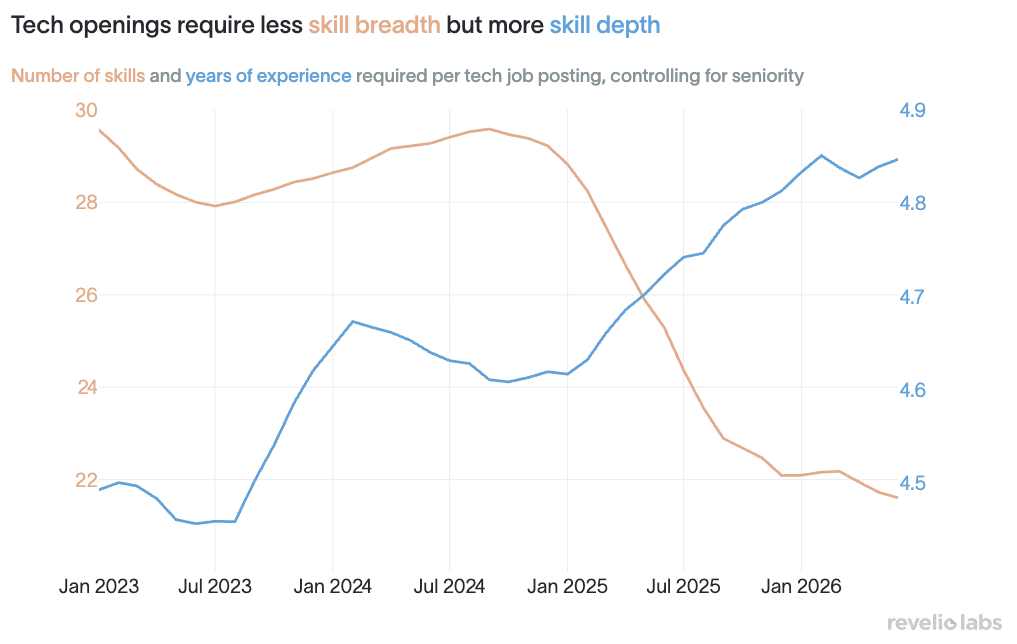
Since late 2024, two trends have emerged. The average number of skills required by tech job postings has fallen, while the average number of required years of experience spent exercising those skills has risen, even when controlling for the recent disproportionate drop in demand for junior roles. In particular, we find that the average number of skills required for tech work has fallen from about 30 to 21, while the average number of required years of experience has risen from about 4.6 to 4.8. Taken together, these trends indicate growing demand for skill depth—the proficiency or mastery that comes with years of experience performing a skill—and slackening demand for skill breadth, or for talent with laundry lists of skills at their disposal.
Which tech skills are growing and which are shrinking?
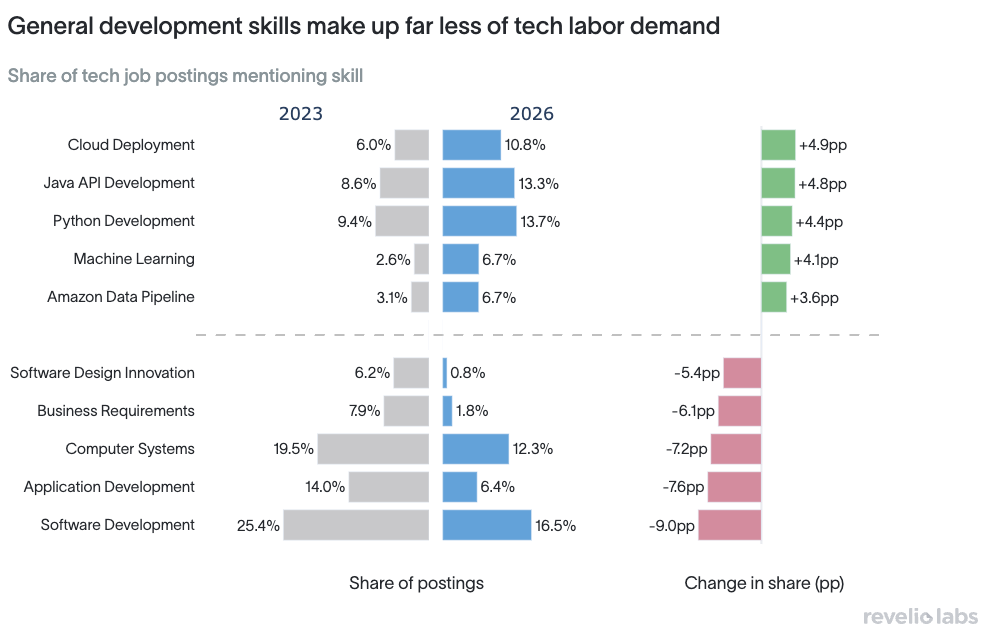
The mix of skills employers still ask for has changed quite a bit in recent years, with the biggest differences found around coding. General calls for software and application development have been found in just 16.5% and 6.4% of tech job postings this year, down from their shares in 2023 of 25.4% and 14%, respectively. Meanwhile, more specific calls for Java API development and Python development, as well as for networking, AI, and data know-how (cloud deployment, machine learning, and AWS Data Pipeline), are all found in greater shares of tech job postings. These underlying compositional changes from the general to the specific coincide with the overall shrinkage in skill counts and increase in years of experience, with companies increasingly favoring specialized rather than general skill sets.
Which skills tech employers now want mastery in
For tech work, companies have recently begun prioritizing depth of experience in data organization, data research, and enterprise architecture design. While in 2023, demands for data organization and research called for an average of 2 years of experience, this year they have called for 5 years, a 150% jump. For enterprise architecture design, the jump is from an average of about 5 years of experience to 6.5 years in that time.
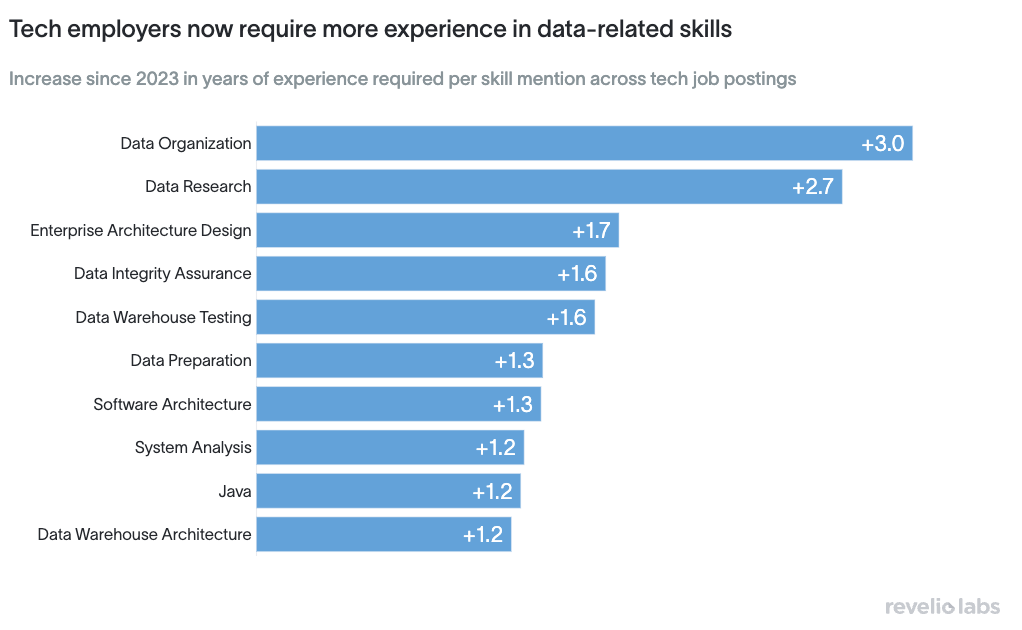
The increase in demand for these skills suggests companies prefer assigning this work to experienced personnel rather than junior hires or AI systems. Conversely, many of the skills most strongly bucking the rising-years-of-experience trend involve coding and coding languages, skills companies have more readily outsourced to—or at least augmented with—AI. Video game development and Windows deployment are the tech skills with the biggest drops in required years of experience, each of about 2 fewer years.
How AI is reshaping tech job requirements
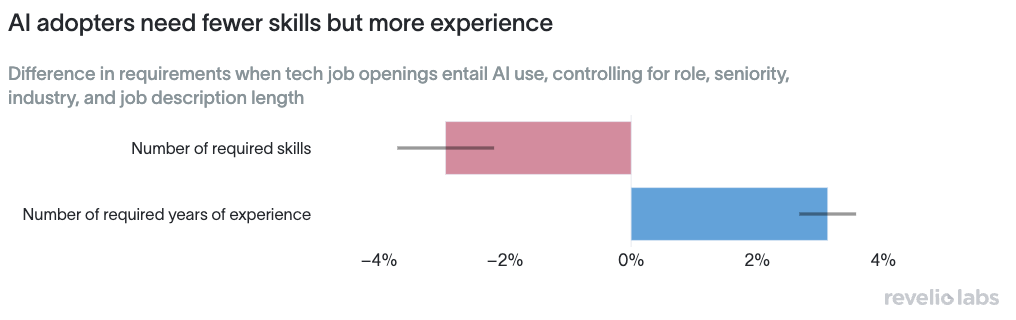
These patterns raise the question of what role AI adoption is playing. We find that tech job postings that call for AI utilization in responsibilities sections on average list modestly fewer distinct required skills and more experience compared to those that don’t. Controlling for seniority, industry, role, and description length, tech job postings calling for AI usage list about 3% fewer skills, and the average required years of experience for these postings is 3%, or about 11 days, greater.
Generalist vs specialist: which is tech hiring rewarding?
These directions align with the overall trends, indicating that AI is at least partly to play here. Companies are able to outsource some skill sets previously demanded from real workers, but in doing so they want the expertise and judgment that come with more experience, plus any skills that aren’t comfortably delegable to AI. For entry- and junior-level workers, though, this development adds to an already difficult picture. Companies aren't simply asking for fewer skills, which would work in these workers' favor—they are asking for years of experience in the more specialized, judgment-heavy skills that remain, which younger workers are the least equipped to offer.
Free to reproduce with attribution and a link to reveliolabs.com.
Cite this article
- Plain text
- Revelio Labs, "Tech Hiring Is Getting More Specialized," September 1, 2026.
- HTML
- Revelio Labs, "<a href="https://www.reveliolabs.com/news/tech/tech-hiring-specialized-job-market-2026">Tech Hiring Is Getting More Specialized</a>," September 1, 2026.
- Academic
- Boerner, D. (2026, September 1). Tech Hiring Is Getting More Specialized. Revelio Labs.


