


Hiring throughout the US economy has been falling since 2023 and into 2026. Retail, leisure, and manufacturing have shed hundreds of thousands of jobs. The headline employment-gains numbers, however, have stayed afloat thanks to one sector: Health Care and Social Assistance. If you have been following RPLS monthly releases, you would have noticed that the healthcare sector is adding new jobs to the economy every single month, acting as a buffer for total employment to not fall.
This week, using Revelio Labs data, along with BLS data, we take a deep dive into the healthcare hiring boom: what drives it, where the jobs are coming from, who is hiring, and what this boom means for the labor market going forward.
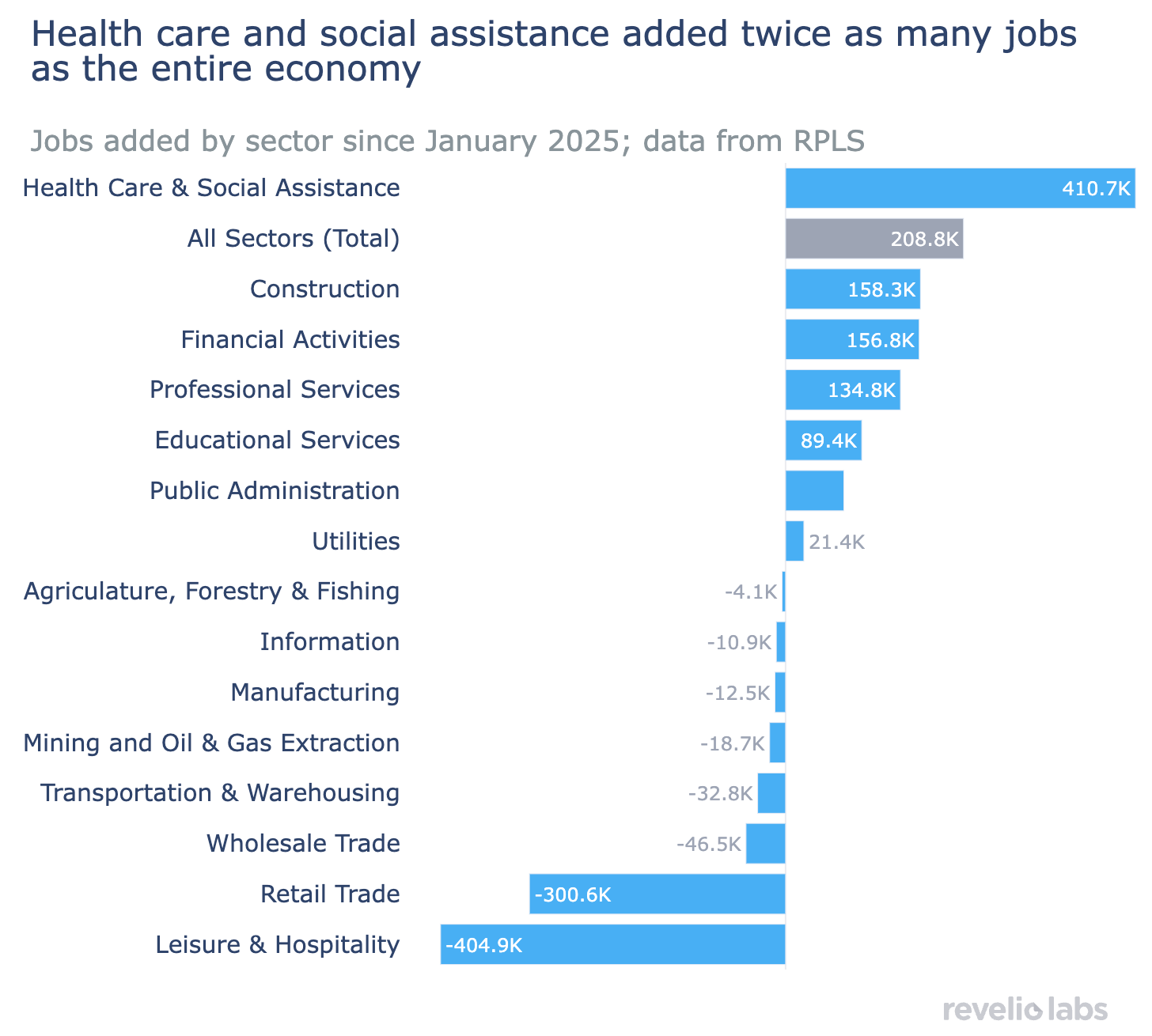
Healthcare added more jobs than any other sector in 2025—in every single month
Since January 2025, the healthcare sector has added more jobs than any other sector in the economy. According to RPLS data, the healthcare sector added 410.7k jobs since January 2025, nearly double the total net job growth across all sectors combined (208.8k). While many sectors have shed workers (most notably leisure and hospitality and retail) since the start of the economic slowdown, healthcare’s hiring pace has single-handedly kept the headline number positive. Construction and financial activities have also contributed meaningfully to job growth, but neither comes close to healthcare's dominance.
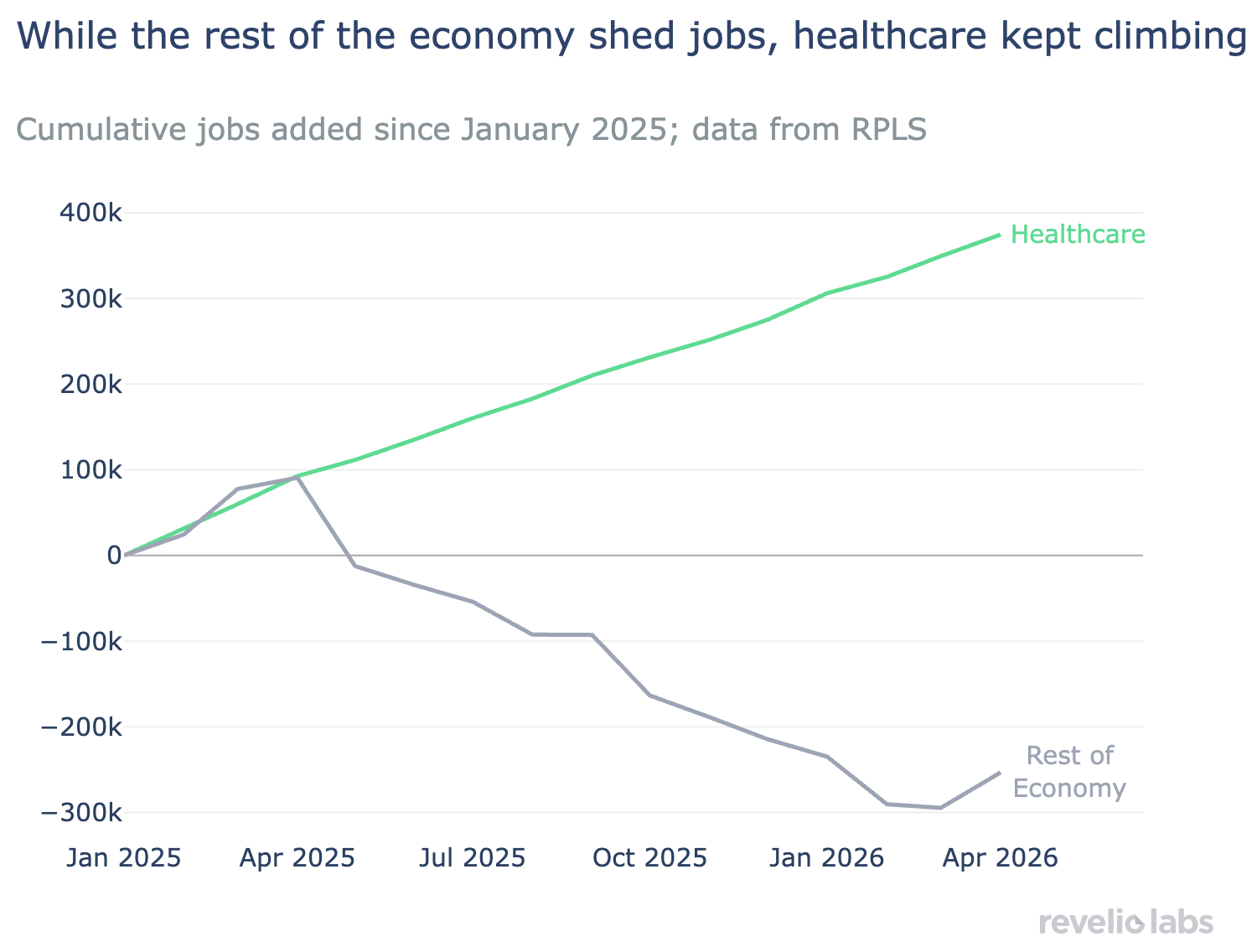
The cumulative picture tells a striking story of divergence. Since January 2025, healthcare has added a steady 400k jobs, while the rest of the economy has shed over 200k. The two lines move in almost perfectly opposite directions: healthcare climbing at a consistent pace, as it has been adding new jobs every single month. Meanwhile, the rest of the economy is drifting steadily downward. Most sectors have been responding to interest rate hikes, consumer sentiment, and broader economic conditions, but healthcare was not affected. The healthcare sector has not just outperformed the rest of the economy, but it has single-handedly kept the headline employment number from turning negative. Without it, the 2025 labor market would look like a contraction and not just a slowdown.
Why is healthcare hiring so aggressively?
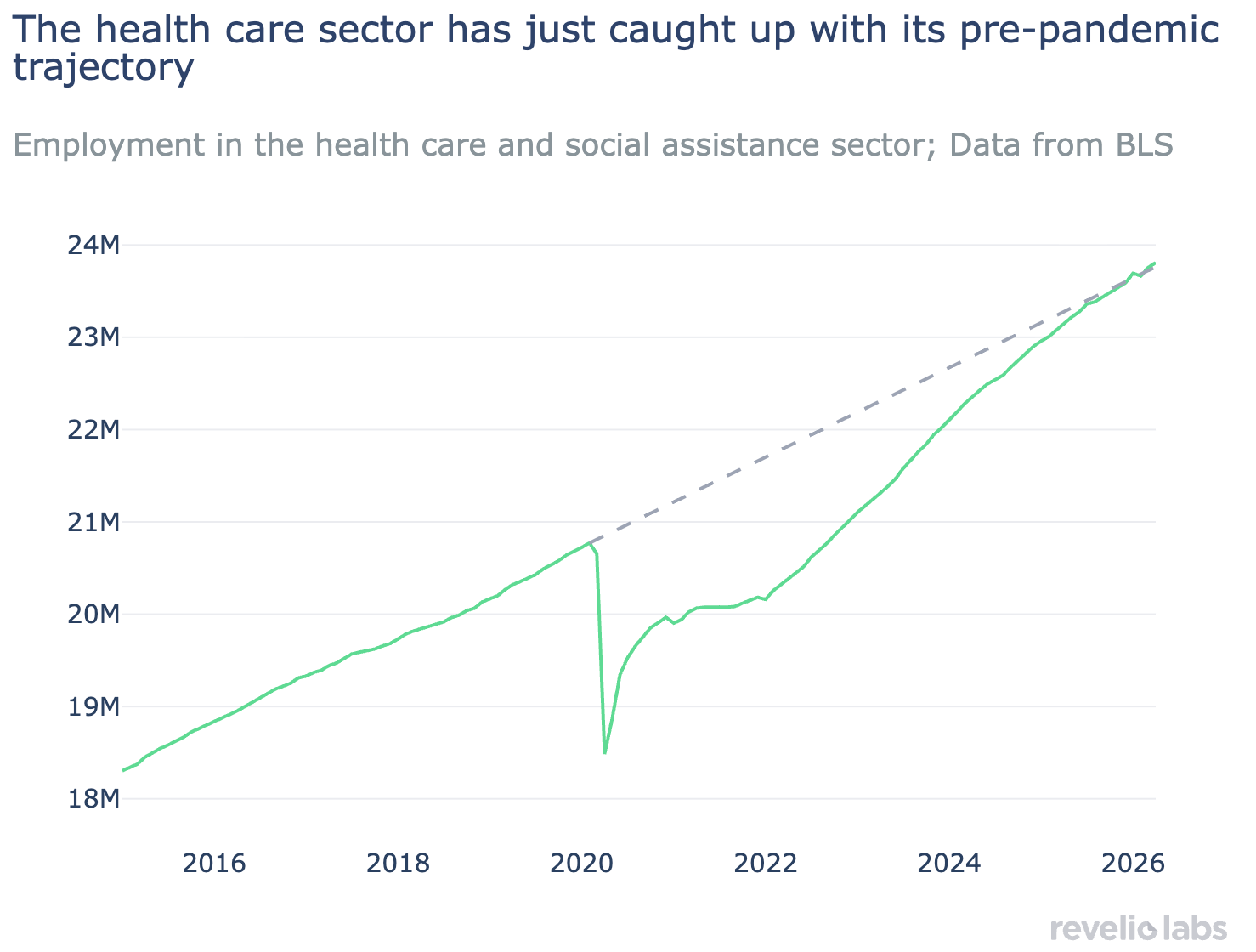
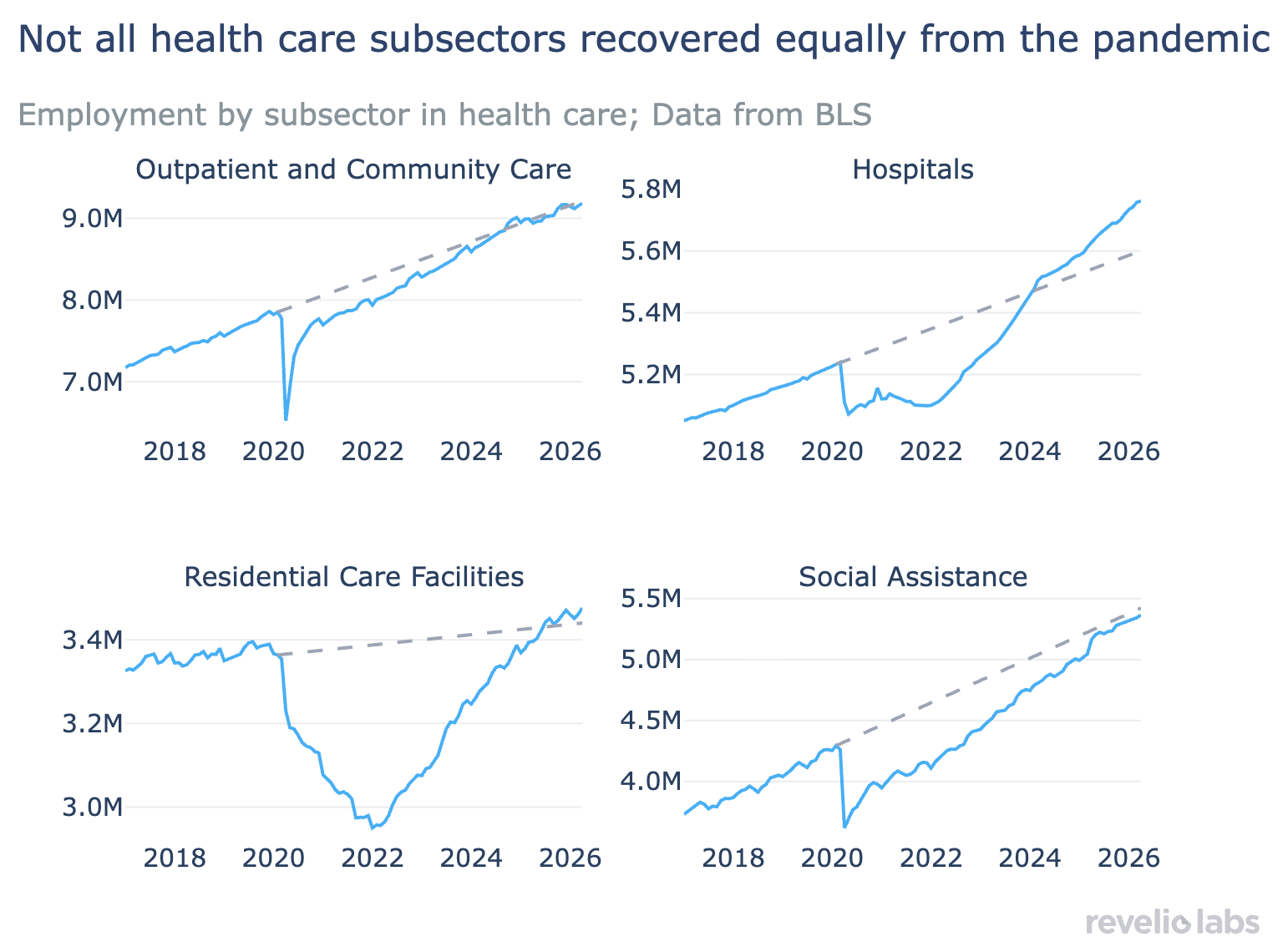
To understand why the healthcare sector is hiring so aggressively, it helps to look at the industry’s employment trends over a long time span. The sector suffered significant job losses when the pandemic hit in early 2020, as many non-frontline healthcare providers were furloughed as a result of the government mandates and hospital policies that paused non-urgent procedures. What followed were years of catch-up that involved recruiting burnt-out workers back into the profession, rebuilding staffing pipelines, and absorbing the enormous backlog of deferred care that accumulated during lockdowns. Even with the slowdown in the rest of the economy, hospitals and clinics still needed nurses and technicians just to get back to pre-COVID levels. The dashed line shows the employment path the sector would have followed had it continued growing at its pre-pandemic rate. Entering 2026, the sector had totally caught up to its pre-pandemic trend line.
The healthcare sector has recently started to pull ahead of where the pre-pandemic trajectory would have predicted. Will this supernormal employment growth last? Restoring employment levels in healthcare to their pre-pandemic trend means that we might see a deceleration in employment growth in healthcare. Yet, we still observe a continuous growth of employment in the healthcare sector, which indicates a more structural change, rather than just a catch-up dynamic. The demographic shift can provide an explanation. Baby boomers account for approximately 20% of the US population, and over the next few years, all baby boomers will be eligible for Medicare. The oldest baby boomers are now in their late 70s, the age range in which healthcare utilization jumps significantly. Moreover, the aging population is continuously in need of care, sometimes at home. These trends suggest demographics will be the primary drivers of employment growth in the healthcare sector in the future.
The shift to outpatient care
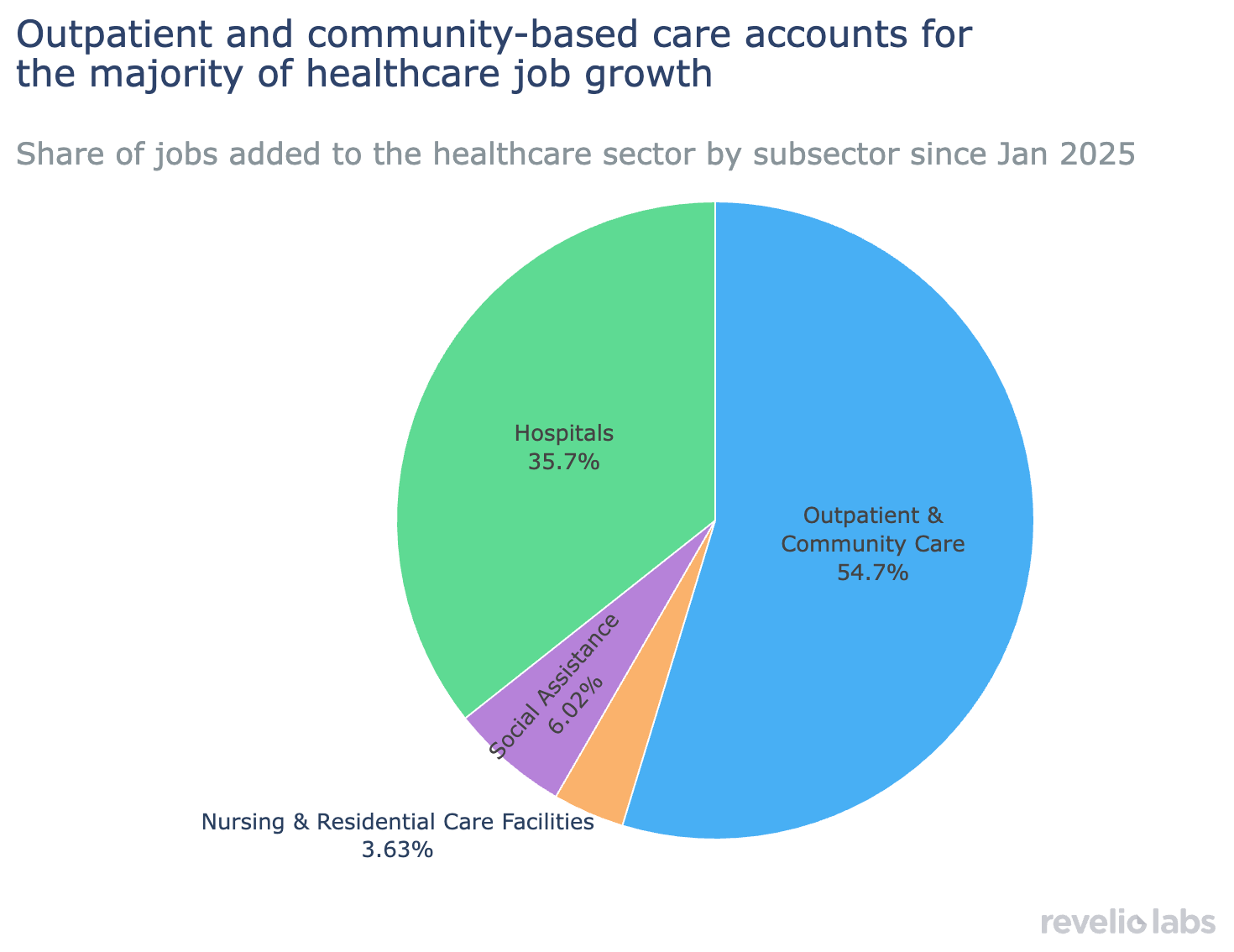
When we break down the healthcare sector into subsectors, we find that more than half of all healthcare jobs added since January 2025 came from ambulatory healthcare services, the broad category that covers outpatient clinics, physician offices, and home health aides. Hospitals contributed a substantial 35.7%, while nursing and residential care facilities and social assistance together accounted for less than 10%.
The concentration of employment growth in outpatient and ambulatory care reflects a structural shift in how Americans receive care, away from inpatient hospitals and toward outpatient and retail clinics. That shift, accelerated by both cost pressures and patient preference, means the jobs being created today look different from the healthcare jobs of a decade ago.
Breaking the sector down further reveals important differences in recovery trajectories across subsectors. Outpatient healthcare services, the largest contributor to job growth, has not only recovered but pulled meaningfully ahead of its pre-pandemic trend, consistent with the structural shift toward outpatient care described above. Hospitals tell a similar story, having crossed back above their trend line and continuing to climb. The picture is more complicated for residential care facilities, which suffered a deeper and more prolonged collapse, given that nursing homes and assisted living facilities were among the hardest-hit settings during the pandemic. That subsector has only recently returned to trend, and its recovery remains the most fragile of the four.
Social assistance, meanwhile, tells the most interesting story. It was tracking well below trend for years before accelerating sharply around 2023, suggesting that demand for social services, such as food assistance, housing support, and mental health services, surged as pandemic-era relief programs wound down. Across all four subsectors, the common thread is that recovery is now largely complete, which reinforces the earlier point: the catch-up phase is over, and what comes next will be driven by demand.
Healthcare demand is for practitioners, not administrators
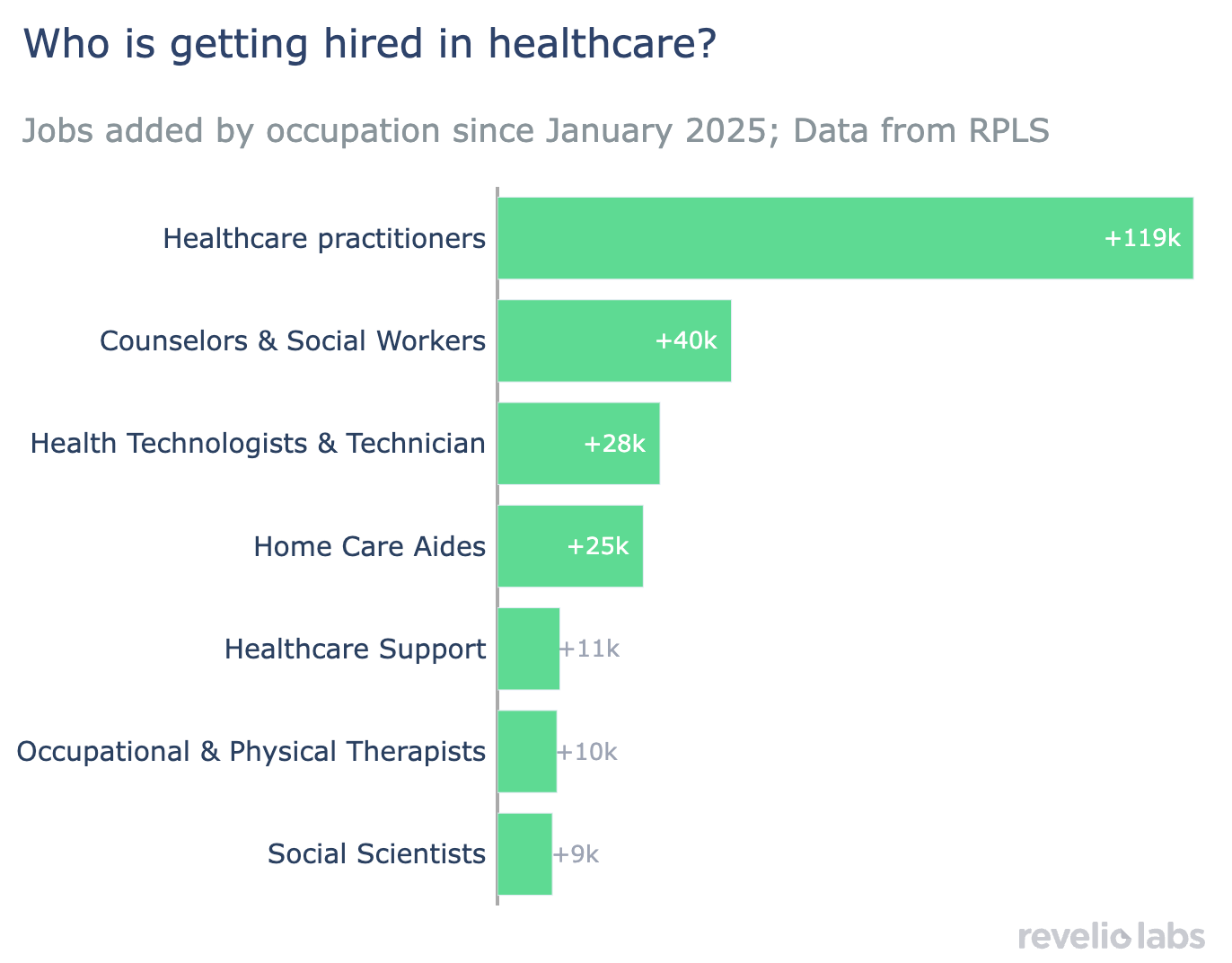
Zooming into the occupation level reveals which occupations have been in demand. Healthcare practitioners, the category encompassing physicians, nurses, and surgeons, account for the lion's share of job growth since January 2025. That's nearly three times the next largest category, counselors and social workers. Home care aides were also among the occupations that saw a large increase in hiring, reflecting the aging-population dynamic. More elderly Americans opt for or require in-home care rather than institutional settings. Overall, the occupation mix of the largest added jobs within the healthcare sector skews toward the high end of the skill and wage spectrum.
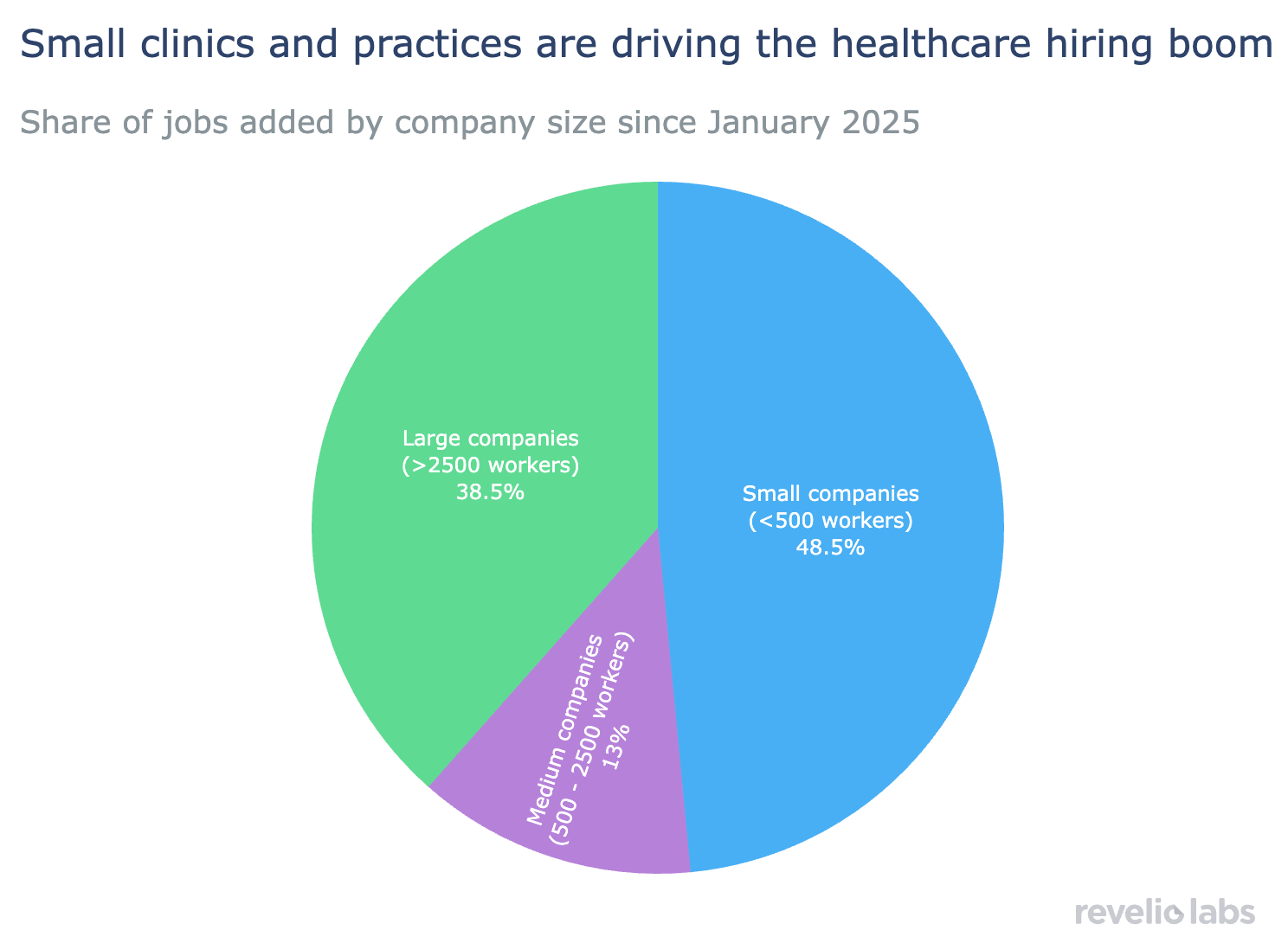
The job growth in healthcare is not concentrated in large hospital systems and corporate clinic chains. Nearly half of all jobs added since January 2025 came from small companies with less than 500 workers. The dominance of small employers reflects the structure of ambulatory care: most physician offices, therapy practices, home health agencies, and specialty clinics are small businesses. Small healthcare employers tend to be embedded in local communities, which means that job gains are geographically distributed rather than concentrated in major metro hospital campuses. It also suggests that growth is driven by genuine demand at the community level, rather than by consolidation and expansion by large health systems chasing market share.
The story of the post-Great Resignation labor market cannot be told without healthcare at the center. While many sectors are shedding workers, healthcare kept adding more jobs than the entire rest of the economy combined. That consistency reflects three forces that had been in play: the final stages of a long pandemic recovery, the demographic wave of an aging baby boomer population, and the structural shift in how Americans receive care away from hospitals and toward outpatient clinics, home health aides, and community-based practitioners.
The catch-up phase is now completed. The workers who left during the pandemic have largely returned, and the easy gains from rebuilding depleted rosters are behind us. What comes next will be slower employment growth in the healthcare sector, propelled by demographic-driven demand.
Free to reproduce with attribution and a link to reveliolabs.com.
Cite this article
- Plain text
- Revelio Labs, "Healthcare Job Growth Is Propping Up the Labor Market. But Can it Last?" June 2, 2026.
- HTML
- Revelio Labs, "<a href="https://www.reveliolabs.com/news/macro/healthcare-job-growth-is-propping-up-the-labor-market-but-can-it-last">Healthcare Job Growth Is Propping Up the Labor Market. But Can it Last?</a>" June 2, 2026.
- Academic
- Abdelwahed, L. (2026, June 2). Healthcare Job Growth Is Propping Up the Labor Market. But Can it Last? Revelio Labs.


