Brexit, Tax Havens, and the Brain Drain That Wasn't
Ten years after the Brexit vote, UK worker outflows has declined across the board


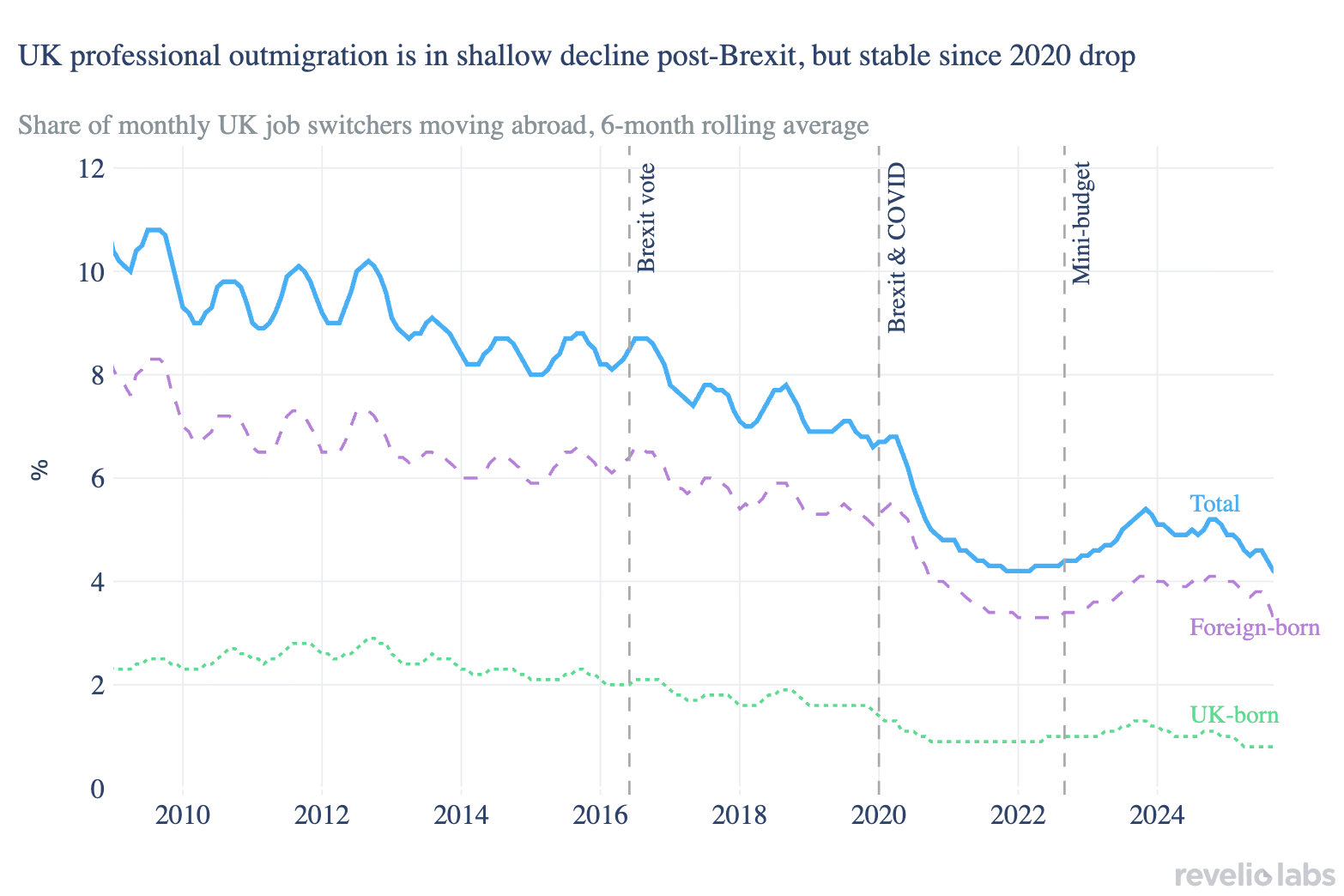
Outmigration from the UK has steadily declined over the past 15 years, with a more sudden drop at the onset of the formal EU exit which also coincided with COVID. Outmigration has remained largely stable since 2022.
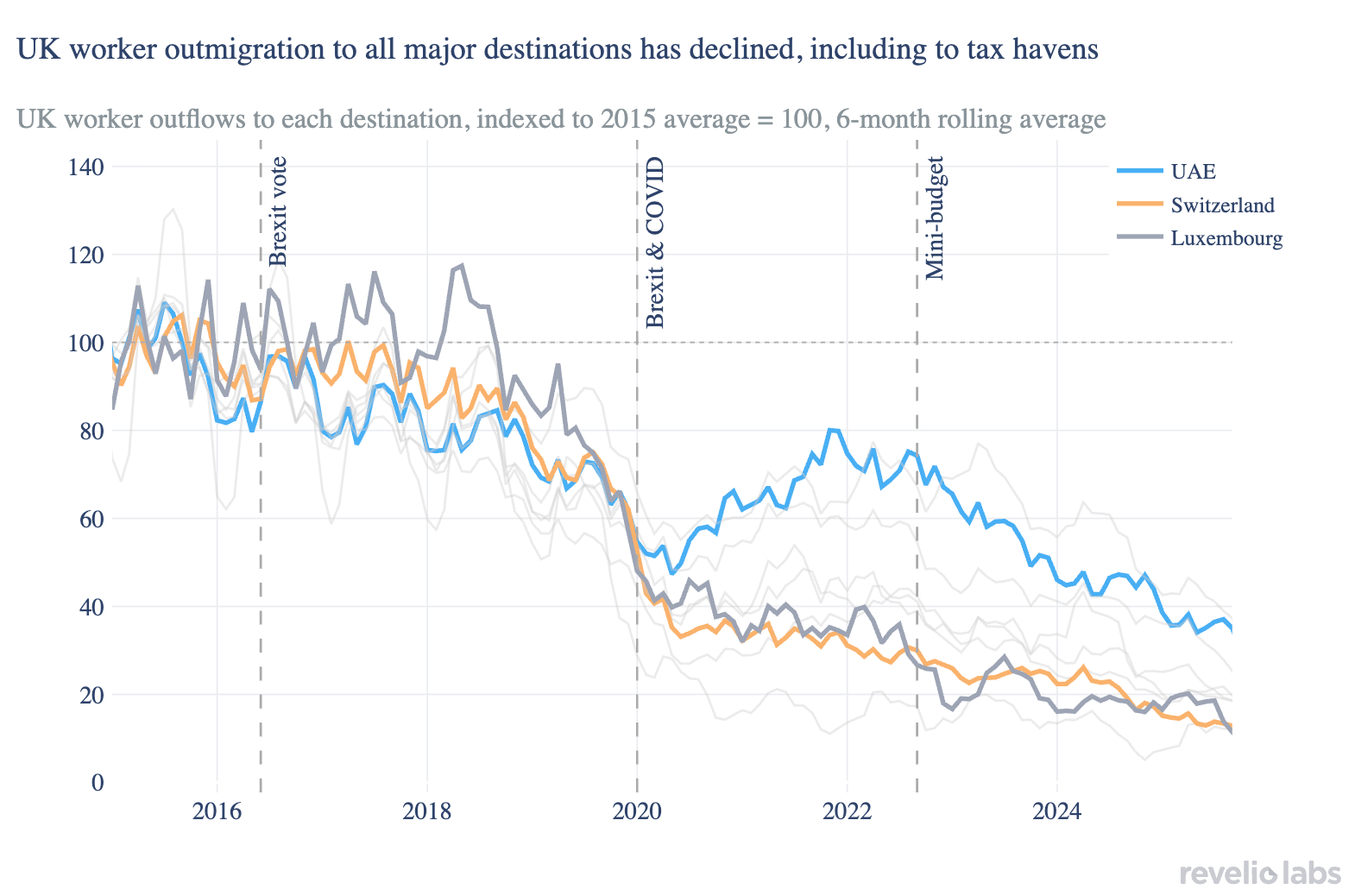
Has there been a surge in outmigration of UK talent to tax havens? Turns out, outmigration to low tax jurisdictions, such as Dubai and Switzerland, has not increased dramatically compared to 2015 levels and does not draw from higher earners.
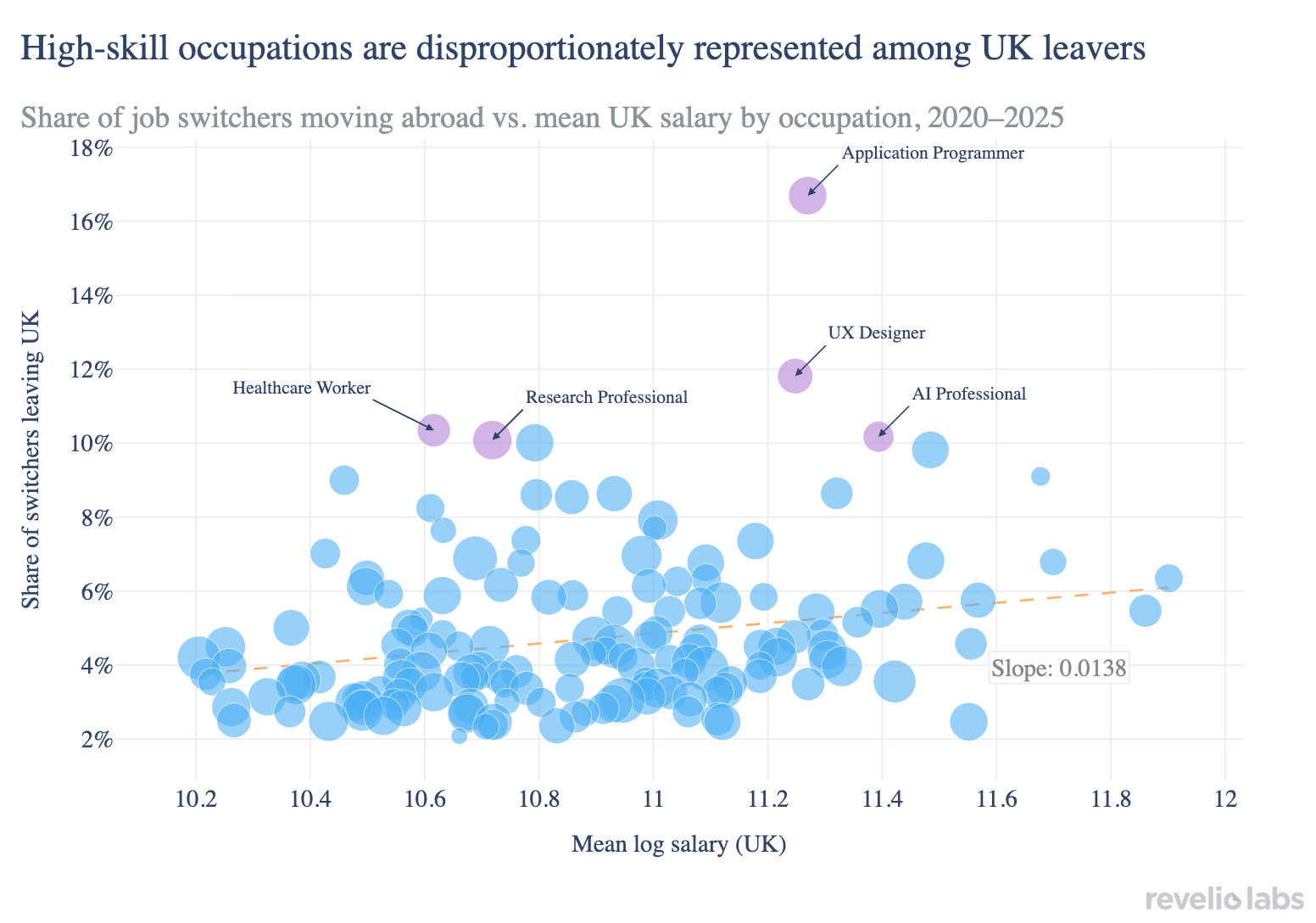
Nonetheless, the occupational mix of leavers points to a loss of higher-skill labor in the post-Brexit era: tech and healthcare roles rank among the occupations with the largest outflow rates.
Sign up for our newsletter
Our weekly data driven newsletter provides in-depth analysis of workforce trends and news, delivered straight to your inbox!
This summer marks ten years since the United Kingdom voted to exit the European Union. For the UK, the past decade has been marked by economic stagnation and decreased migration inflows from Europe. Amidst these economic developments as well as recent scrutiny of outmigration of top earners to tax havens, it is worth assessing the recent trajectory and state of outmigration of workers from the UK. How have outflows evolved? Where are UK workers relocating to? Who is leaving the UK?
Using Revelio Lab's data on job switches and job profile updates, we track international labor movements and worker characteristics. It is difficult to separately identify the migration effects of the UK’s formal exit from the EU from the chilling effects on international mobility of the COVID 19 pandemic, as well as from other large macroeconomic events. Nonetheless, the patterns that emerge are informative in assessing where the UK stands in the wake of this monumental policy shift.
How has UK outmigration evolved?
We start by characterizing aggregate worker outflows from the UK. We tag individuals as moving from the UK abroad if they report corresponding job moves or if they update their profiles to reflect physical locations outside the UK, which is important for tagging remote work.
We track the share of UK job switchers who move abroad each month, splitting by UK-born and foreign status. The outmigration rate declined steadily from 10% to 7.5% between 2009 and 2020, with no visible break around the Brexit referendum. Outmigration fell sharply in 2020, reducing to around 4%, coinciding with both the formal EU exit period and the onset of the COVID-19 pandemic.
Since 2021, outmigration has remained remarkably stable. Notably, the trend sees no further declines even in response to the mini-budget fiscal event that announced intention to abolish the 45% top rate of income tax, cutting stamp duty, reversing the National Insurance increase, and scrapping the planned corporation tax rise. The rationale of the mini budget was to improve the UK’s competitiveness within the international business and labor environment, and was explicitly framed as a response to the perception that high-earning professionals were leaving for lower-tax jurisdictions like Dubai or Switzerland. The proposed fiscal changes were unfunded, which prompted a market panic, resulting in their subsequent reversal, the firing of the Chancellor, and the resignation of Prime Minister Liz Truss. The low outmigration trend holds for both UK-born and foreign-born UK workers, although foreign-born workers represent a far greater share of UK out-migrants following a job switch.

Are UK workers fleeing to tax havens?
However, were perceptions of tax-motivated brain drain grounded, given that outmigration has actually been in decline? We fail to document any compelling increase in outflows to low tax jurisdictions, such as the UAE, Switzerland, or Luxembourg, relative to levels a decade earlier. Outmigration to the UAE did see a modest increase since a sharp drop in 2020, but only peaking in 2022 at 20% below 2015 levels before declining once again. Moreover, the baseline level of outmigration to the UAE is small to begin with at 5%, so this development still reflects only small changes in outflows to the UAE. We can also see that most destinations have seen declines in receipt of UK out-migrating workers since 2016.
Are high earners the ones leaving to tax havens?
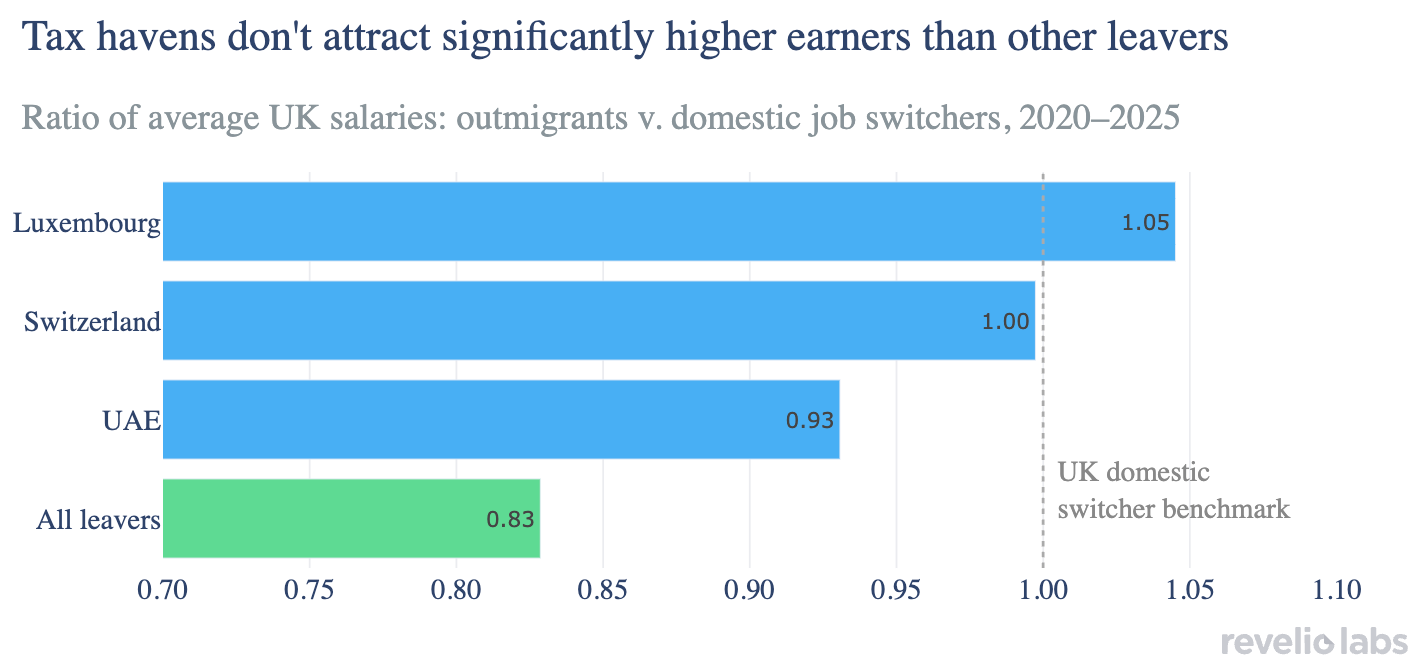
We can also explore the composition of leavers: who they are and how much they were earning. Contrary to the popular narrative, we do not find evidence that high-earning professionals flee the UK to tax havens.
Workers leaving the UK earned, on average, only 83% of what domestic job switchers earned. While leavers bound for the UAE, Switzerland, and Luxembourg do earn somewhat more than the average leaver, they still earn no more than—and in the case of Dubai, meaningfully less than—the typical UK worker who stays. The data offer little support for the idea that Brexit or the UK's tax environment has triggered a disproportionate exodus of top earners to low-tax destinations.
UK Skilled Worker Shortage: Which Professions Are Losing the Most to Outmigration?
Lastly, we examine which UK occupations have experienced the greatest rates of outmigration by plotting the share of workers in each occupation classification who switched jobs since 2020 and moved abroad against the occupation's mean UK salary. While most occupations exhibit relatively modest exit rates, a small number stand out. Application programmers have the highest observed outmigration rate (16.7%), followed by user experience designers, healthcare workers, AI professionals, and research professionals. Although the overall relationship between salary and outmigration is positive but weak, the occupations with the highest exit rates are disproportionately concentrated among higher-skilled, higher-paying professions.
Taken together, this analysis of UK outmigration in the post-Brexit era paints a picture of a labor environment that is less connected with the outside world. Brexit appears to have not only restricted migrant inflows into the UK, but also prompted UK workers to respond by staying put rather than seeking opportunities abroad. The documented labor flows discount more recent popular narratives about brain drain and loss of talent to lower-tax jurisdictions such as the UAE, but do suggest some additional possible loss of higher-human-capital workers.