


Following the surge in remote work opportunities that occurred in the wake of the Covid pandemic, the job market is steadily switching back to hybrid or fully on-site jobs. Despite this overall push to return to office, there is still a high degree of variation in the share of remote positions, depending on the activities that a position entails. Moreover, some industries seem to be more open than others to having remote workers, even for positions that perform the same activities.
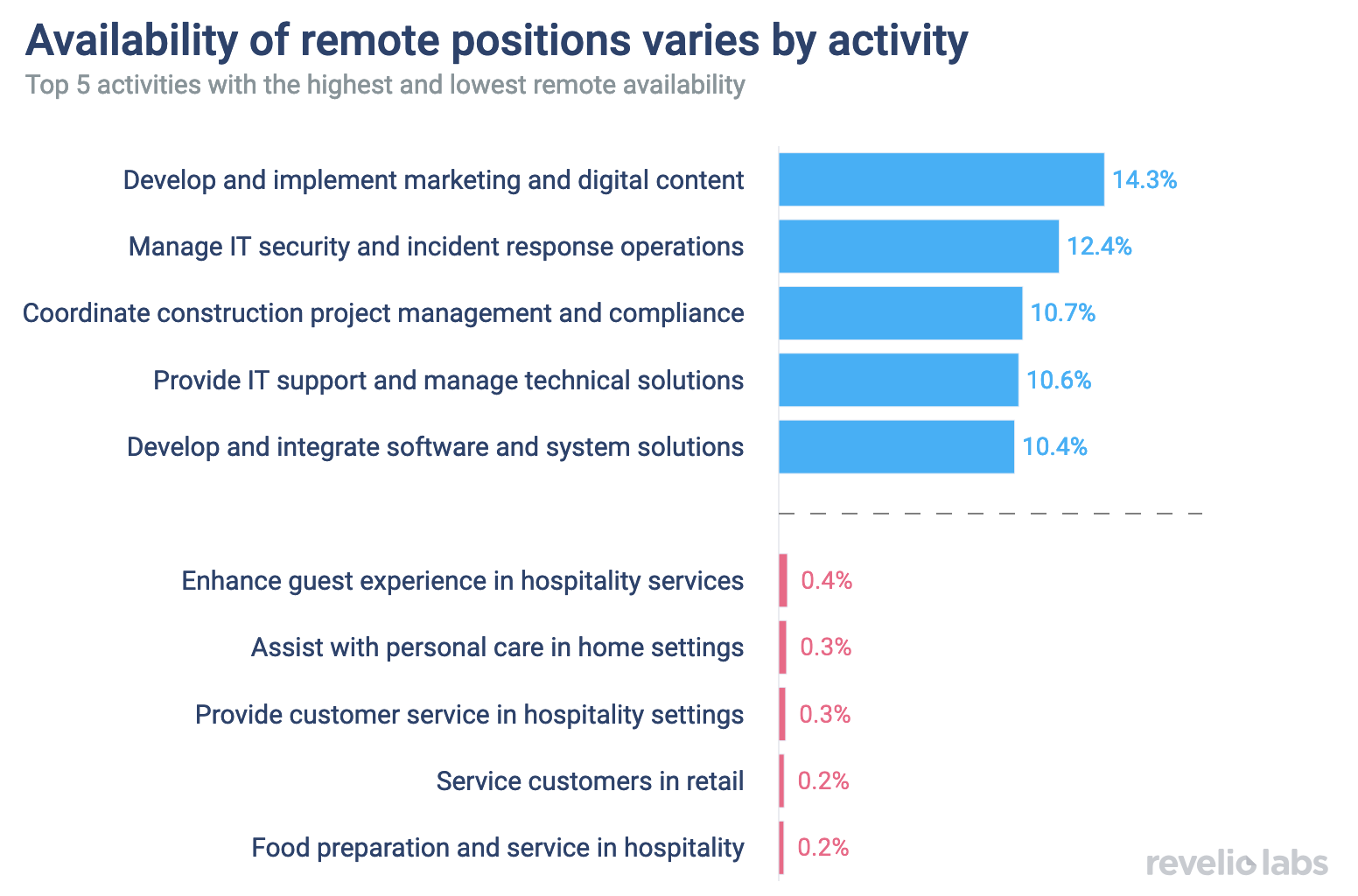
Using Revelio Labs' COSMOS job postings data and new activities model, we characterize job activities into how likely they are to be listed on job postings for remote work. We find that the activities associated with a job are a key factor in explaining the likelihood of that job being remote, even more so than the job title. Positions that require activities related to developing digital content, software or technological solutions, and data analysis are the most likely to be remote, with shares as high as 14% in 2024. On the other hand, jobs whose activities are more naturally carried out in person, such as customer service or equipment operation, are almost always non-remote.
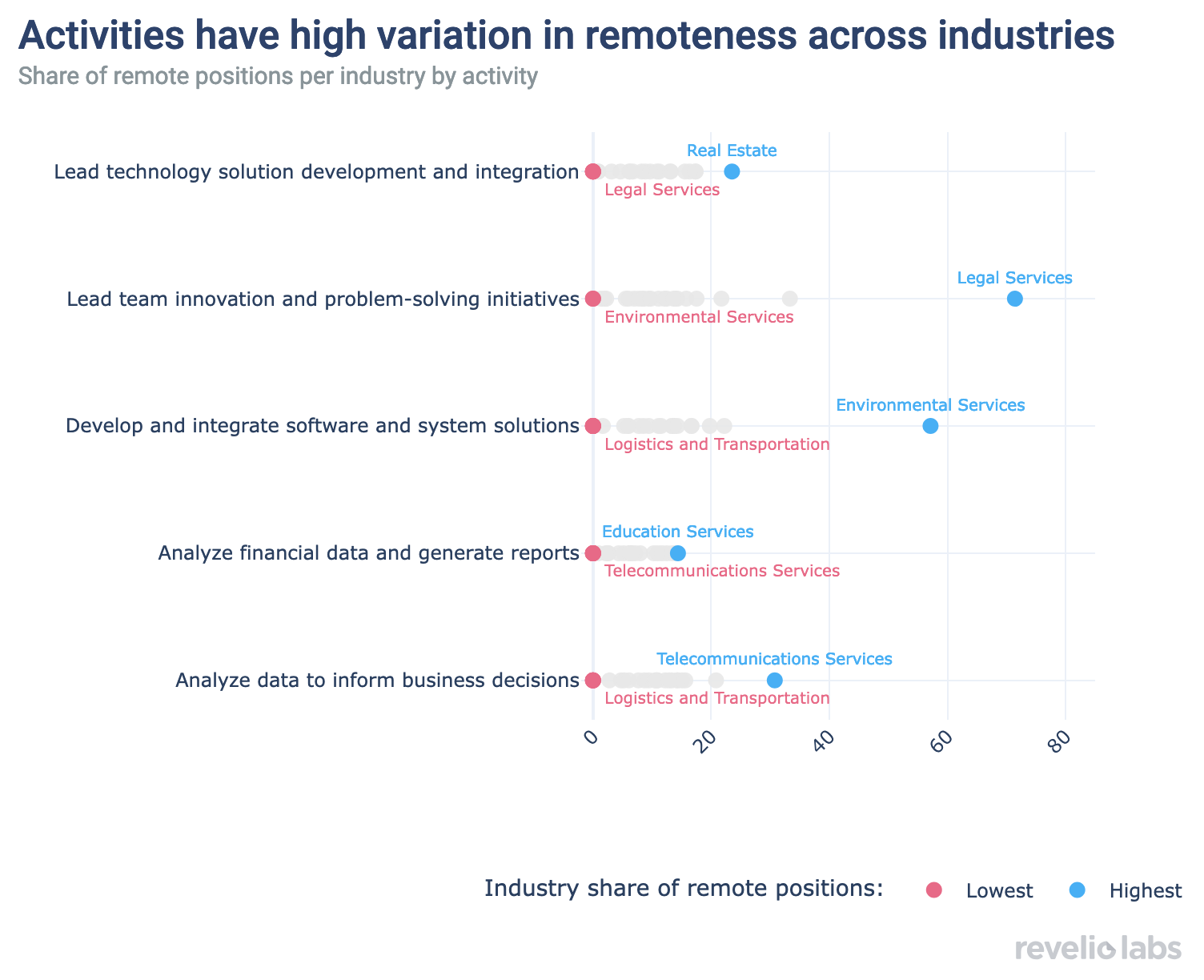
We also find that some industries are more open to the idea of remote work than others, even for similar sets of activities. In the figure below, we select five commonly performed activities and show how likely each activity is to be performed remotely by industry. For example, close to 30% of positions that require developing software solutions are remote in the Business Consulting sector, whereas only 6% are remote in the Financial Services sector. This suggests that some industries are more resistant to remote work than others, even after holding activities constant.
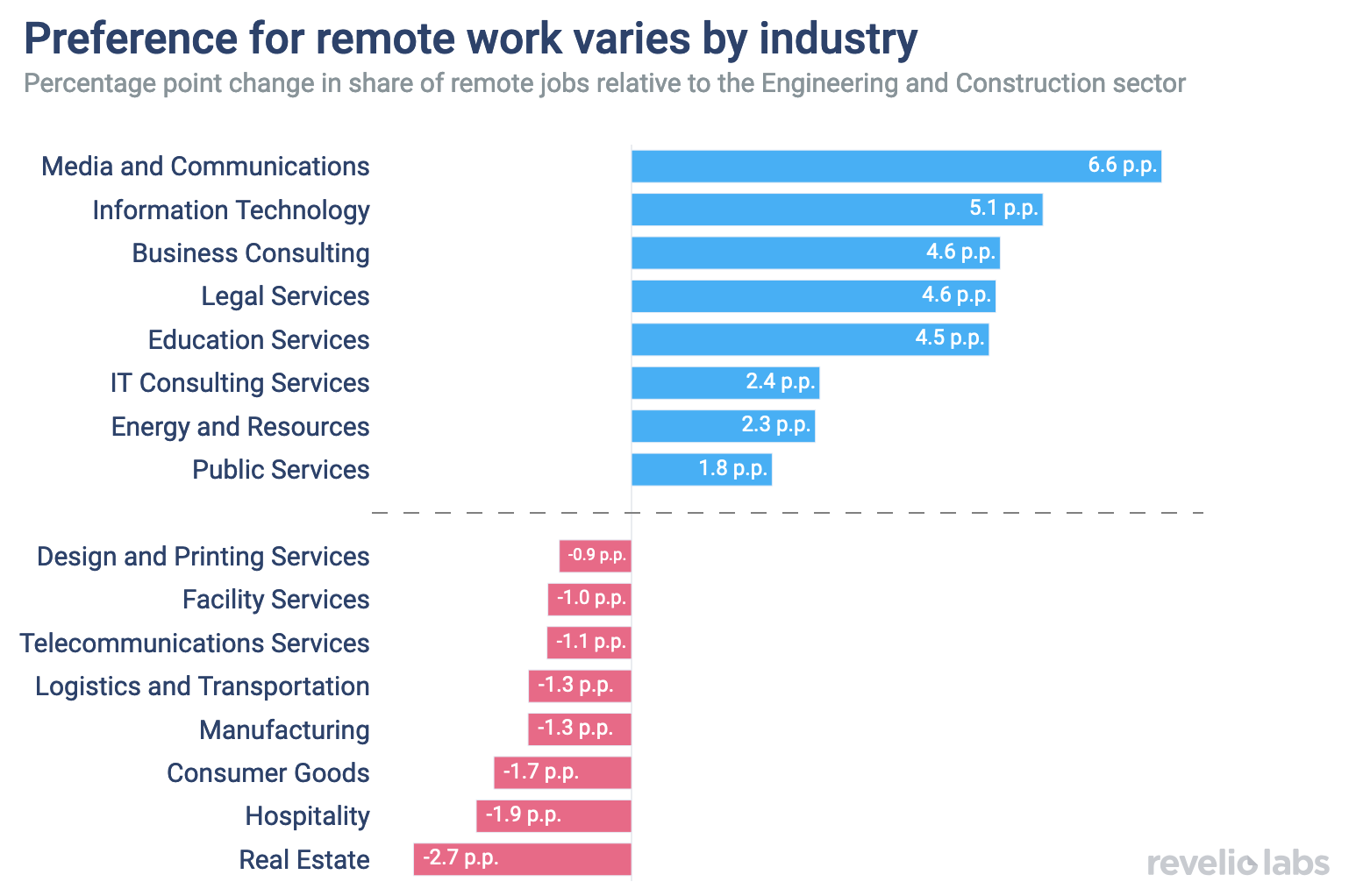
Comparing job characteristics—such as their likelihood of being remote— across industries requires careful consideration, because different industries offer different types of jobs. For instance, jobs in the Hospitality sector are much less likely to be remote on average than jobs in the Real Estate sector. However, this "naive" comparison does not acknowledge the fact that the job composition across both industries is different: Jobs in Hospitality tend to encompass activities that require on-site presence, which is less true for Real Estate. Thus, directly comparing jobs across industries is not an apples-to-apples comparison.
However, our analyses suggest that industries have significant differences in the likelihood of offering remote positions, even after holding activities and other factors constant. We find that, after controlling for activities performed, as well as for other factors like metro area, level of income, and seniority, positions in Real Estate are almost 2.7 percentage points less likely to be remote than positions in Engineering and Construction. That is, for any given job that exists across industries, the same job is less likely to be offered remotely in Real Estate, regardless of how overall remote-suitable the job is. The Financial Services sector, known for mandating employees back to the office despite having highly remote-suitable jobs, is 7 percentage points less likely to offer a job remotely than Media and Communications, which is the industry that most favors remote positions. The Hospitality and Consumer Goods industries are the least likely to offer remote jobs, while Consulting and IT are much more likely.
These last few years have seen a sudden increase in remote work availability, followed by a slow return to on-site jobs. These circumstances are helping us understand how different industries view jobs as bundles of tasks, and how there seems to be different preferences for these tasks to be carried out remotely or on-site. Industries affect multiple aspects of the jobs you might consider, and remote work appears to be an important new aspect in which they differ substantially.
Free to reproduce with attribution and a link to reveliolabs.com.
Cite this article
- Plain text
- Revelio Labs, "These Industries Could Offer Remote Jobs — But They Don’t Want To," August 28, 2024.
- HTML
- Revelio Labs, "<a href="https://www.reveliolabs.com/news/social/these-industries-could-offer-remote-jobs-but-they-do-not-want-to">These Industries Could Offer Remote Jobs — But They Don’t Want To</a>," August 28, 2024.
- Academic
- Carril, A. (2024, August 28). These Industries Could Offer Remote Jobs — But They Don’t Want To. Revelio Labs.


