


Every week seems to bring a new conclusion about what AI will do to the labor market. “AI will eliminate jobs. It will create new ones. It will replace entry-level workers, raise productivity, transform occupations, and make hiring more efficient.” The harder question is more immediate: What is AI actually doing to the labor market now?
This week, Revelio Labs is launching the new monthly AI Labor Market Tracker, an effort to answer that question using workforce, job-posting, salary, and employee-sentiment data. The tracker follows AI’s effects across five parts of the labor market: the supply of workers, employer demand, equilibrium in employment and wages, the activities that make up jobs, and the process through which workers and employers find one another. It combines original Revelio Labs analyses with updated applications, replications, and extensions of findings from emerging academic research.
The objective is deliberately descriptive rather than predictive or prescriptive. We are not trying to forecast the eventual future of work or tell firms how they should use AI. We want to measure the changes already taking place across a comprehensive set of metrics.
AI Exposure and AI Adoption Tell Different Employment Stories
A central challenge in studying AI's labor market effects is distinguishing anticipation from adoption. Firms may adjust hiring plans before deploying AI tools, while workers may change skill investment decisions in response to expectations about future demand. Conversely, measurable labor market effects may emerge only after organizations formally adopt AI technologies. It helps to separate these two ideas that are often treated as interchangeable.
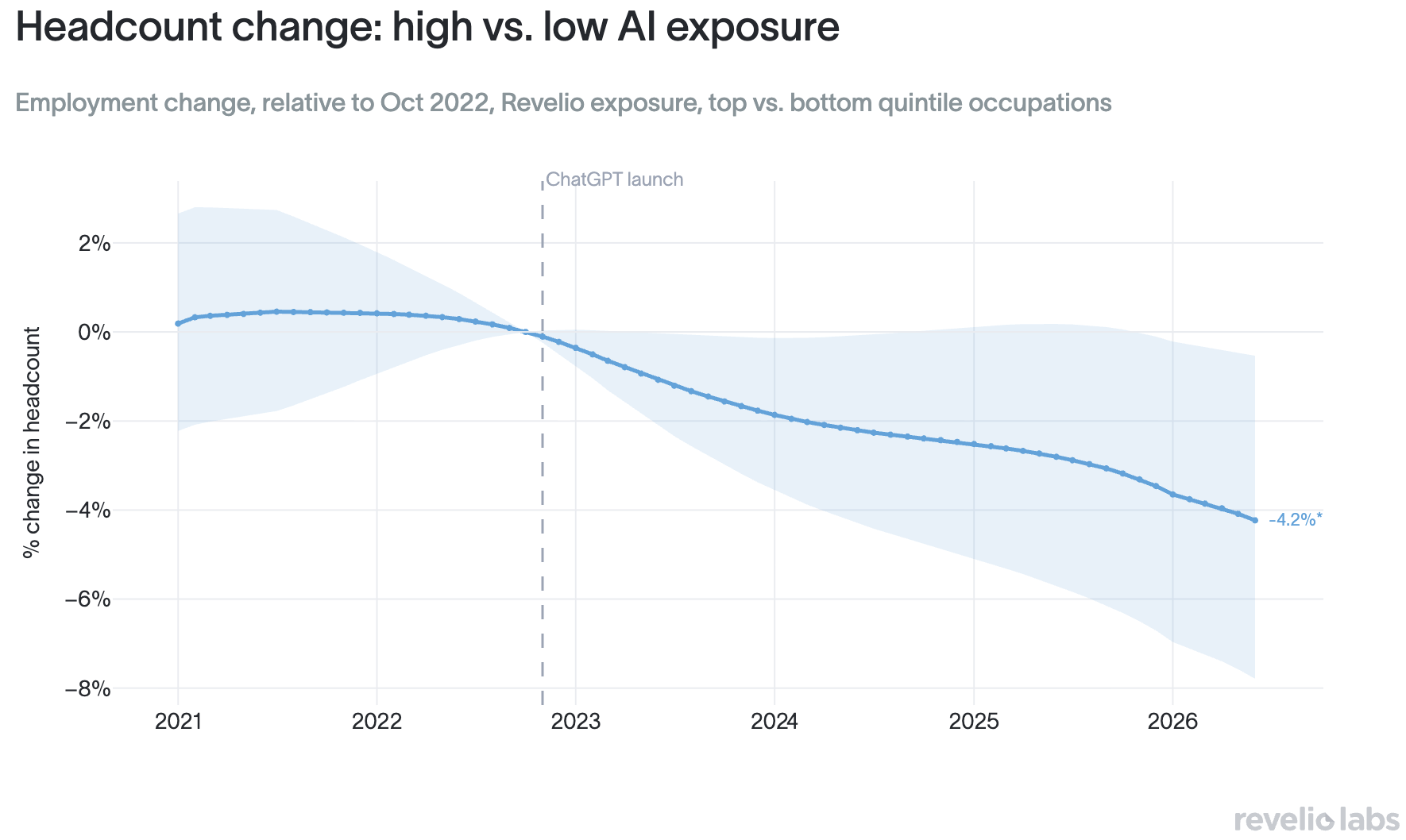
The first is AI exposure: the share of work activities performed in an occupation that current AI systems could plausibly do. Exposure does not mean that employers or workers in these roles are already using AI. The possibility alone can change behavior. Firms may decrease hiring in exposed roles, redirect demand toward different work, or reconsider which entry-level positions they need before they have fully deployed the technology. These are anticipatory effects: labor-market changes driven by what employers expect AI will be able to do, rather than by its observed use inside a company.
Building on the approach of Brynjolfsson, Chandar, and Chen (2025) in Canaries in the Coal Mine, we find that employment in the most AI-exposed occupations has grown about 4% less than employment in the least-exposed occupations since the launch of ChatGPT. We find that the decline is larger for younger workers in exposed occupations, compared to older workers.
The second idea is AI adoption: whether a firm has actually begun using AI in its operations.
Following Hosseini Maasoum and Lichtinger (2025), we identify AI-adopting firms from job postings. A firm is considered AI adopting, when it posts jobs for AI integrator roles. Note that this approach in identifying adopters is different from Kharazian, Simon and Stevens (2026), which identified adoption from spending data.
Adopting firms grow headcount by 27% relative to non-adopters since October 2022. Adopting firms were growing faster pre-adoption, meaning the adoption is not random and adopting companies are different from non-adopting companies before adoption. We also see that the growth is not distributed evenly. Senior roles grow by 31%, compared with just 6% for junior roles.
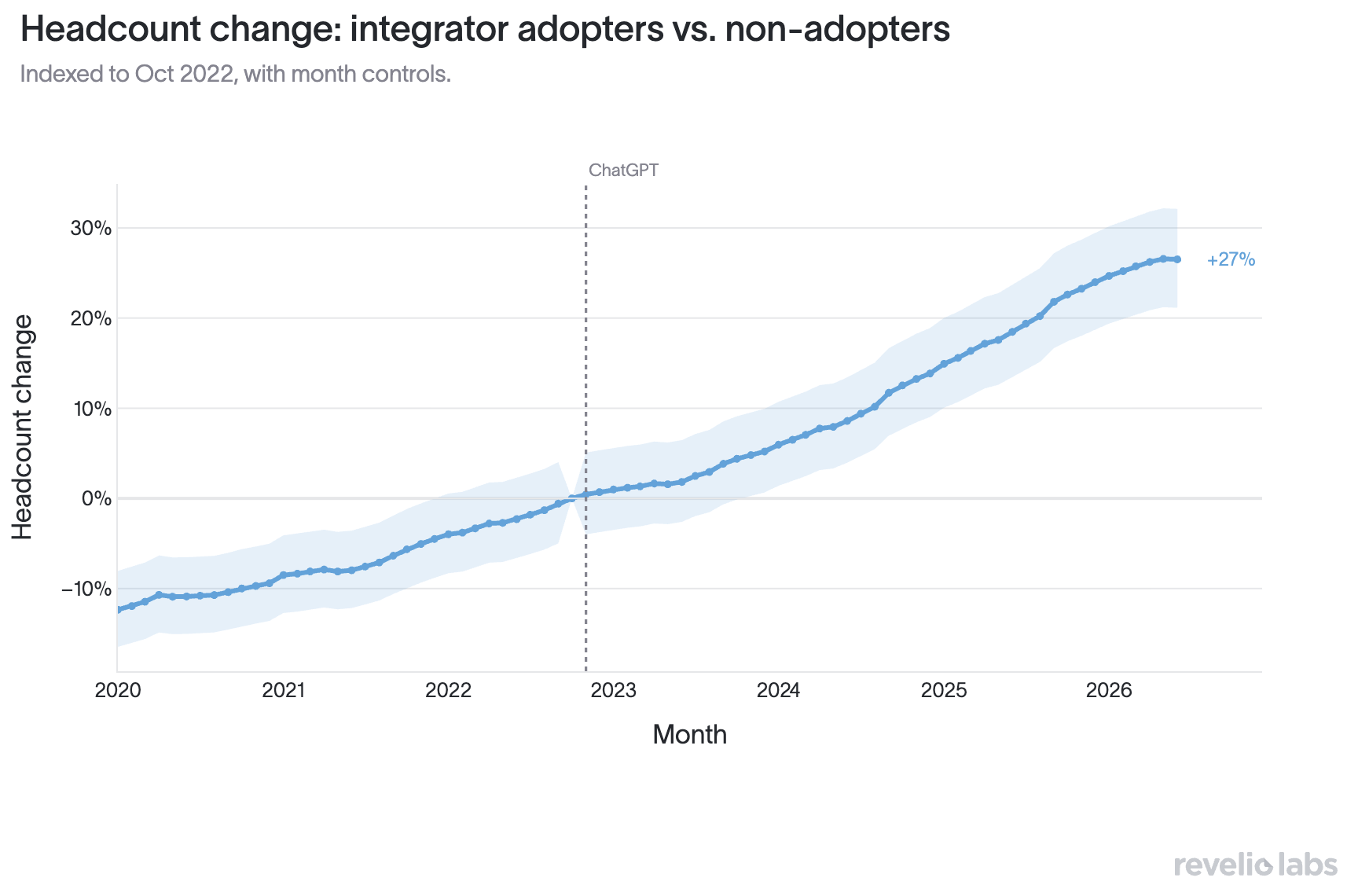
The findings between AI exposure and adoption are are not contradictory. AI can reduce demand for particular kinds of work while helping the firms that use it grow overall.
Work Is Changing Faster Than Jobs
Employment counts and job titles capture only part of AI’s impact.
Jobs are bundles of activities. Employers can change those activities substantially without changing the occupation—or eliminating the job altogether. A worker may remain in the same role while spending less time drafting, summarizing, entering data, or performing routine analysis, and more time reviewing AI-generated outputs, exercising judgment, or managing AI-assisted workflows.
Our activity dissimilarity index (DI) measures how much the mix of work performed across the economy, weighted by the number of workers doing it, differs from the mix observed a year earlier. After remaining relatively stable, it has risen sharply over the past three months.
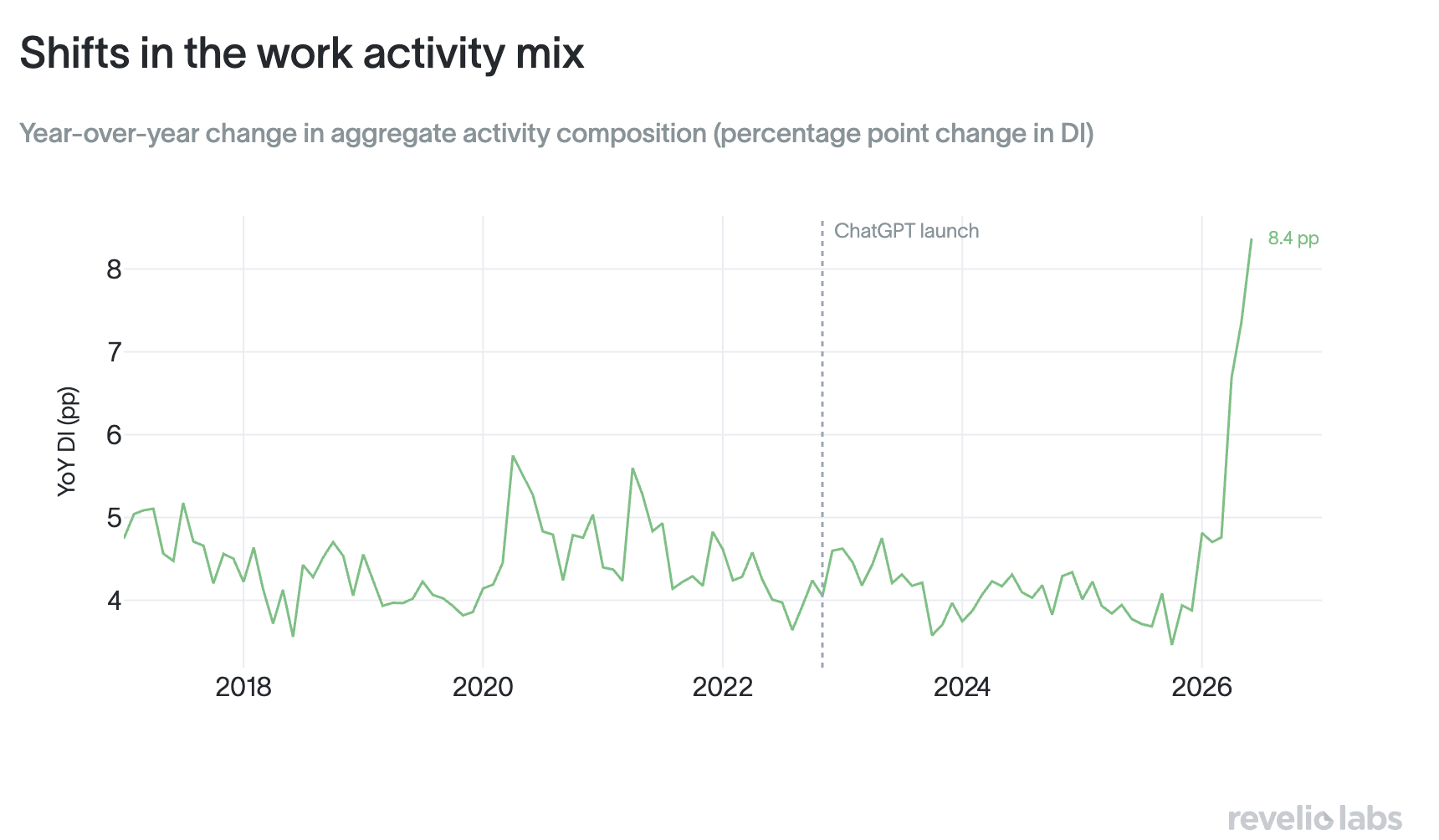
In June 2026 the year-over-year change in the activity mix dissimilarity index increased to 8.4 percentage points, meaning that 8.4% of the economy’s headcount-weighted activity mix would need to be reallocated across activities to return to its June 2025 composition.
Interestingly, most of this change is happening within occupations, rather than because the economy is shifting from one set of occupations to another. Roles and job titles may remain the same even as the activities performed by workers in those jobs change.
This helps explain why research focused on occupation-level employment has generally found relatively limited change. If the job remains in place while the work inside it changes, an analysis based primarily on occupation distributions misses much of the transformation.
There is also evidence that employers are shifting away from the work AI can most readily perform. Since November 2022, the share of job postings with high AI exposure has declined by approximately 5 percentage points.
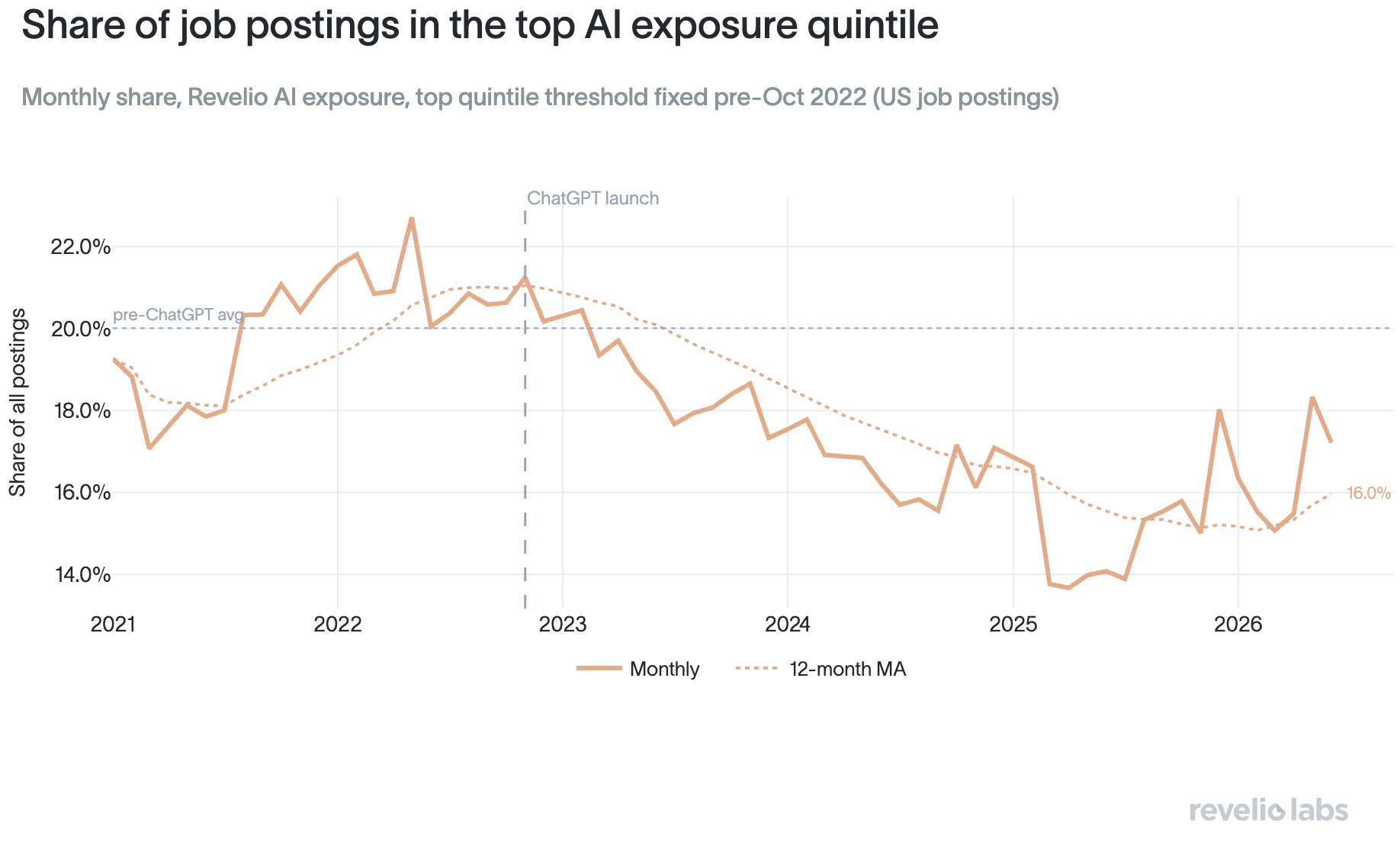
The decline does not prove that AI has already replaced this work. Employers may also be reacting to expectations about what AI will soon be able to do or to other changes in labor demand. But the pattern is consistent with some automation, or reduced reliance on highly exposed activities, already taking place.
For now, the clearest description may be: AI is automating work, but not jobs.
How AI May Be Making Hiring Less Effective
AI is not only changing what employers hire people to do. It is also changing how candidates compete for jobs.
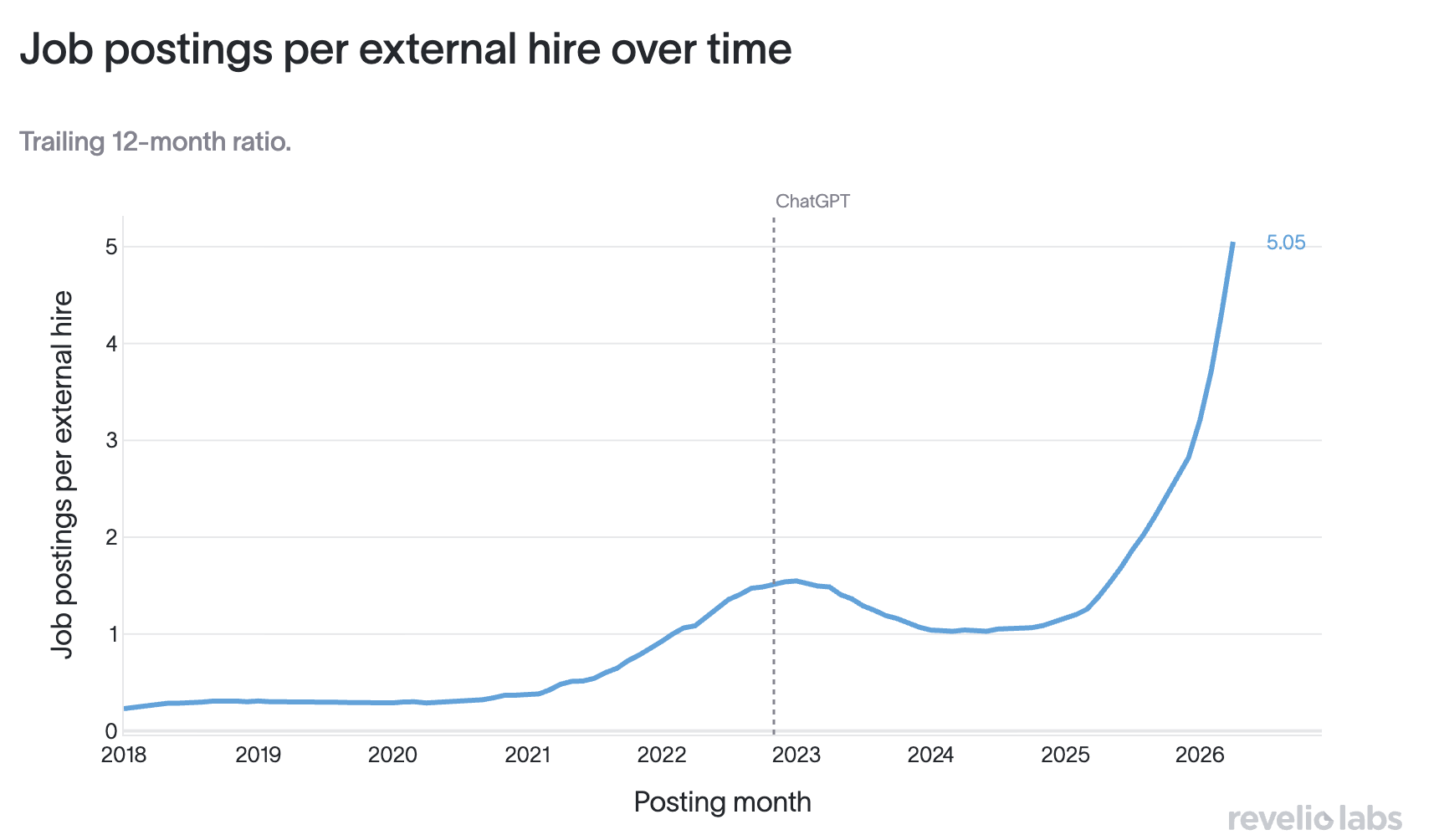
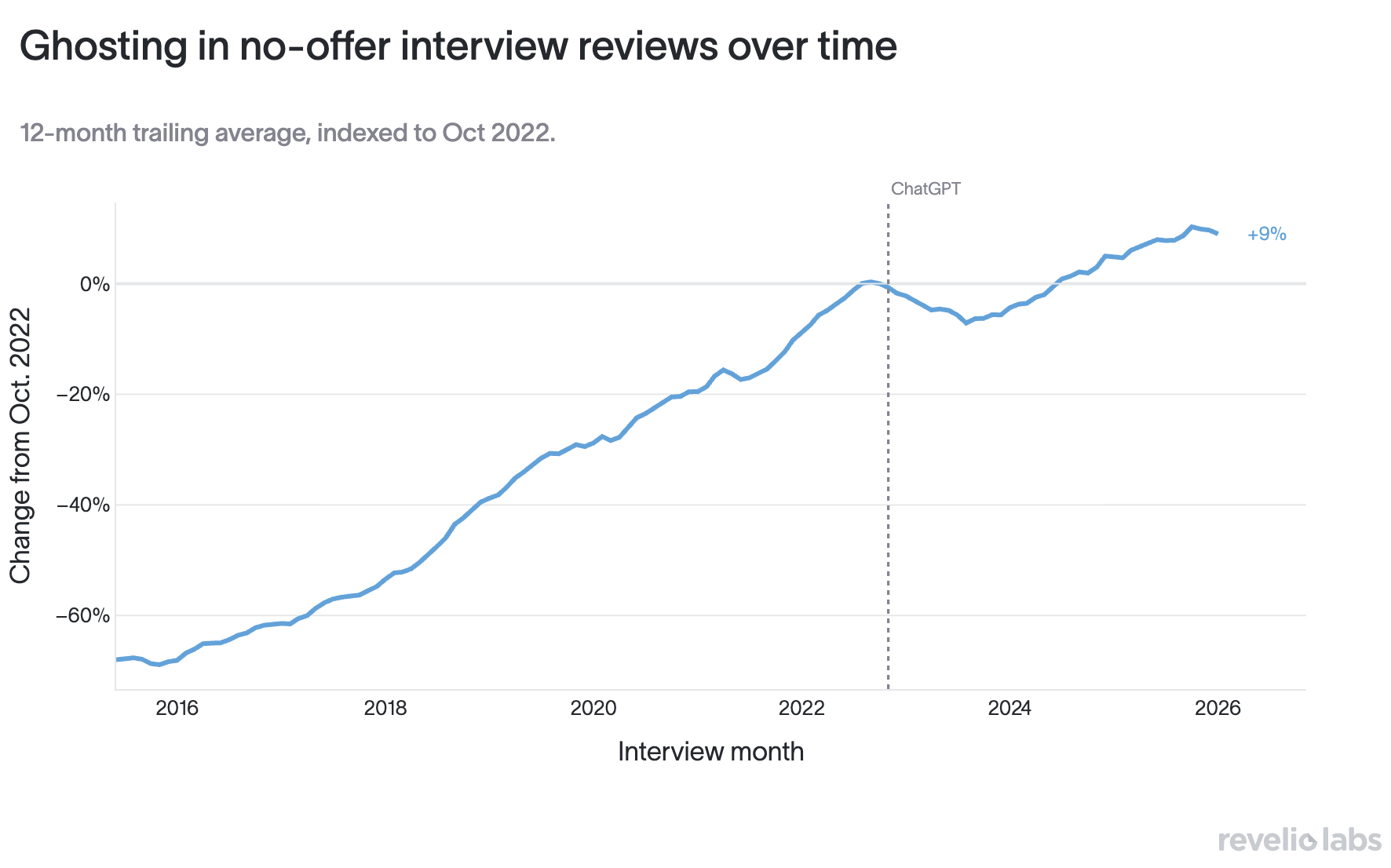
The hiring process is producing fewer successful matches. The number of job postings required to one hire has been increasing for six years, while candidates increasingly report recruiter silence and poor communication. These trends predate ChatGPT, so they cannot be attributed entirely to generative AI. But AI may be making an existing problem worse by enabling candidates to submit more polished applications, weakening the signals employers use to identify strong candidates.
The job postings to hire ratio, i.e. the number of postings a company needs to post to hire one employee has been increasing for 6 years, and has started to dramatically increase since late 2022. While it used to be around or below one (i.e.companies would hire one or more people for every post), now the ratio has grown to over 5. To hire a single employee, an employer needs to post a job 5 times in expectation. Employers are advertising jobs, but each posting is producing fewer successful matches.
Candidates are also increasingly reporting poor communication from employers. Mentions of recruiter ghosting in no-offer interview reviews have risen by about 9% since October 2022.
Generative AI may be intensifying an existing matching problem.
Candidates can now tailor resumes, draft cover letters, prepare responses, and submit applications at very little additional cost. This makes it easier for strong candidates to present themselves well—but it also makes it easier for almost anyone to produce a plausible-looking application. The result is an erosion in the signaling value of strong resumes.
Employers may receive more applications without receiving better signals about who will perform well. Strong candidates become harder to identify, employers communicate with a smaller share of applicants, and candidates compensate by submitting even more applications.
The evidence does not establish that generative AI caused the decline in hires per posting; that trend began well before ChatGPT. Nor do we directly observe whether AI-generated applications are driving the increase in recruiter silence. But the results suggest that AI may be adding noise to a hiring process that was already struggling to produce effective matches.
Tracking AI’s Labor Market Impact in Real Time
The effects of AI will not arrive as a single labor-market shock. They will emerge through changes in hiring, firm growth, career entry, job activities, wages, and the mechanisms connecting workers to employers.
Those changes can move in different directions. Employment can weaken in exposed occupations while growing at adopting firms. Jobs can remain in place while the work inside them changes. Recruiting tools can become more powerful while the hiring process becomes less effective.
That is why we built the AI Labor Market Tracker. We will update it each month as new workforce and job-posting data become available, adding new indicators and revisiting existing results. Our goal is to provide a consistent view of how AI is changing the labor market, now.
Free to reproduce with attribution and a link to reveliolabs.com.
Cite this article
- Plain text
- Revelio Labs, "Introducing the Revelio AI Labor Market Tracker," July 28, 2026.
- HTML
- Revelio Labs, "<a href="https://www.reveliolabs.com/news/ai-and-work/introduction-the-revelio-ai-labor-market-tracker">Introducing the Revelio AI Labor Market Tracker</a>," July 28, 2026.
- Academic
- Simon, L. K., Zweig, B., & Wilkie-Rogers, C. (2026, July 28). Introducing the Revelio AI Labor Market Tracker. Revelio Labs.


