What You Study Matters More Than Where You Study
Choice of major is the strongest predictor of earnings after college


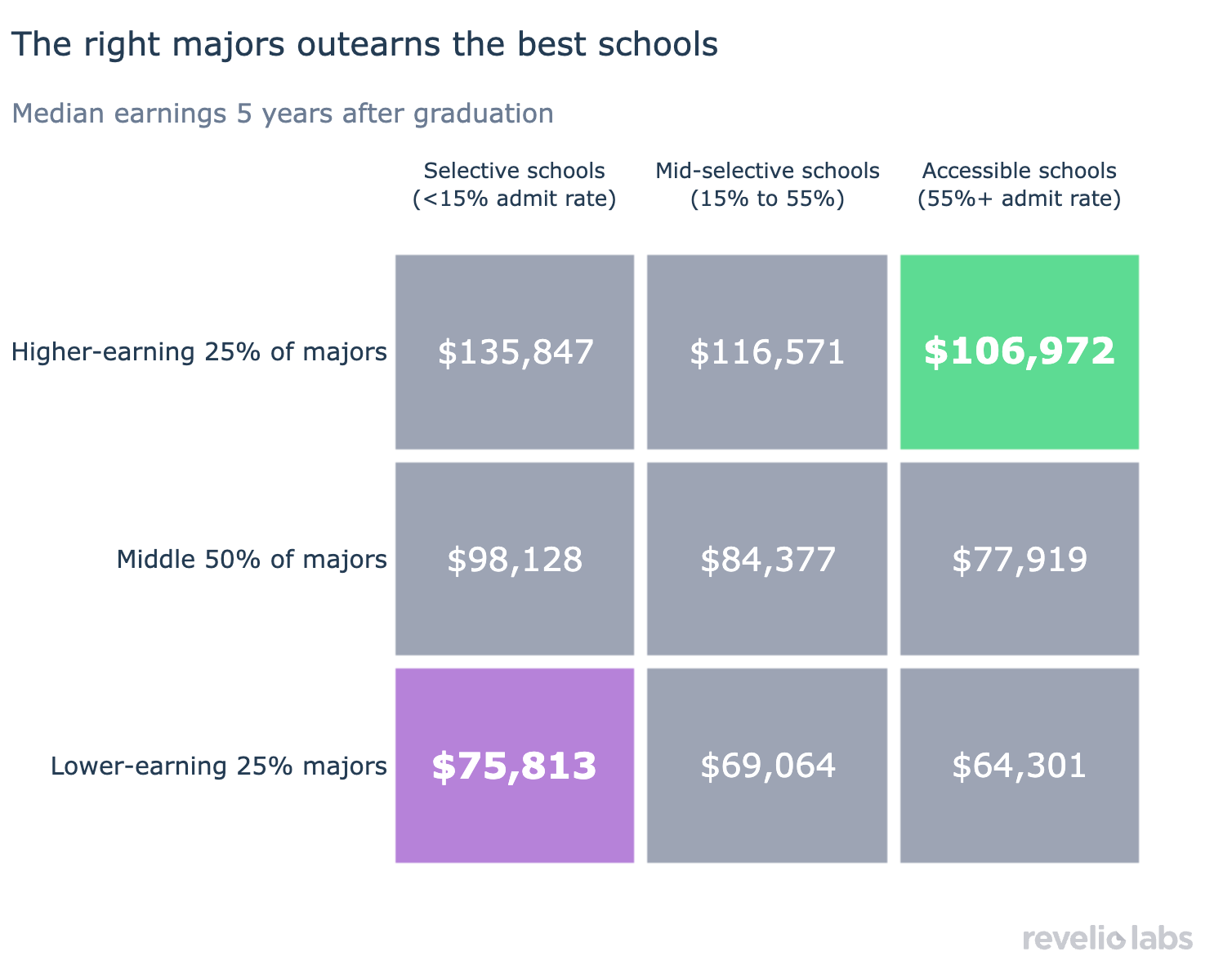
The "elite college wage premium" is overstated. On average, a recent graduate with a Psychology degree from a very selective college earns less than an Engineering graduate from a less selective school.
Choice of major explains a large and lasting share of graduates’ income. Even at the same school, those in the highest-paying majors earn roughly $30,000 to $50,000 more per year than those in the lowest-paying, a gap that persists well beyond early careers.
Computer science majors still lead their classmates in earnings, but their first-year premium has fallen to about $27k after sitting above $40k for over a decade. Where earlier cohorts concentrated in software engineering, recent graduates are landing in a wider range of well-paying roles.
For many, college is one of the largest financial investments they’ll make. Students often spend tens of thousands of dollars and four years for a degree, yet where they go and what they study may determine the entire payoff. Granted, income is not the only thing college is for. Friendships, experiences, intellectual growth and independence are immeasurable benefits of attending college.
Our data, on the other hand, can help understand the returns to college through graduates’ earnings. With university admission decisions landing this month, and starting salaries for recent graduates softening, we use our data to examine how school and major choices translate into labor market outcomes. This allows us to answer the simple question: do earnings depend more on what you study or where you go?
To do this, we link education and employment records for bachelor’s graduates over the past 20 years, from the class of 2005 to 2025 using our professional online profiles. We restrict our sample to schools offering at least four majors and excluded for-profit or defunct institutions. The result is a sample of over 1,600 colleges and universities.
To ensure that our results are not driven by selectivity in our data, we benchmark our coverage of graduates against official numbers from IPEDS and find it to be consistent across schools, ranging from about 55 to 95 percent of bachelor’s graduates in a given year, with an average around 70 percent. Tracking this coverage by school, year, and major helps ensure that the patterns we observe are not driven by changes in coverage across schools, years, or majors.
We first examine median earnings for graduates from the classes of 2015 through 2020, measured five years after graduation, by school selectivity and major. School selectivity is measured as admission rates from College Scorecard. The figure shows average earnings by school selectivity and major type.
Majors are split into three groups based on average earnings across schools: the lowest 25 percent, the middle 50 percent, and the highest 25 percent. Schools are grouped by undergraduate admission rates into accessible (55 percent and above), mid-selective (15 to 55 percent), and selective (below 15 percent). The chart summarizes a simple comparison: how do earnings change when you combine a stronger or weaker major with a more or less selective school?

Sign up for our newsletter
Our weekly data driven newsletter provides in-depth analysis of workforce trends and news, delivered straight to your inbox!
Graduates from more selective schools do earn more — but the difference in earnings between majors at the same school is larger than the difference between schools offering the same major. A high-earning major at a less selective school can outperform a low-earning major at a selective one.
A Virginia Tech graduate who studied math, computer science, or engineering earns more, on average, five years after graduation than a Harvard graduate who studied psychology, political science, biology, or history.
These patterns are not causal. Students self-select into majors, and we cannot fully separate that from their innate ability or the skills they build, or the networks they join. To understand how earnings differences across majors and schools play out over the course of a career, we ask how much major choice versus school selectivity explains those differences. We do this by holding one fixed and varying the other, comparing higher and lower-paying majors within the same school and more and less selective schools within the same major. In the first year after graduation, differences in major are associated with about $33k in earnings, compared to roughly $19k from school selectivity. That gap grows over time, with major consistently explaining a larger share of the variation.
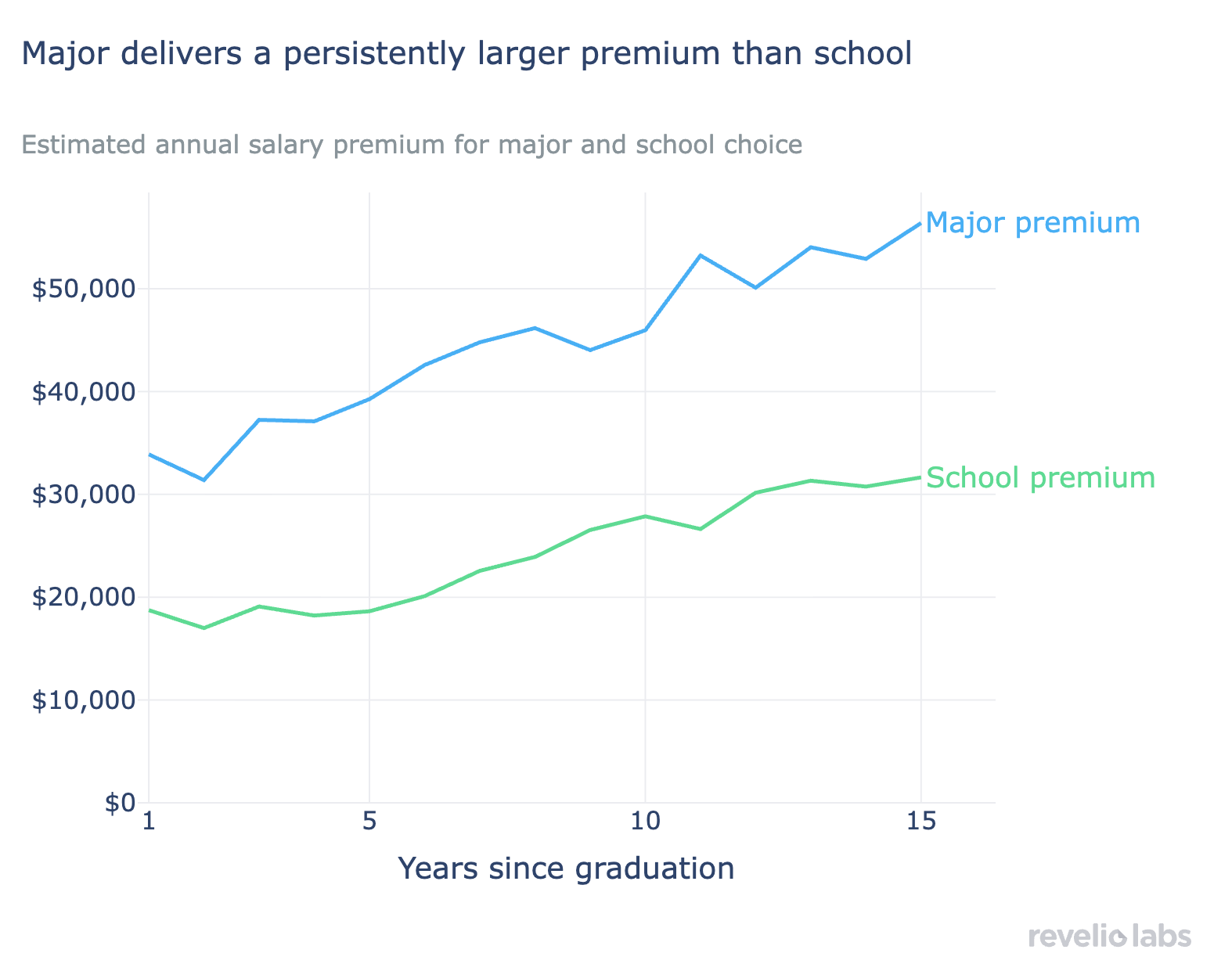
Holding major constant, even moving from one of the least selective schools in our sample to one of the most selective ones, yields a smaller increase in expected earnings five years after graduation than switching from a psychology major to a higher-paying field like economics or nursing at the same school.
If choice of major matters this much, the next question is natural: which majors are actually driving these differences? To determine which majors have been generating these large returns recently, we focus on the class of 2025 and break down how much the average graduate of each major earns over and above their school’s median. That is, assuming graduates are constrained by the school they attend, how much more or less would they expect to earn one year out of school by switching to a given major?
Mostly, the highest and lowest-earning majors look familiar: students in STEM majors tend to earn more than their school’s median. Still, it is somewhat surprising that Computer Science still ranks number one despite the downturn in the tech hiring market and the increased supply of Computer Science graduates over the past several years.
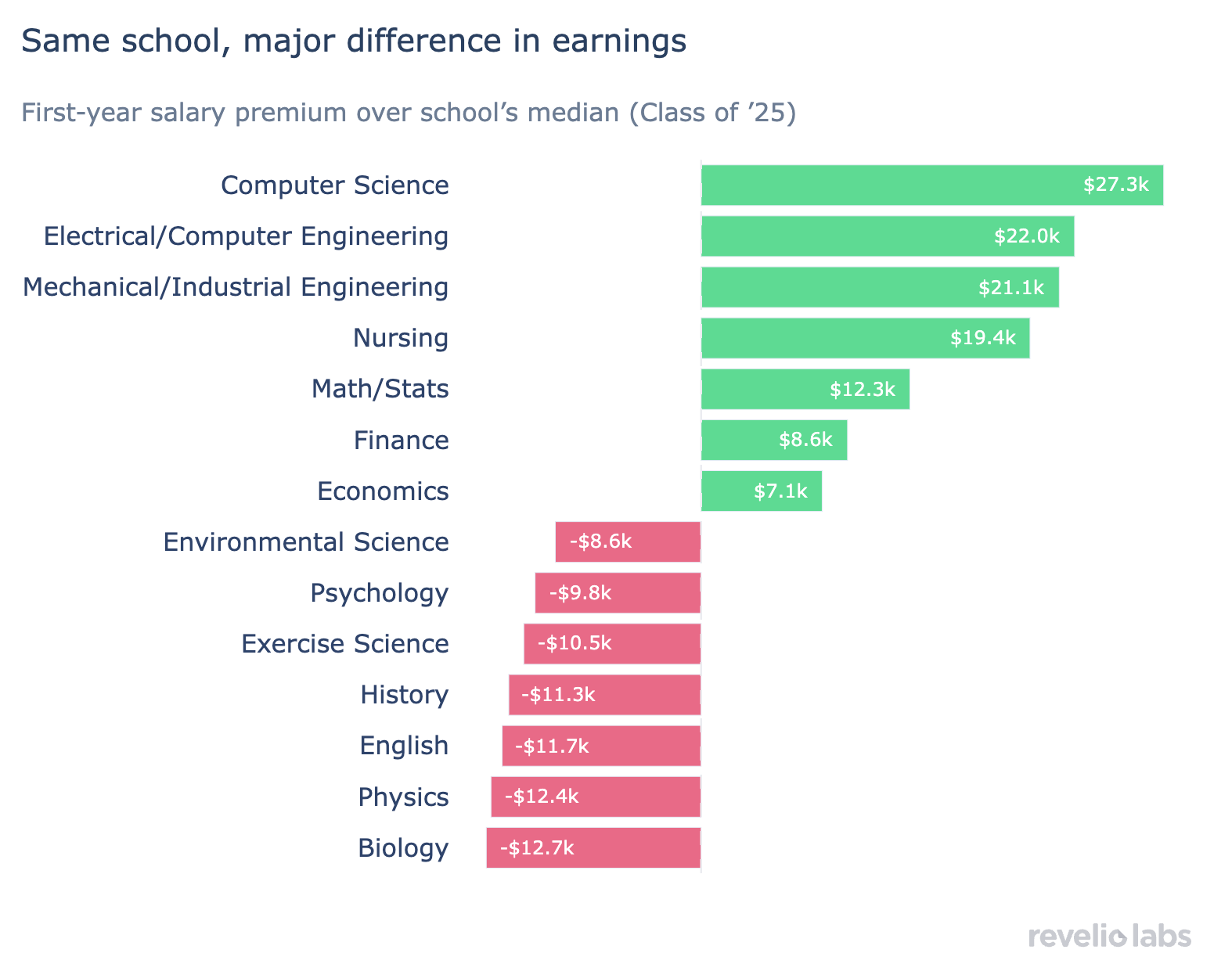
Computer Science’s dominance is partially a matter of where it is offered. It is available at roughly twice as many schools in our data as most engineering programs, so on many campuses it is one of the only high-paying technical options. Many schools that offer electrical or mechanical engineering, by contrast, also offer Computer Science, so earnings in these majors are compared with several other lucrative options on the same campus.
Even so, Computer Science grads are holding up better than recent headlines suggest. As the chart shows, their first-year earnings premium has come down from its peak of about $45,000 for the class of 2019 to roughly $27,000 today, but it remains the highest of any major.
The adjustment is happening in where they land. Comparing the first jobs of Computer Science majors who graduated in 2019 to those from 2025, software engineering remains the most common role, but its share has fallen from nearly a third to about a quarter of graduates. Application developer roles have also declined, from 4% to 2%.
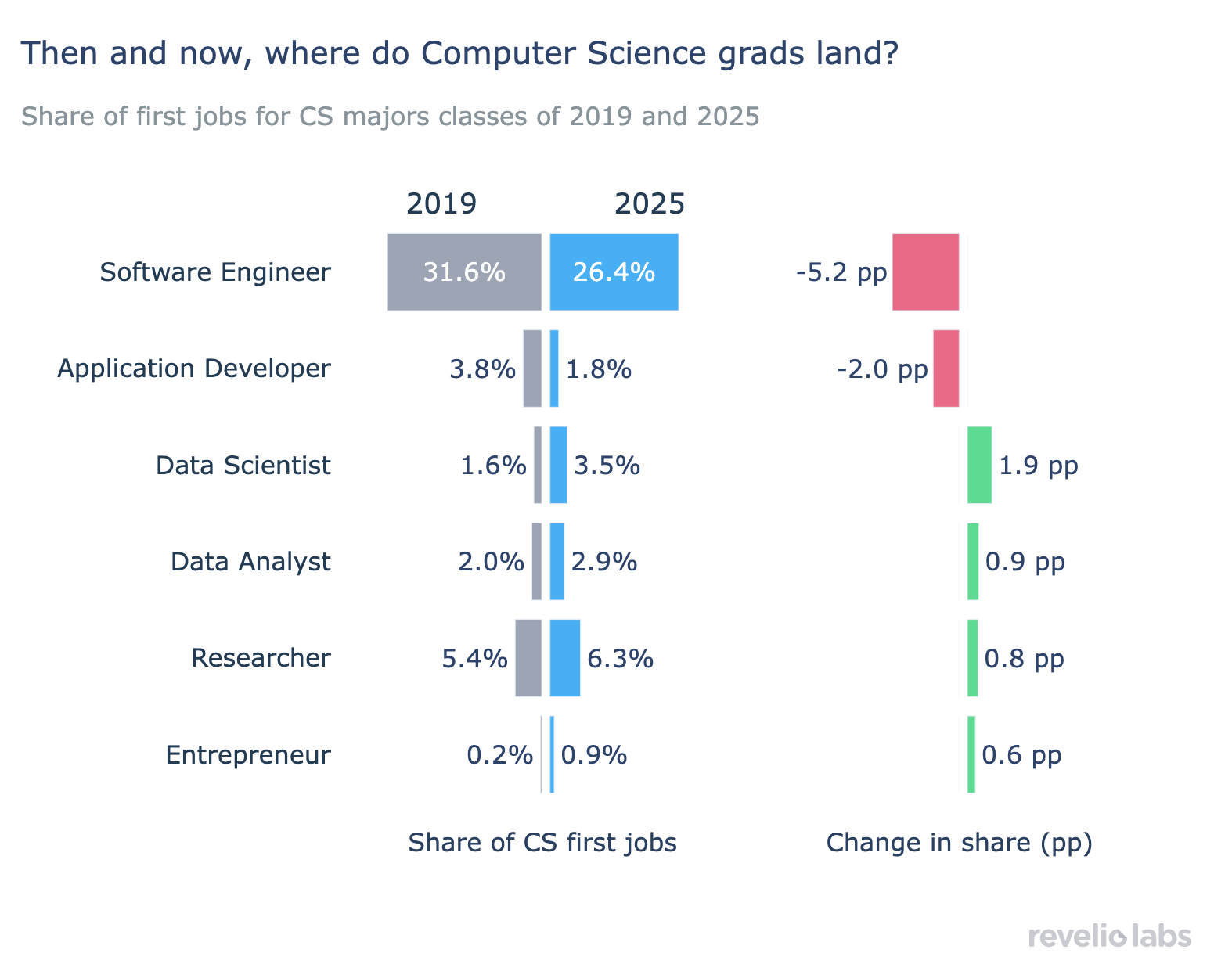
At the same time, more Computer Science grads are moving into adjacent roles. A growing share now work as data scientists and analysts, and the “researcher” category has expanded to include both academic paths and roles at tech and finance firms. There has also been an increase in graduates starting their own companies, even if it remains a small share overall. Rather than collapsing, outcomes are broadening as graduates shift into a wider set of well-paying positions.
The premium Computer Science majors earn may continue to erode, and the class of 2026 will provide a clearer read. Earnings are down from their peak, and those who enrolled expecting six-figure software roles have reason to feel burned. Even so, graduates have shifted into a broader set of well-compensated roles.
For all the attention paid to admissions and school selectivity, we find that earnings vary more by what students study than by where they go. In the data, that choice shows up more clearly, and more persistently, than the name of the institution. For most students, the more important decision is not where they get in, but what they choose to study once they arrive.