


"So now, less than five years later, you can go up on a steep hill in Las Vegas and look West, and with the right kind of eyes you can almost see the high-water mark, that place where the wave finally broke and rolled back." — Hunter S. Thompson, Fear and Loathing in Las Vegas
For more than a decade, studying computer science has been the safest bet for a high-paying job. Computer science graduates have been feeding the fastest-growing, most exciting sector in the American economy, and Silicon Valley's hunger for engineering talent has seemed insatiable. CS enrollments doubled, then tripled at schools across the country, as tech firms competed for new grads with soaring starting salaries, large signing bonuses, and offices kitted out with ball pits, yoga studios, and gaming rooms.
But every wave has a crest, and the computer science major's is now visible in our data: the share of US students majoring in computer science has started to decline.
We first look at how enrollments have changed since 2018, with current students ranging from this spring's graduating seniors (class of 2026) through this year's freshmen (class of 2029). Relative to 2018, the headline changes are the fall of computer science and IT and the broad-based rise of engineering. Computer science peaks at nearly 11% of student profiles in the class of 2026 before falling back. Mechanical and industrial engineering, flat at around 3% of profiles for years, reach nearly 7% in the class of 2029. Finance, which rose alongside CS for much of the past decade, has accelerated and now surpasses it.
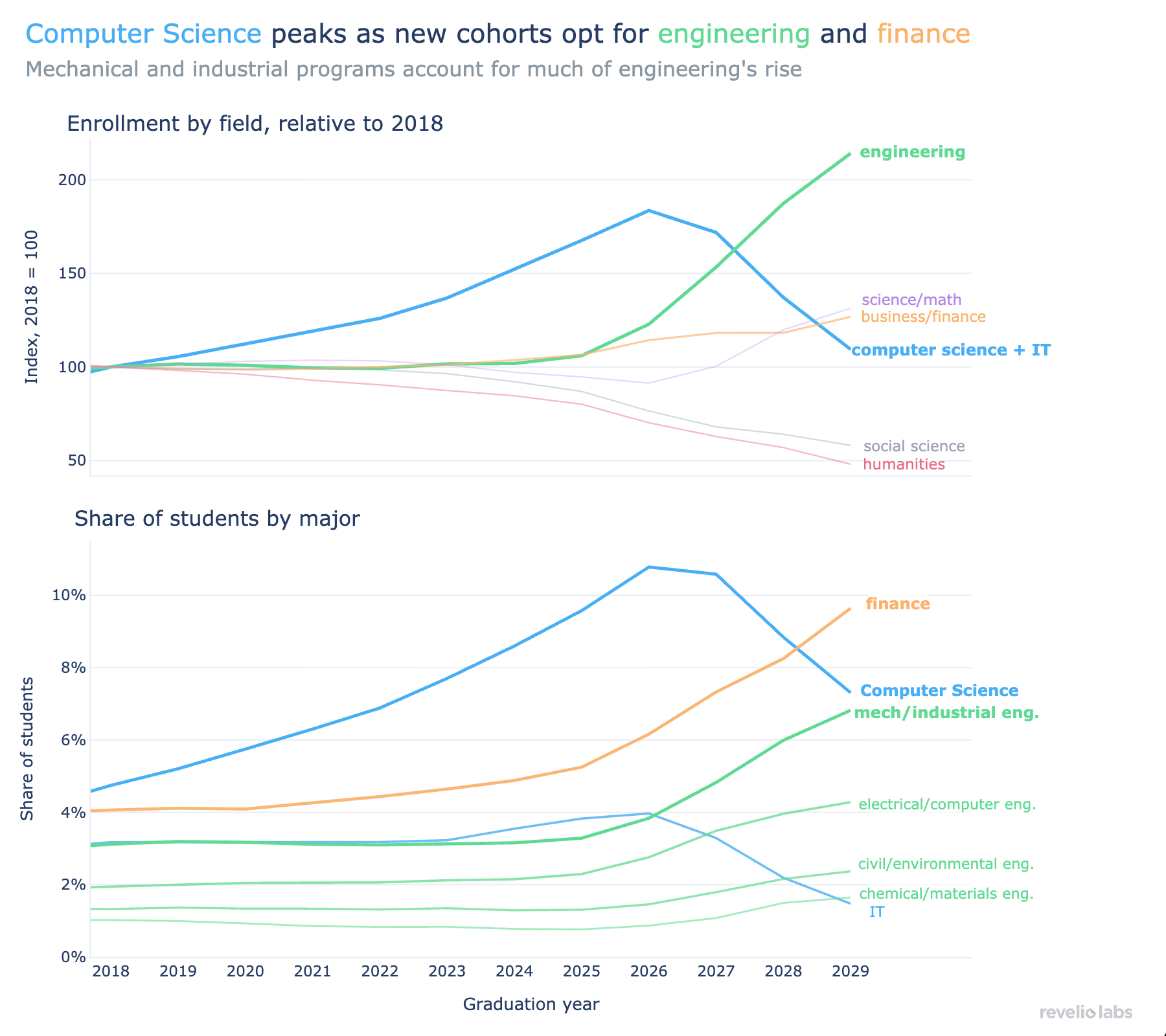
There are several reasons for the turning tide. Rising interest rates put pressure on tech hiring, the arrival of AI raised real questions about entry-level coding jobs, and the major's own growth may have outrun what the job market could absorb.
Students do not all show up in our data at the same time: looking back at historical data reveals that someone at a top school studying finance or computer science is likely to build a professional online profile very early in their college career, while a history major at a less prestigious school creates their profile later. To make sure these trends were not driven by differences in profile timing, we used that pattern, varying by major and school tier, to correct for the bias in the current student population.
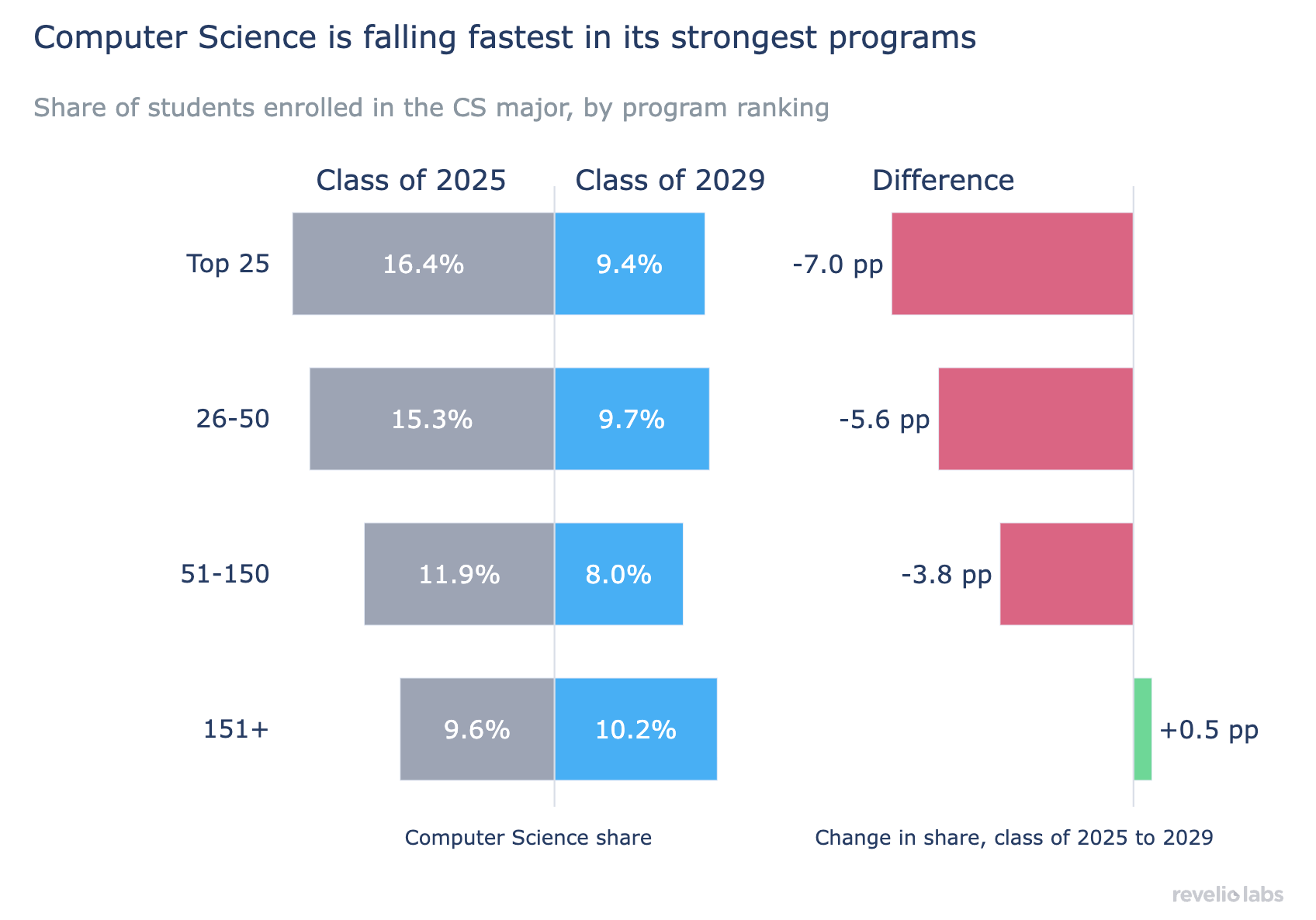
Having a good computer science program does not spare a school from decline. In fact, the best departments are seeing the fastest drops. To isolate program quality from overall school prestige, we ranked computer science departments by how successfully their graduates placed into prestigious, high-paying tech roles between 2016 and 2025. The pattern is striking: the share of students majoring in computer science is falling fastest at the top 25 programs, with the decline steadily shrinking as you move down the rankings. Only programs outside the top 150 have held roughly flat.
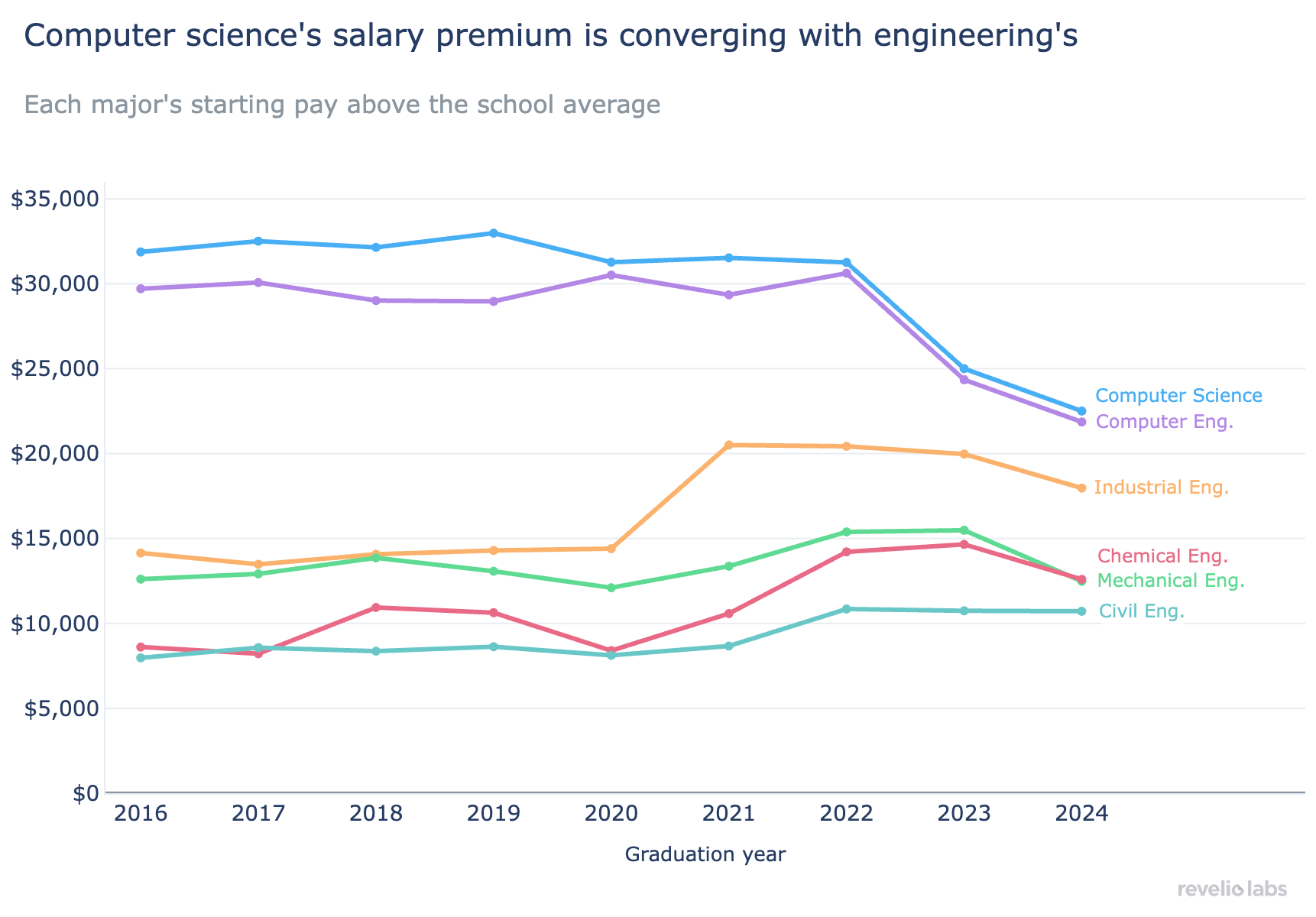
Why are students turning away from computer science? To understand the reason, we look at the salary premium that comes with a computer science degree. We measure the premium as the median graduate's earnings over their school's average, which controls for school-level pay differences and broader labor market shifts. Computer science outcomes, while still strong, have shifted from extraordinary to merely high-earning.
For most of the last decade, a new computer science graduate started earning tens of thousands of dollars more than a classmate from the same school who studied something else. A computer science graduate in 2016 earned roughly $19,000 more than a mechanical engineering graduate from the same school. By 2024 the gap was less than $10,000. That gap, the computer science premium, is what made the major such an easy bet, and it has shrunk to look much more comparable to other STEM majors. By 2024 the gap was less than $10,000. The timing points to the job market these recent graduates walked into rather than anything about the major itself. The end of zero interest rates in 2022 made tech companies cut back hiring, the layoffs that followed put experienced engineers on the market willing to take lower pay, and the launch of ChatGPT in November 2022 created uncertainty about how many entry-level coding jobs would even exist in the near future.
If earnings are driving part of this shift, we should expect students to gravitate toward majors with rising salary premiums and away from those slipping down the ranking. That is broadly what appears in the data. Majors whose graduates saw rising salary premiums between 2020 and 2024 expanded their share of students, while those with falling premiums tended to shrink. The relationship is particularly tight for STEM majors, where engineering shows both rising pay and rising share. Non-STEM fields follow the same direction but more weakly. Finance and economics, both with rising premiums, saw their shares grow alongside; marketing, where the premium fell sharply, saw its share decline as well.
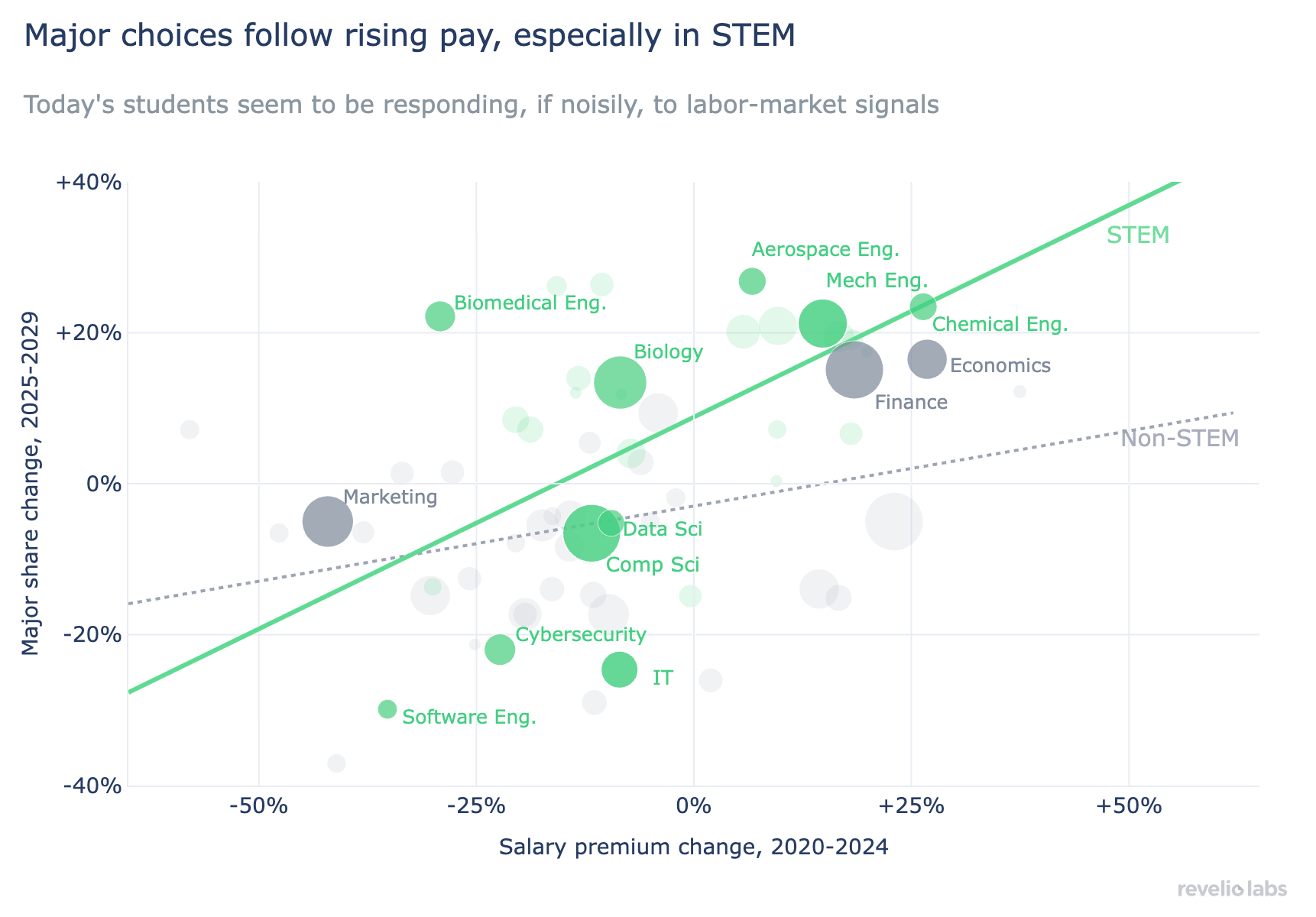
Declining salary premiums and shrinking student shares in STEM are mostly captured by software-related majors. computer science, software engineering, IT, cybersecurity, and data science all fall into this category. In both dimensions, software engineering and IT are declining more rapidly in relative terms, but computer science, as the largest field in the group, accounts for most of the shift even with its more modest decline.
High and rising pay built the computer science boom, and a cooling salary premium may now be ending it. The students who poured into the major over the last decade were responding to a labor market that seemed to be begging them to learn to code. Now that signal has weakened, and students have responded quickly. The class of 2026 appears to mark the peak, and the cohorts behind them are already moving in a different direction.
The wave has crested, but it has not crashed. Computer science remains one of the largest and highest-paying majors in the country. What the data suggests is less a crash than a normalization after years of extraordinary growth. Still, the shift is significant. With AI shrinking the runway for entry-level coders, ambitious students are betting with their feet, and with their major declaration forms, on a different future. They are gravitating toward fields tied to engineering, manufacturing, infrastructure, and finance and imagining a decade where growth comes from building physical things, robots, jets, factories, and the bridges and grids that connect them, and from the finance that funds it. And what students study is not only a prediction of where the future is headed. It is part of how it gets built.
Free to reproduce with attribution and a link to reveliolabs.com.
Cite this article
- Plain text
- Revelio Labs, "Computer Science Has Hit Its High Water Mark," May 19, 2026.
- HTML
- Revelio Labs, "<a href="https://www.reveliolabs.com/news/social/computer-science-has-hit-its-high-water-mark">Computer Science Has Hit Its High Water Mark</a>," May 19, 2026.
- Academic
- Wilkie-Rogers, C. (2026, May 19). Computer Science Has Hit Its High Water Mark. Revelio Labs.


