


The post-pandemic hiring surge of 2021 and 2022 led to a notable increase in demand for all occupations. Companies increased hiring across the board, from software engineers and data scientists to frontline and staff-level workers. Since the labor market began cooling between 2023 and 2024, overall job postings have been consistently falling. However, it is never the case that demand for every role falls during economic downturns. Some occupations still see steady demand throughout slowdowns—not because they are trendy, but because companies simply would not be able to function without them. These are the roles that keep businesses and essential services running. Using Revelio Labs' unified job postings data, we identify which occupations have been the most resilient in the most recent labor market slowdown and how they differ from other roles that have seen wilder swings over the past two years.
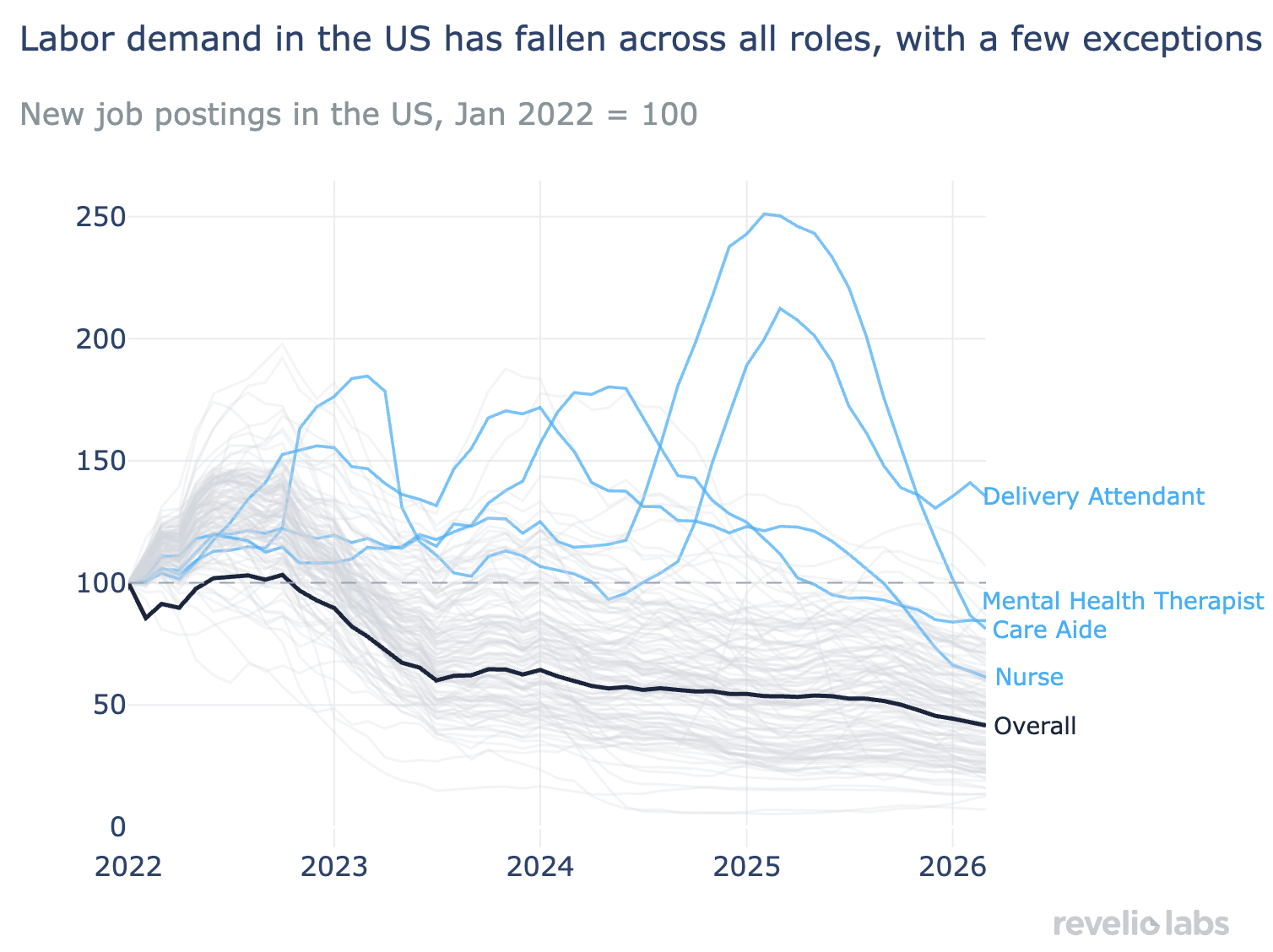
Since January 2022, job postings in the US have declined by nearly 60% across most occupations. Yet, some roles have seen notable growth in demand relative to their 2022 levels. One example is delivery workers, who saw a surge in labor demand through 2024, largely driven by the continued expansion of e-commerce and last-mile logistics as consumer spending shifted back towards goods following the post-pandemic services boom. Similarly, demand for care aides, therapists, nurses, and other healthcare-related roles climbed steadily through 2023 and 2024. This sustained demand has made healthcare one of the few sectors where employers continued to add jobs even as the rest of the economy has softened.
To identify which roles have held up through the current labor market slowdown, we classify each occupation across two dimensions: first, how volatile demand has been since 2022 (measured by the coefficient of variation) and second, where demand stands today relative to January 2022. Together, these two dimensions reveal not just whether a role is shrinking, but whether companies treat it as essential or discretionary. We plot these two dimensions simultaneously in the plot below, separated into four distinct groups:
Resilient roles (stable & growing): demand for these roles remained stable or grew relative to 2022 with minimal volatility. These are the roles companies keep hiring for regardless of how the economy is doing and are located at the bottom-right quadrant of the plot below.
Declining roles (stable & shrinking): these roles have seen a steady, consistent decline in demand, but without dramatic swings. Companies are quietly pulling back rather than cutting sharply.
Risky roles (volatile & shrinking): these roles have experienced both volatile demand and an overall decline since 2022. Tech roles such as software engineers and project managers fall in this quadrant. Demand for these roles surged during the boom years and have contracted sharply as conditions tightened.
Rising roles (volatile & growing): these roles have seen strong demand growth, but with significant volatility along the way. Delivery drivers and AI engineers are the clearest examples. These are countercyclical in the sense that demand has held up or even grown, but not in a smooth or predictable way.
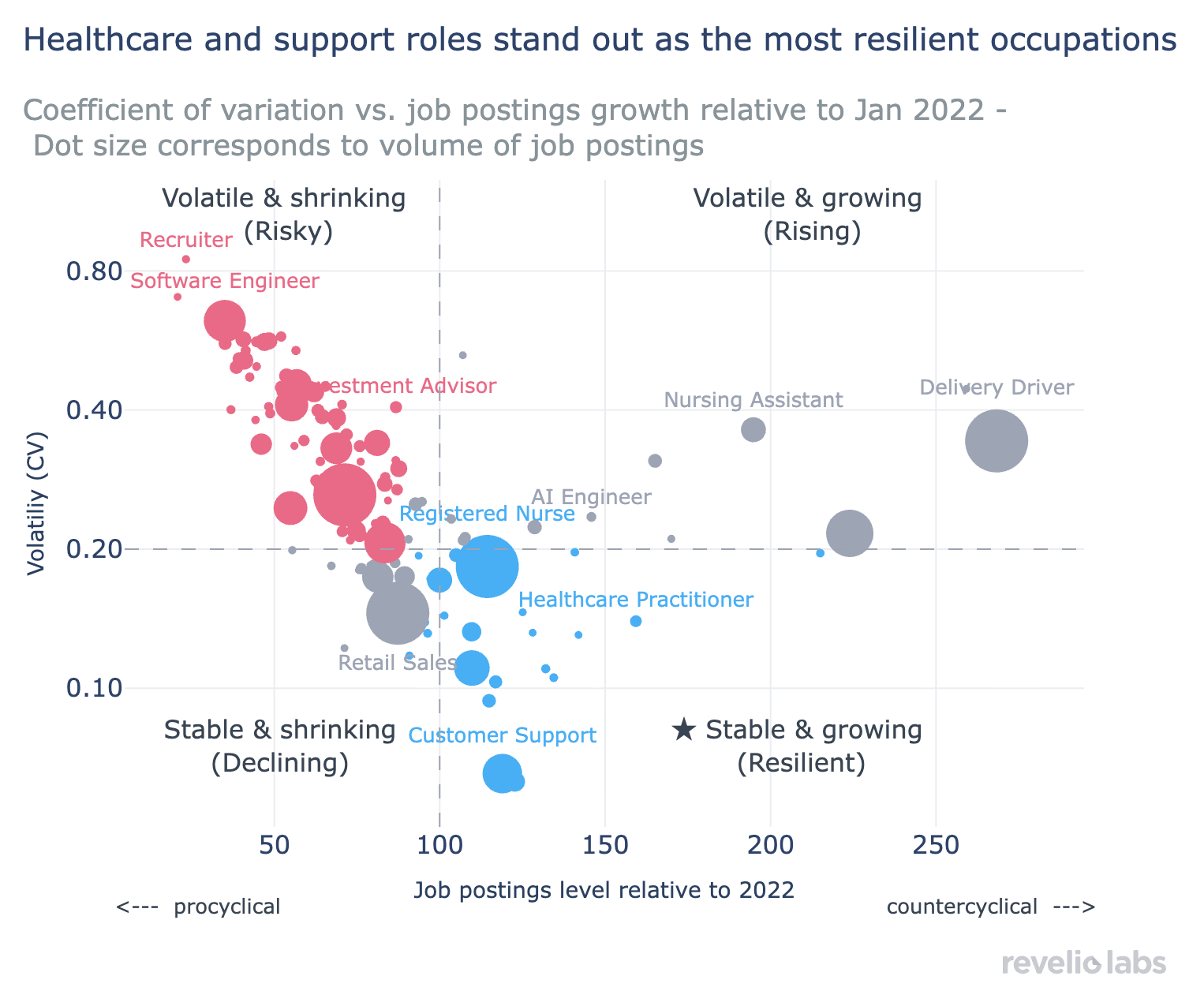
Roles in the bottom-right quadrant (low volatility, demand at or above baseline) are the resilient ones where companies have kept hiring consistently regardless of macro conditions.
The vast majority of roles cluster in the top-left (volatile and shrinking). Yet, registered nurses, healthcare practitioners, and customer support roles sit firmly in the resilient quadrant, combining steady demand with minimal volatility. These are not the roles that dominated hiring headlines during the boom, but they are the ones that kept showing up anyway.
Rising roles (volatile and growing) have seen strong demand growth, but with significant swings. These roles are countercyclical in the current downturn, but their resilience is better understood as a product of this particular moment rather than a structural feature of the labor market. For example, delivery workers have benefited from the continued expansion of e-commerce, a trend that may not repeat in the same way in future downturns. AI engineer demand reflects the AI investment boom that has run parallel to the broader labor market slowdown. This major technology shock is unlikely to coincide with every recession. In a different downturn, under different technological and consumer conditions, these roles might look very different. Rising roles are not recession-proof; rather, they are recession-lucky.
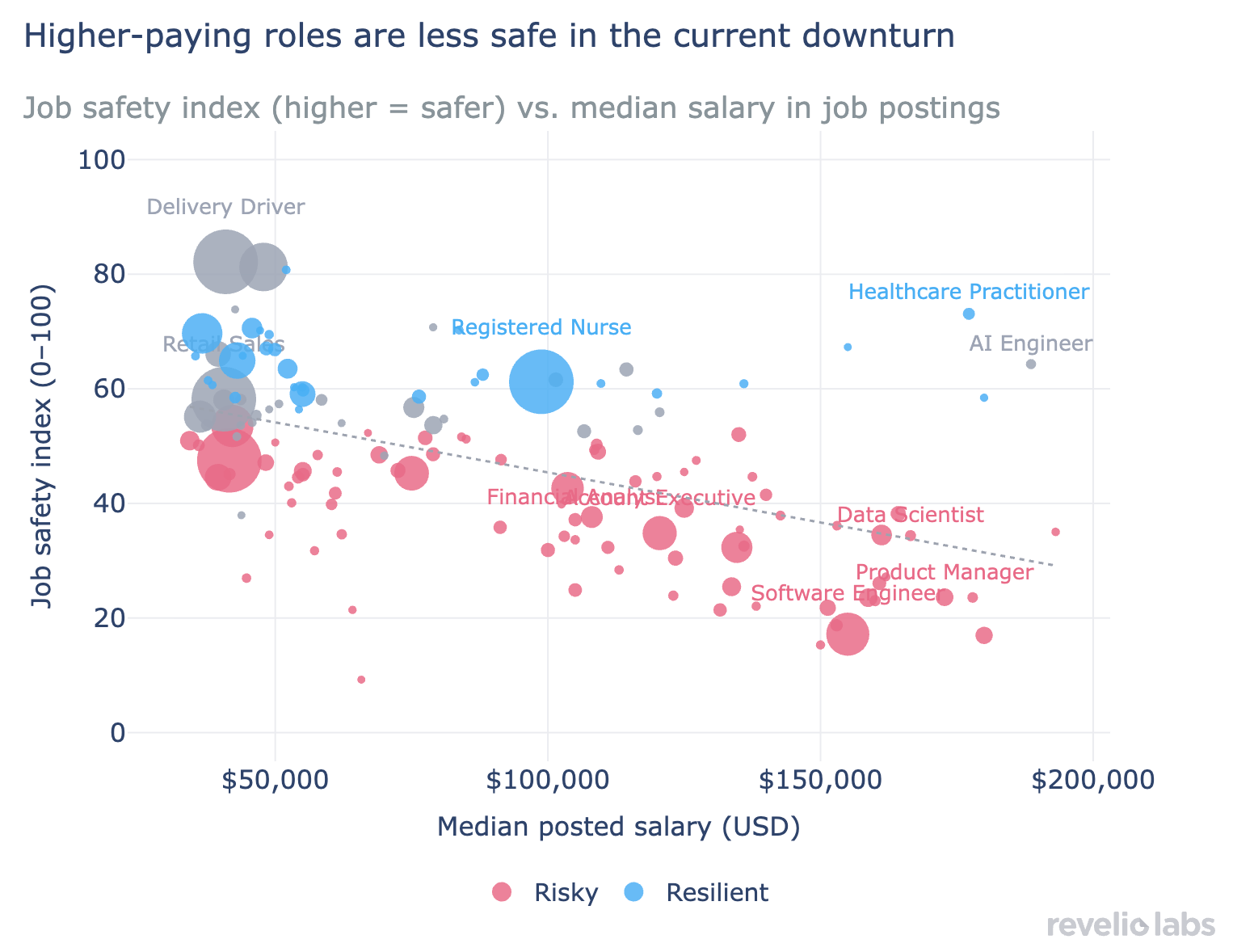
To capture both dimensions of job security simultaneously: demand growth and demand volatility, we construct a job safety index that combines both elements into a single score. The index rewards roles that have maintained or grown their posting volume since 2022 while penalizing those that have seen erratic swings in hiring. The index is computed by normalizing each role's coefficient of variation and demand level relative to January 2022 to a common 0–1 scale using min-max normalization, then computing a weighted average that rewards high demand retention and penalizes high volatility. A score closer to 100 means a role has been both stable and in demand, while a score closer to 0 means it has been volatile and shrinking.
We then plot the job safety index against the median salary posted in job openings and observe a clear negative relationship: The higher the pay, the less safe the role. Software engineers and product managers, which are among the highest-paying occupations, sit at the bottom of the safety index, combining steep declines in demand with some of the most volatile hiring patterns of any occupation.
The negative relationship between pay and job safety is not entirely surprising from an economics perspective. High-paying specialist roles tend to be concentrated in industries and functions where hiring is highly discretionary. Thus, companies expand aggressively when growth is strong and pull back sharply when conditions tighten. These roles tend to have longer hiring cycles, higher replacement costs, and stronger ties to capital expenditure budgets, all of which make them more sensitive to economic uncertainty. Frontline roles, by contrast, are tied to operational necessity rather than growth ambition. Demand for a registered nurse or a customer support agent does not fluctuate with quarterly earnings guidance–rather, it reflects a relatively stable need that exists regardless of the macro environment. In labor economics terms, demand for essential frontline roles is more inelastic: Companies cannot easily substitute away from them or defer hiring without immediate operational consequences. High-paying specialist roles, by contrast, face much more elastic demand, as firms can delay a software engineer hire or consolidate a product management function when budgets tighten, in a way they simply cannot with a nurse or a care aide.
Not every role follows this pattern. Registered nurses score well above 60 on the safety index despite a median salary around $100,000, sitting well above the trend line. Healthcare practitioners similarly defy expectations, combining relatively high compensation with exceptional stability. These roles demonstrate that the pay-safety tradeoff is not absolute.
Delivery drivers are the most notable outlier in the other direction. It has a high safety score despite low pay, driven by the e-commerce boom discussed earlier. As with rising roles more broadly, this reflects the specific conditions of the current downturn rather than a structural feature of the role.
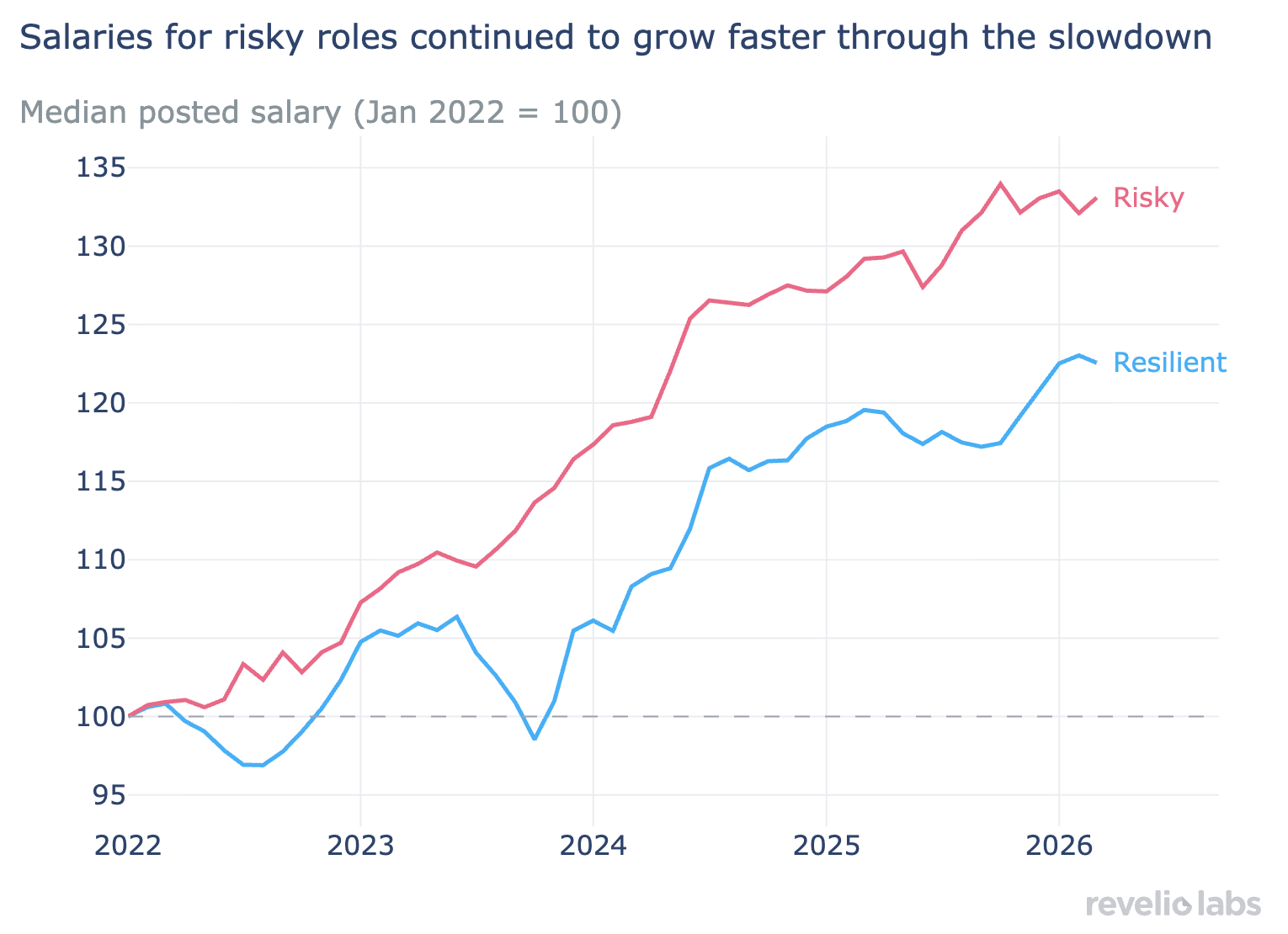
The pay premium for risky roles has widened consistently since 2022. Posted salaries for risky roles grew by roughly 35% between January 2022 and early 2026, consistently outpacing resilient roles throughout the entire period. Resilient roles saw more modest salary growth of around 23% over the same period, and the gap opened up particularly sharply from mid-2023 onward as risky role salaries accelerated while resilient role wages grew more steadily.
This divergence reflects the same supply and demand dynamics discussed above. Companies that continued hiring for high-paying specialist roles amid the broader slowdown competed fiercely for a shrinking pool of candidates willing to take on positions with uncertain tenure. Resilient roles, by contrast, face more stable but less competitive hiring conditions. The result is a labor market where the highest pay comes with the highest risk, and the most stable jobs offer the most modest wage growth.
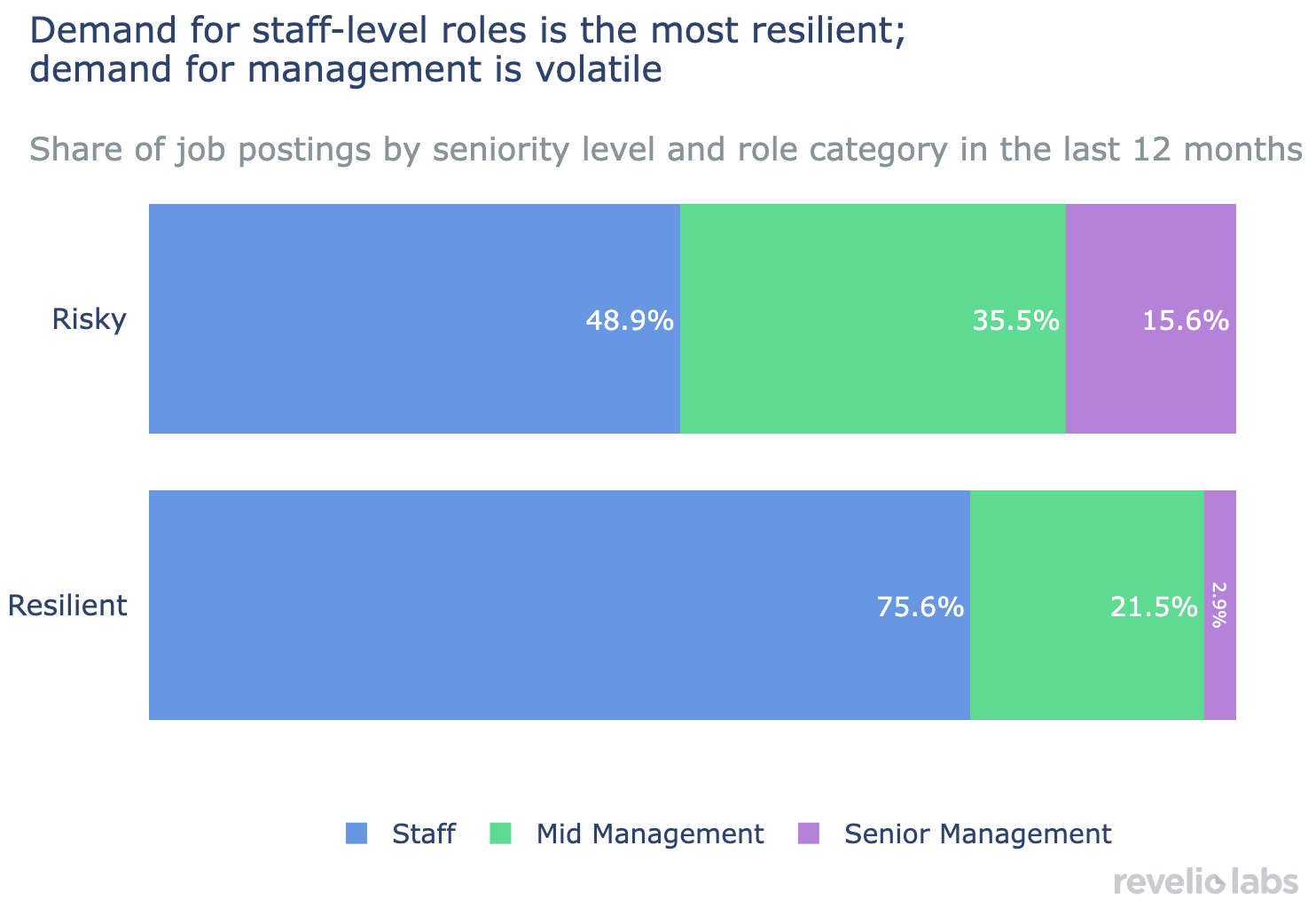
The seniority breakdown reinforces the nature of resilient jobs. Demand for resilient roles is overwhelmingly dominated by staff-level hiring. Staff-level roles are low-seniority, individual contributor roles that do not carry managerial or supervisory responsibilities and have limited upward mobility within the role, such as customer support agents, delivery workers, and nurses. Three in four job postings for resilient occupations are for frontline, staff-level positions, with middle management accounting for just 21.5% and senior management a negligible 2.9%. On the other hand, demand for risky roles look almost inverted: Fewer than half of postings are for staff-level workers, while middle management accounts for 35.5% and senior management for nearly 16%.
This pattern reflects a fundamental difference in how companies treat these two types of roles during a downturn. Frontline and staff-level positions are tied to operational necessity, and companies cannot defer them without immediate consequences for service delivery and day-to-day operations. These roles also have limited opportunities for upward mobility. Managerial and specialist hiring, by contrast, is far more discretionary. Companies can consolidate management layers, delay leadership searches, and restructure reporting lines when budgets tighten in a way they simply cannot with frontline workers.
The labor market is still cooling rapidly, and job postings remain well below their 2022 peak with no clear sign of a broad recovery. In this environment, the most resilient roles are the essential roles that keep the business going. Companies do not just cut labor indiscriminately; rather, they remain in need of workers to fill roles that keep operations running, particularly frontline workers. The software engineers and data scientists who commanded the highest salaries and the most attention during the boom years have seen the sharpest and most erratic declines in demand.
These findings have real implications for how we think about the labor market. A high-paying role, while great in a booming labor market, is not a hedge against demand volatility. Resilience, in the labor market as elsewhere, tends to belong to those who are needed every day, not just when times are good. For employers, the lesson is that workforce planning in a downturn is as much about protecting core operational capacity as it is about managing costs.


