


In a recent newsletter, we showed that Europe is increasingly attracting US-based tech workers, with flows reversing long-standing patterns. Experienced US-based professionals have been transitioning into better jobs abroad. While that analysis focused on cross-Atlantic dynamics, it also raised a broader question: is this shift part of a wider rebalancing of global talent, or is it specific to tech and Europe? In this newsletter, we zoom out to examine outmigration from the United States as a whole, tracking how many workers are leaving, which industries are driving the change, and what factors are shaping these decisions. The results point to a labor market that is increasingly global, where demand, technology, and firm-level opportunity interact to shape mobility decisions.
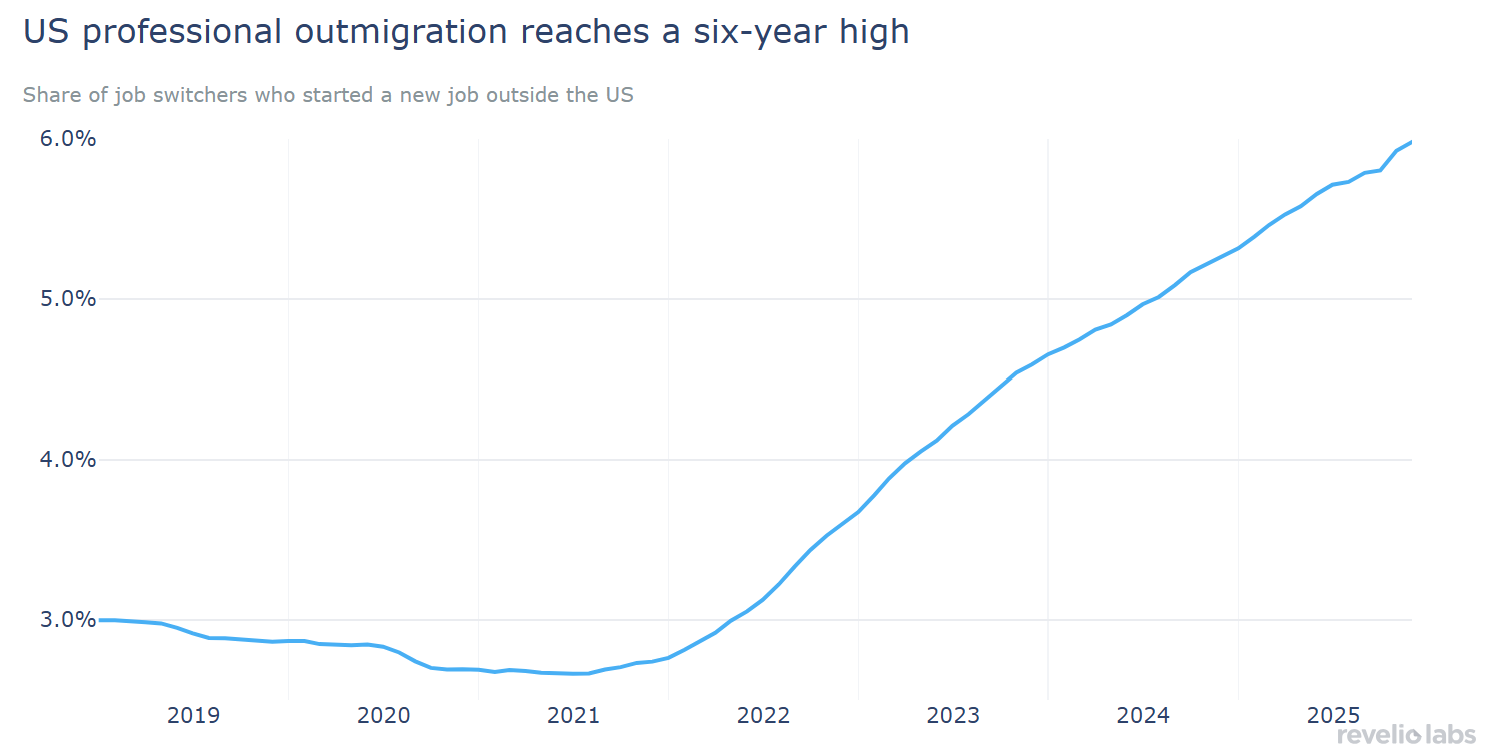
The share of US workers who transition to a job abroad, among those who switched jobs, has risen markedly since 2021, going from just under 3% to nearly 6% by 2025. After an initial dip in 2020 due to pandemic-related frictions in global mobility, outmigration has accelerated in a steady and persistent manner. This suggests structural rather than cyclical forces. The upward trajectory is smooth, with little evidence of reversal, indicating that firms and workers alike are increasingly operating in a global labor market. Importantly, this measure captures realized job transitions, not intentions, making it a strong indicator of actual mobility. The magnitude may be modest in absolute terms, but the relative increase is substantial. Doubling over a four-year period signals a meaningful shift in labor allocation.
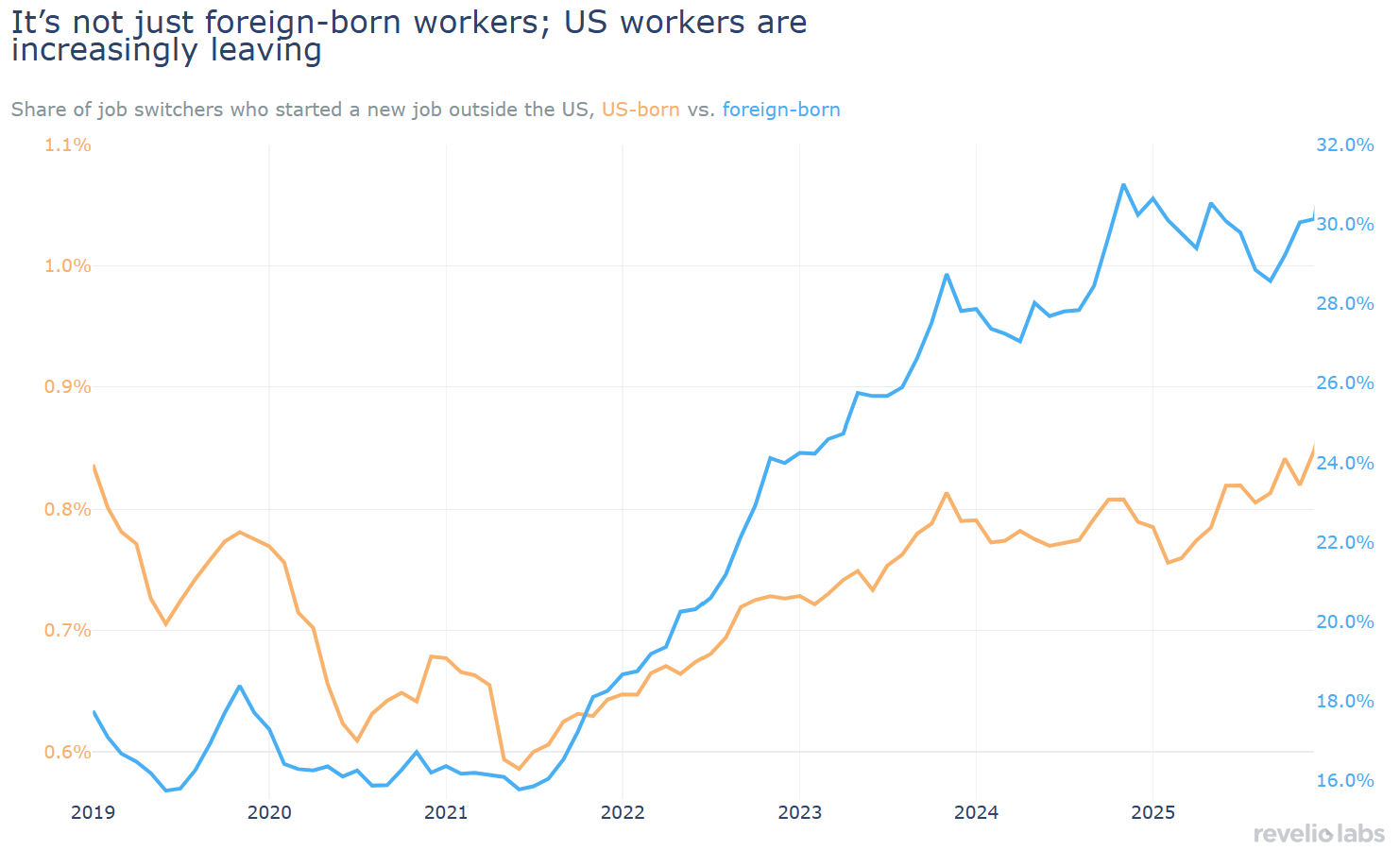
Outmigration is rising for both US-born and foreign-born workers. As expected, foreign-born workers are significantly more likely to take jobs abroad and migrate back home, with roughly 30% of job switchers leaving the US in recent periods, compared to less than 1% of US-born workers. However, the trend is upward for both groups, particularly since 2021, suggesting a broad-based shift rather than a compositional change alone. The increase among US-born workers is especially notable: while starting from a low base, their outmigration rate has climbed steadily, indicating that international opportunities are becoming more attractive even for those without prior migration ties. A recent New York Times piece puts faces to this trend, following Americans living abroad on modest incomes who enjoy lifestyles they couldn't afford back home and find the prospect of returning too costly to contemplate. For foreign-born workers, the rise likely reflects a combination of return migration and improved opportunities abroad. Taken together, the pattern points to a more globally fluid labor market, where both groups are increasingly responsive to opportunities outside the US.
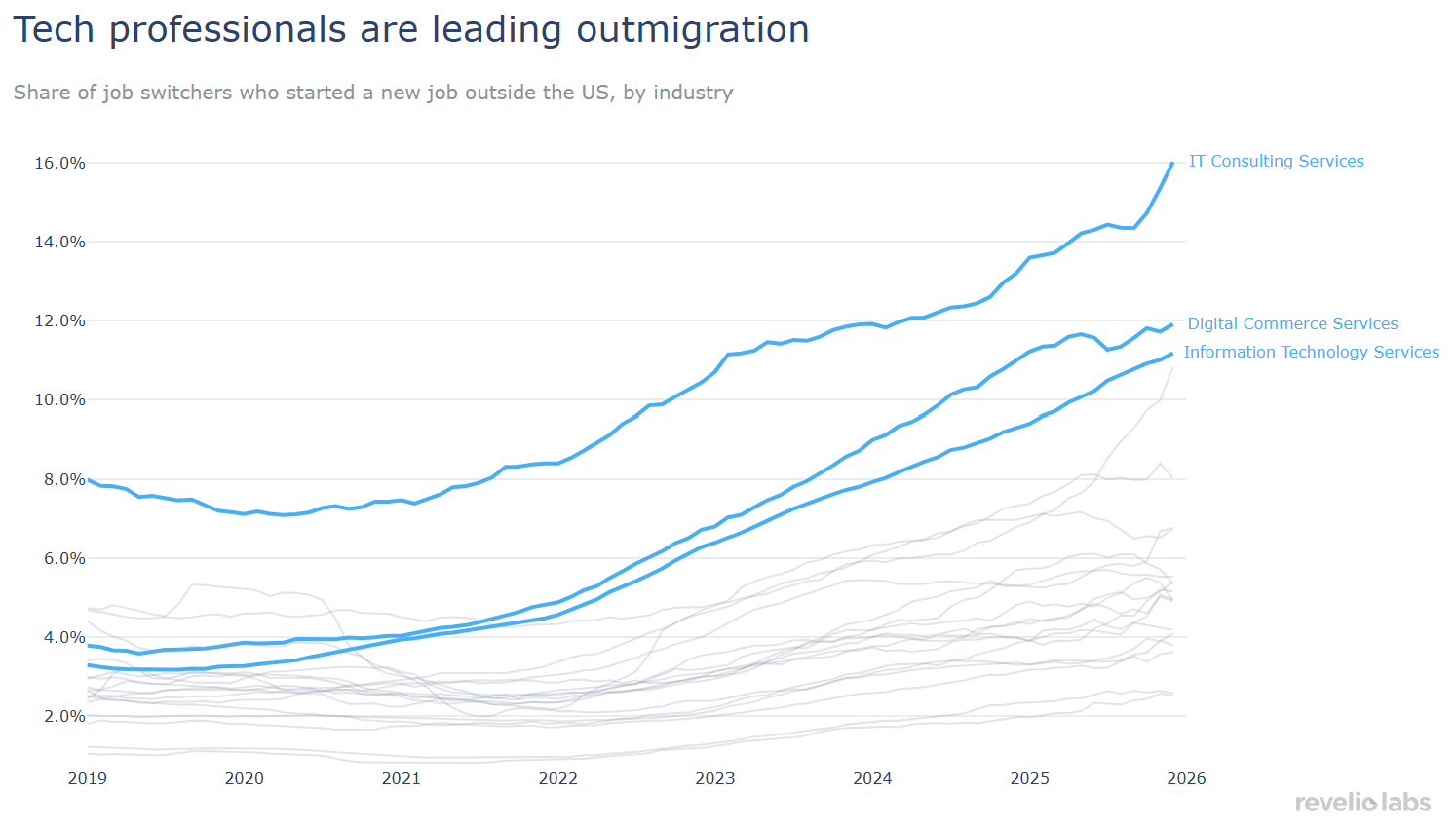
Looking at the industries within the US losing talent to outmigration, technology and digitally oriented sectors are clearly leading the increase. To keep the comparison meaningful, we focus on the largest industries by total outbound flows—those that account for the bulk of workers leaving rather than smaller niches that can show high rates but very few actual movers. Within this set, IT consulting services stand out, with nearly 16% of workers switching to jobs abroad, followed by digital commerce and broader information technology services. These sectors combine both high baseline mobility and strong upward trends, distinguishing them from more traditional industries. In contrast, many other industries remain clustered in the 3–6% range, with slower and more incremental growth. The dispersion across industries underscores that the rise in outmigration is not simply a macro story about the US versus the rest of the world, but one tied closely to the nature of work itself.
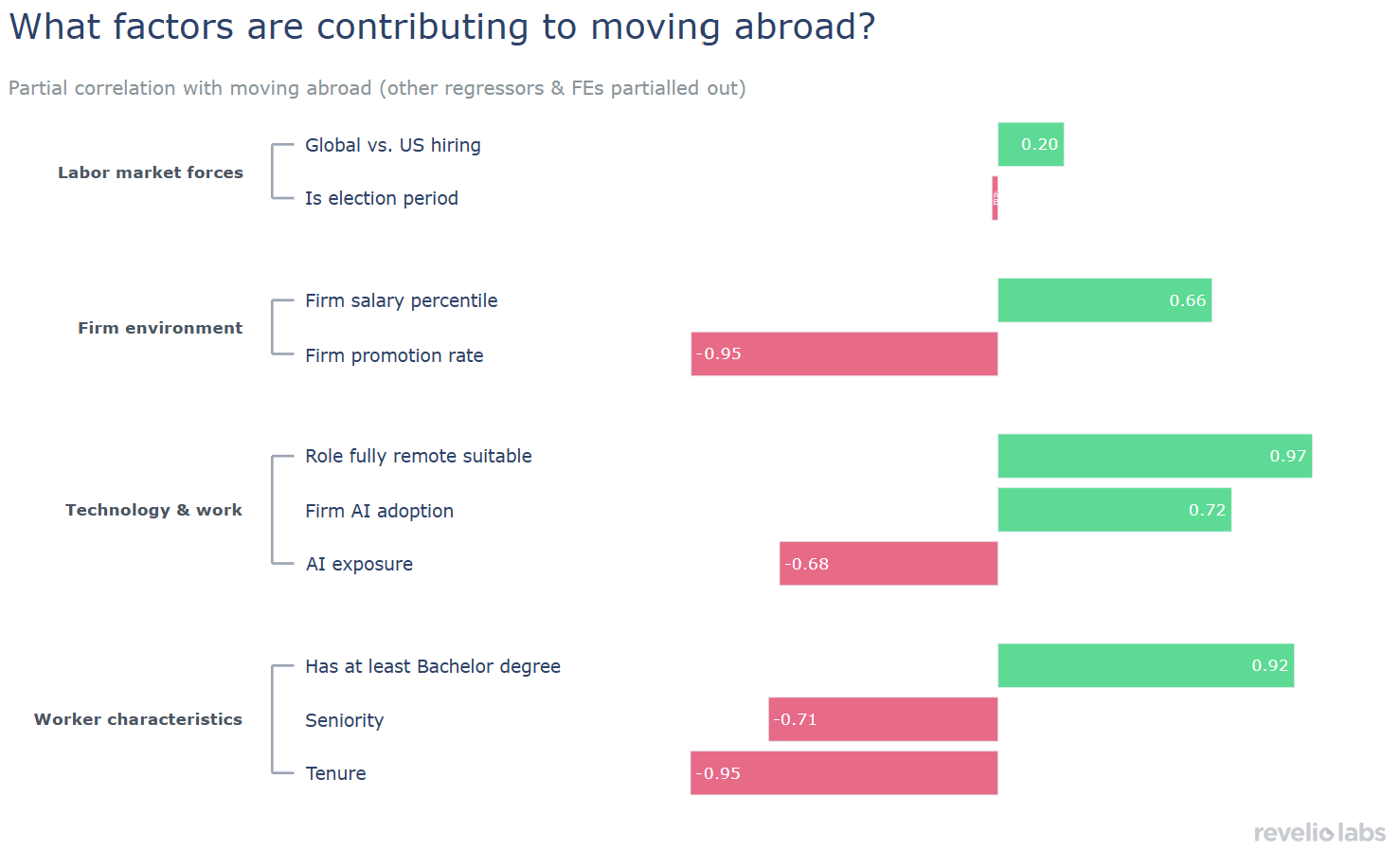
To better understand what drives outmigration, we run a regression. Remote work and internal mobility stand out as the clearest drivers of moving abroad. Roles that are fully remote-suitable show the strongest positive relationship with outmigration, underscoring how the ability to work from anywhere reduces friction and expands access to global opportunities. In contrast, firm promotion rates are negatively associated with leaving. Variation in promotion intensity across firms shapes career outcomes while limited advancement opportunities push workers to look elsewhere.
Other factors play more supporting roles. Higher firm salary percentiles and AI adoption are positively associated with mobility, likely reflecting exposure to globally competitive environments, while AI exposure at the role level is negatively related, suggesting more embedded or less portable work. Worker characteristics follow expected patterns: more educated workers are more mobile, while seniority and tenure reduce the likelihood of leaving, reflecting stronger firm-specific attachment.
US worker outmigration is rising, driven by a combination of global demand, firm-level opportunity, and the increasing portability of work. The trend is concentrated in sectors where skills are most transferable and where remote work lowers geographic barriers. While international mobility has long been a feature of the labor market, its recent acceleration suggests a shift toward a more integrated global workforce. Firms that fail to provide competitive pay, advancement opportunities, or flexible work arrangements may face growing retention challenges as US-based workers now increasingly look abroad. At the same time, workers are more easily able to arbitrage opportunities across borders, reshaping traditional notions of labor market competition.
Free to reproduce with attribution and a link to reveliolabs.com.
Cite this article
- Plain text
- Revelio Labs, "US Talent Is Quietly Exiting," April 21, 2026.
- HTML
- Revelio Labs, "<a href="https://www.reveliolabs.com/news/macro/us-talent-is-quietly-exiting">US Talent Is Quietly Exiting</a>," April 21, 2026.
- Academic
- Aksu, E. (2026, April 21). US Talent Is Quietly Exiting. Revelio Labs.


