AI Enthusiasm Is Driving a Jobless Stock Market Boom
Understanding the disconnect between market valuations and employment


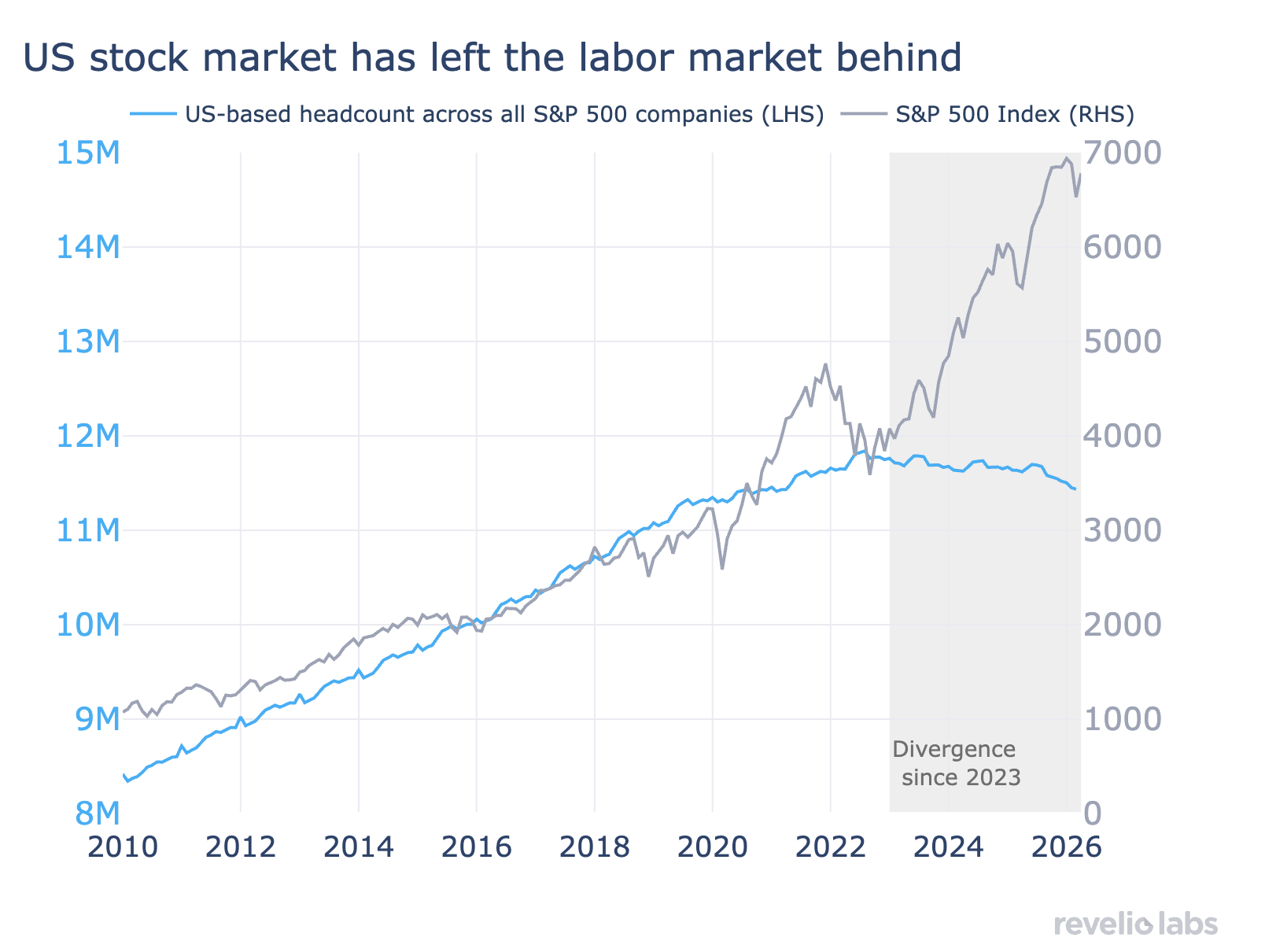
The stock market has risen sharply in recent years as investors bid up AI-focused firms, while employment has flatlined.
Valuations are being supported by expectations for huge revenue gains from AI infrastructure as well as cost savings from AI-driven efficiency. Big tech and AI-focused firms are potentially best placed to capture both.
Market capitalization per employee is positively correlated with AI adoption, and evidence of AI-focused hiring and efficiency gains are emerging. While it is too early to determine what the ultimate productivity benefits of AI will be, markets are expecting plenty.
The stock market is experiencing a jobless boom. Asset prices have soared, while it has become increasingly difficult for many workers to find a job. The result is an unprecedented disconnect between the stock market and the labor market: The S&P 500 is at record highs even as US job growth grinds to a halt.
Across earnings calls and layoff announcements, executives have increasingly emphasized that AI will allow firms to “do more with less,” pointing to automation, internal tooling, and workflow augmentation as drivers of efficiency. In many cases, workforce reductions have been framed not as cyclical cost-cutting, but as part of a longer-term restructuring toward leaner, more productive organizations. While there is reason to be suspicious of this narrative in some cases, revenue and earnings growth has indeed seen strong improvement for many publicly-listed firms even as hiring has slowed in recent years.
The resultant divergence is evident in both current employment and labor demand. Historically, job openings reported by the Bureau of Labor Statistics have tracked equity markets closely. But, as many have pointed out, that relationship has broken down. Likewise, market valuations have become estranged from overall headcounts: The S&P 500 has risen roughly 86% since the start of 2023, while our data show that US-based employment at these index companies has actually declined. This is also not a story about outsourcing, as our data also shows very little gains in global employment for these companies over the same period.

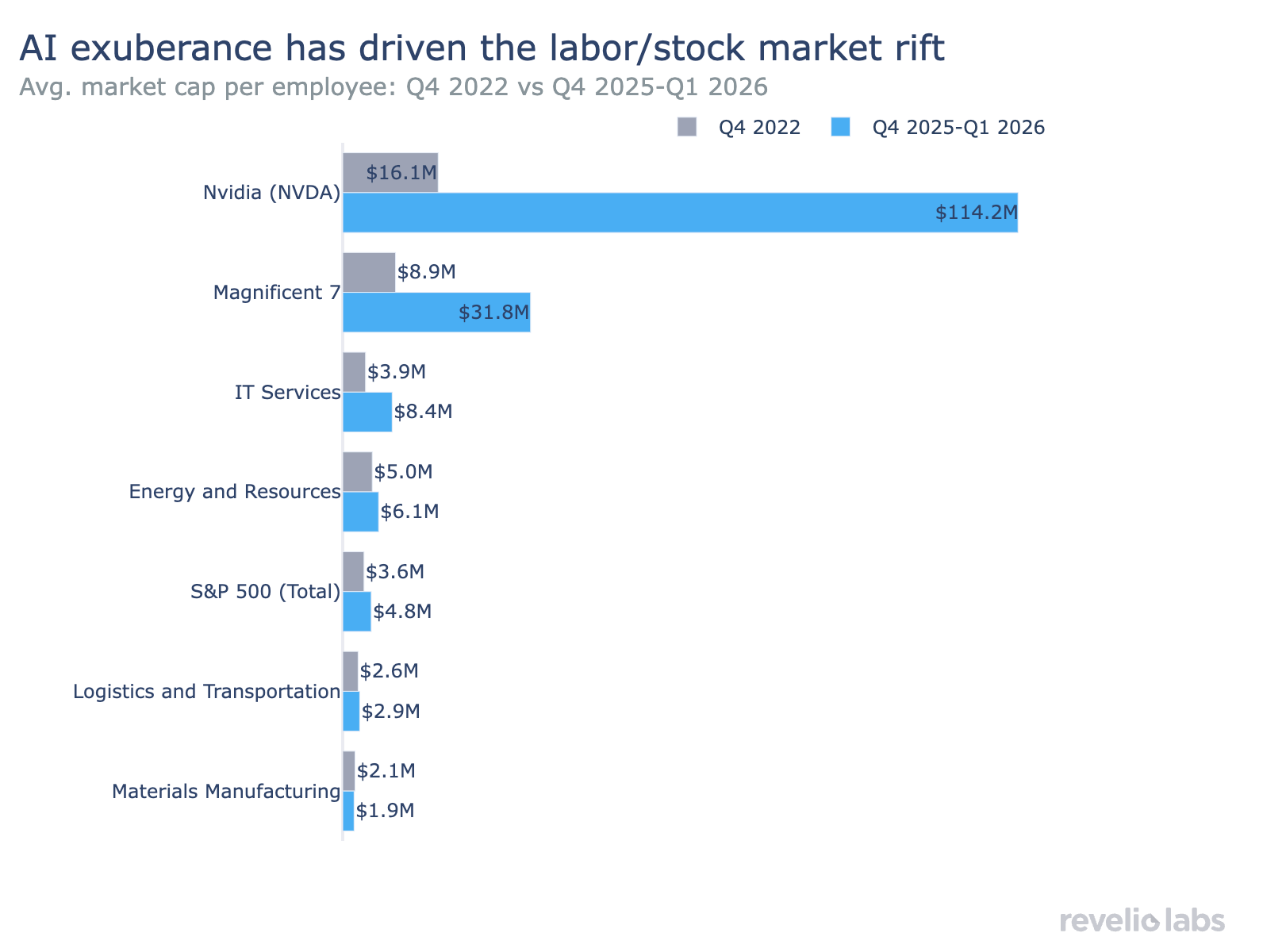
The disconnect is largely concentrated in the technology sector, especially among big tech and AI-focused firms, as investors pile into AI-related names. A clear signal shows up in market cap per employee (now looking at global workforce), which we can use as a proxy for how much value investors expect each worker to support. The increases here have been especially pronounced among AI-exposed firms.
Among AI-focused companies, market cap per employee soared. At Nvidia for example, this metric has risen from $16 million in Q4 2022 to over $100 million. Firms like Palantir, Broadcom, and Arista Networks have also seen huge increases, as has the rest Magnificent 7, which has seen more than a threefold increase.
By contrast, the rest of the market has seen far more modest increases. IT services and the broader S&P 500 have experienced less pronounced gains, while sectors like materials manufacturing and logistics transportation have remained relatively flat, or reversed.
Sign up for our newsletter
Our weekly data driven newsletter provides in-depth analysis of workforce trends and news, delivered straight to your inbox!
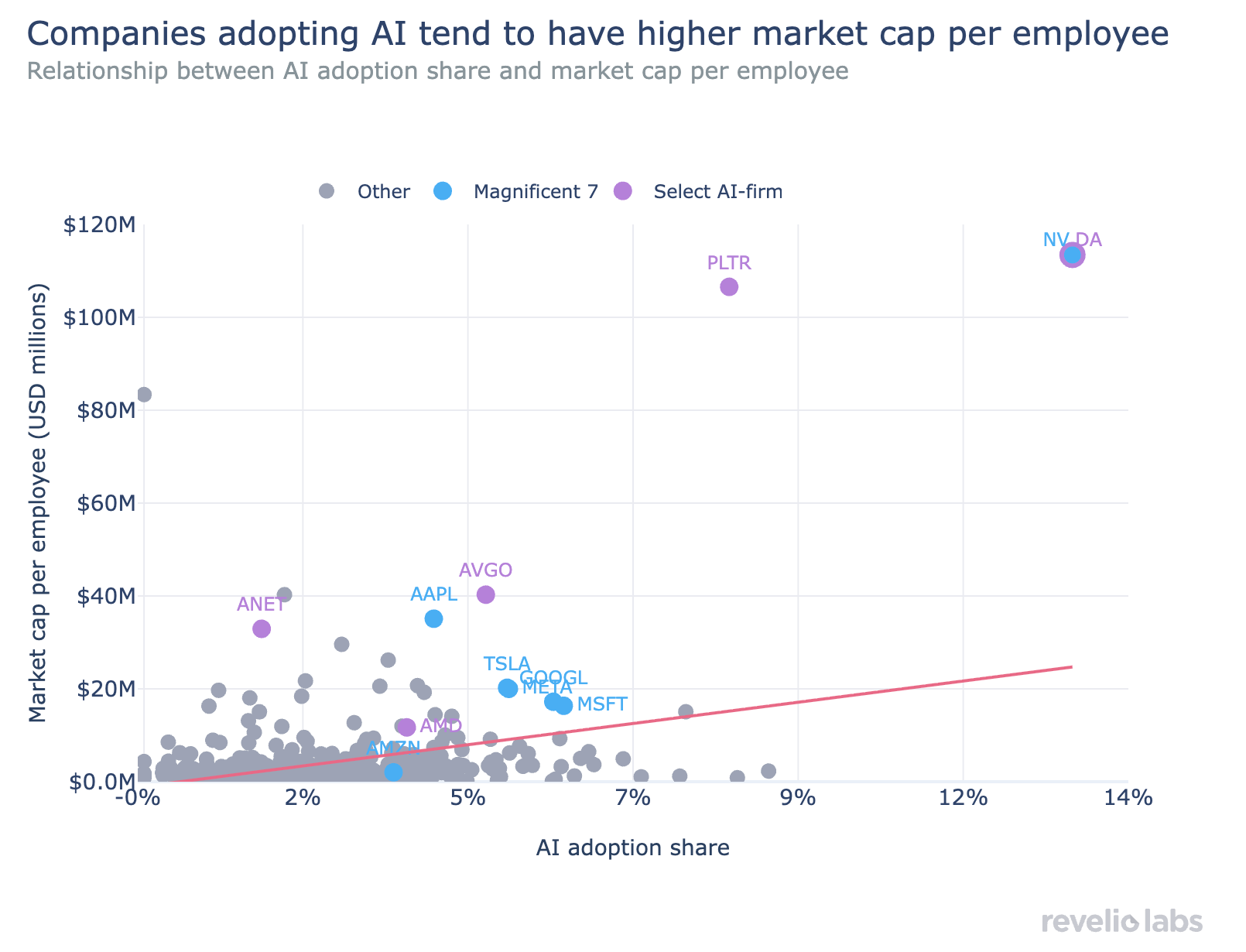
Using our individual-level profile data, we can examine AI adoption rates across these companies. We define AI adoption as the share of positions at a company whose descriptions in online professional profiles explicitly mention a list of AI-related keywords and technologies. While this is effectively a self-reported baseline, it provides a good comparison for adoption rates across firms.
Across S&P 500 companies, higher AI adoption rates are associated with higher market cap per employee, suggesting that firms are attempting to do more with fewer workers. In many cases, workforce reductions have coincided with rising share prices. The data suggest that early adopters tend to be rewarded, and tech and AI players are indeed well suited to implement AI into their own processes.
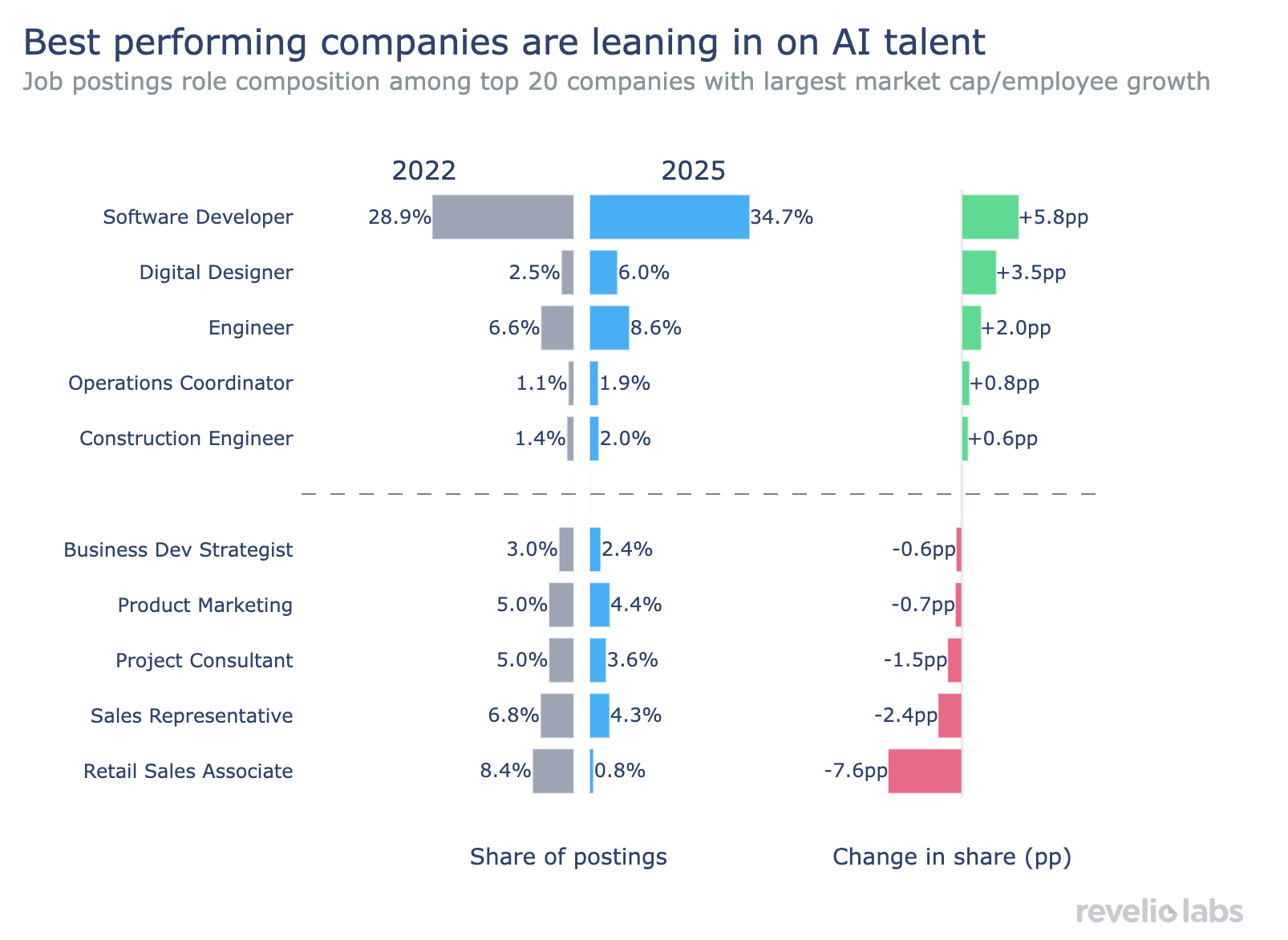
While overall headcount is declining, the best-performing firms are still hiring, just with more focus. The roles they are hiring for provide insight into how they expect to translate AI tools into overall productivity gains.
Hiring decisions reflect the marginal productivity of labor. As AI tools empower workers to more quickly do certain tasks, emphasis is being placed on recruiting workers that have the ability to organize, coordinate, and scale processes using AI systems rather than for roles which are composed of a large number of tasks that can be directly automated.
Among companies with the largest increases in market cap per employee since Q4 2022, recruiting has emphasized highly technical roles. While many of these firms were already tech-heavy, the share of job postings in software development, engineering, and AI-aligned roles has increased further.
The disconnect between markets and employment is, at its core, a bet on AI. Since around the release of ChatGPT, investors have sharply repriced AI-exposed companies, driven by expectations of both new revenue streams and meaningful efficiency gains. Some of this is straightforward. Firms like Nvidia and other AI infrastructure or platform players stand to benefit directly from rising demand, and their revenues have surged. But a larger part of the rally reflects a shift in how investors and managers are thinking about production, with increasing emphasis on the ability to generate more output per worker.
There are early signs that this narrative may well play out. Firms with the largest valuation gains also tend to show higher levels of AI adoption, and their hiring patterns reinforce this, concentrating on technical and AI-aligned roles that can implement and scale productivity gains while pulling back in more automatable areas. Still, the scale of the market response suggests expectations may be running ahead of realized outcomes.