People Analytics Teams Are Scaling Through AI, Not Headcount
Outside of engineering, people analytics is the fastest to adopt AI


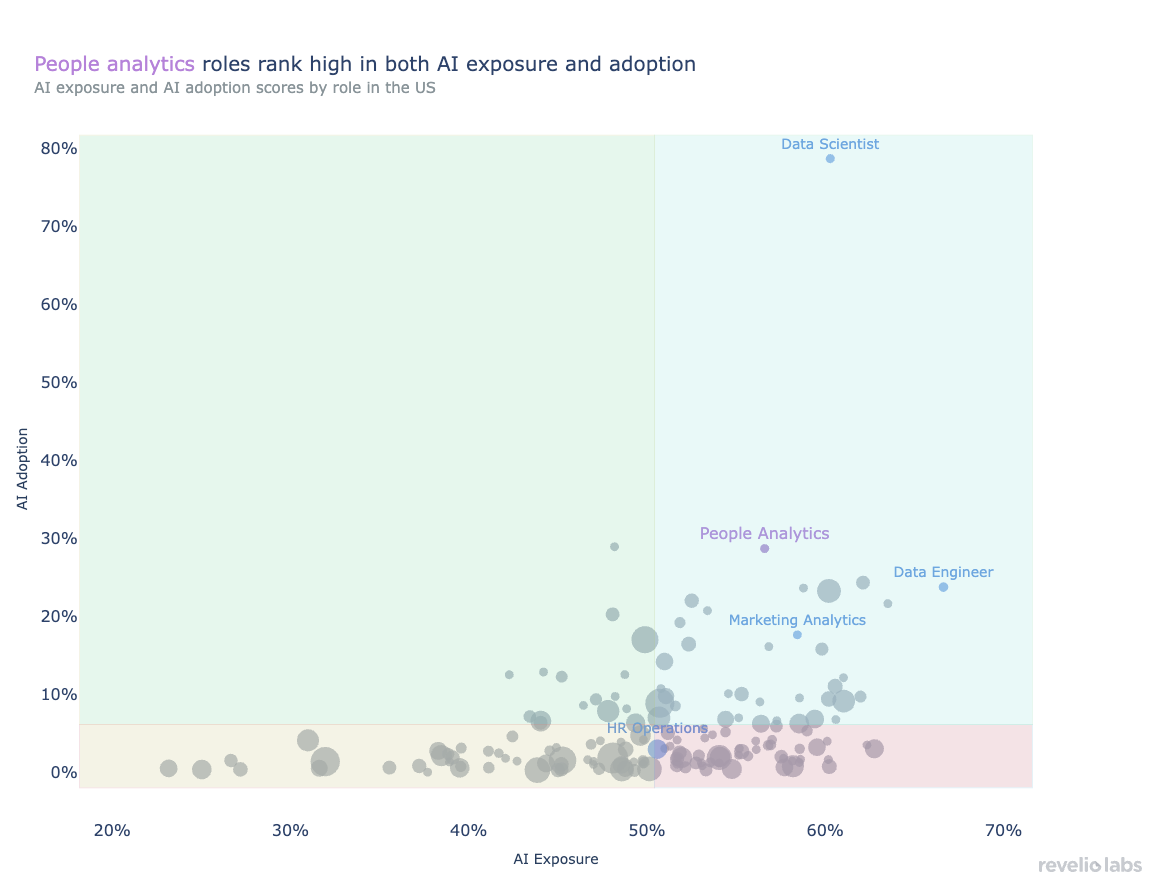
- Second Only to Data Scientists: People analytics professionals adopt AI tools at higher rates than general HR and other analytical functions such as marketing analytics, trailing only data scientists in overall AI uptake.
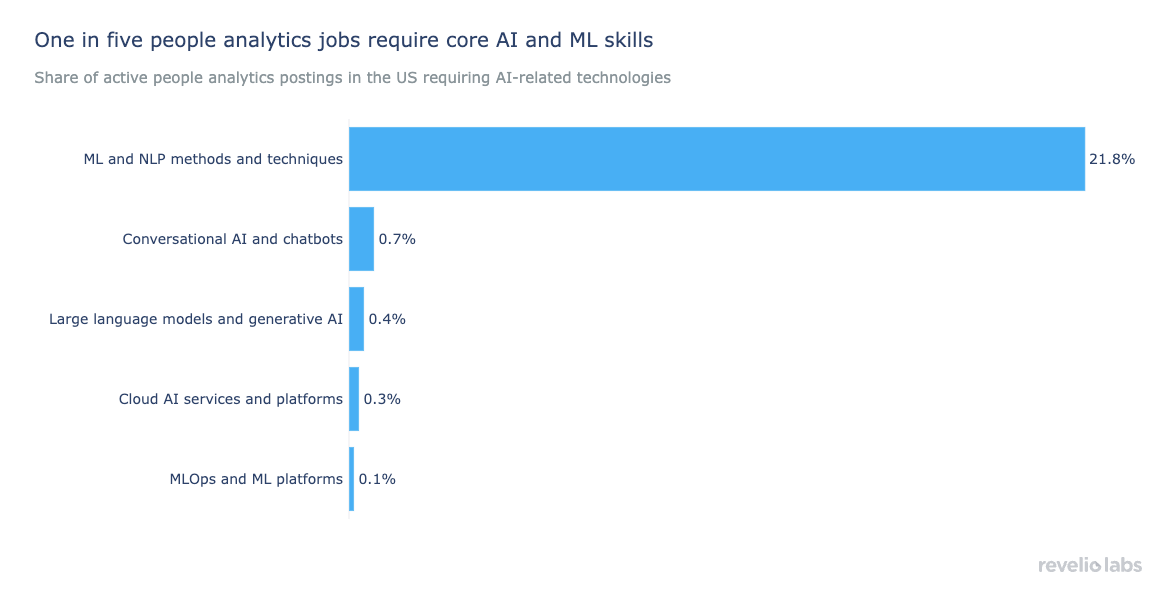
- 1-in-5 Postings Require AI Skills: Approximately one in five people analytics postings now lists core AI and machine learning skills as requirements — a sharp signal of how fast AI in people analytics is becoming a baseline expectation, not a differentiator.
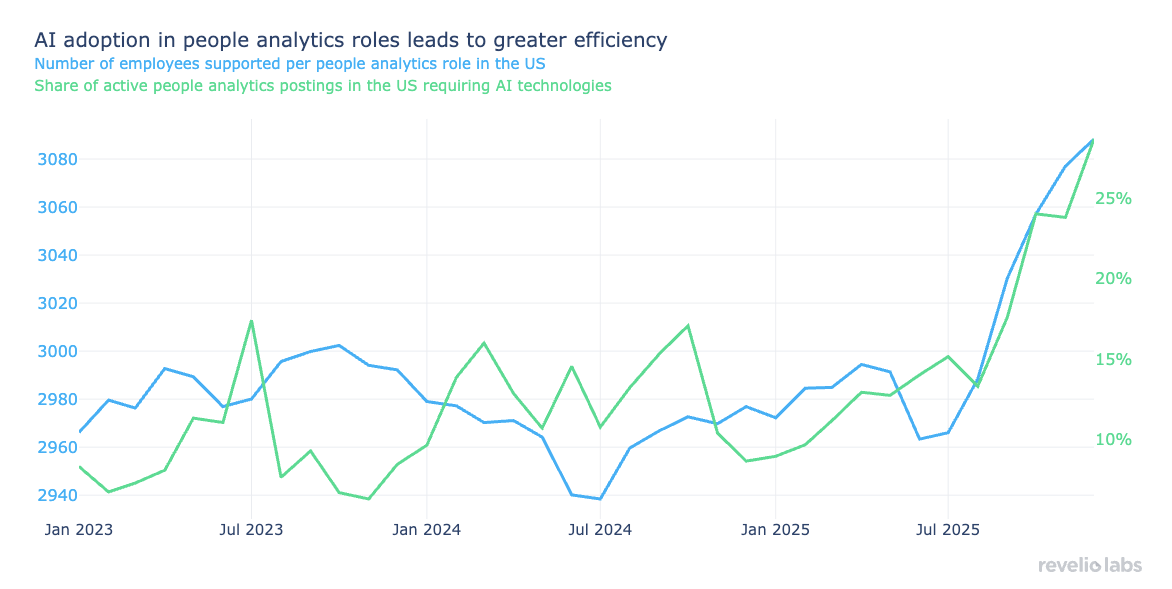
- Scaling Through Tools, Not Headcount: The number of employees supported per people analytics role has risen alongside this jump in AI requirements, indicating that AI adoption is letting teams expand their scope without proportional increases in headcount.
How Exposed Is People Analytics to AI?
People analytics plays a central role in how firms measure, manage, and optimize their workforce, making it a critical function to examine as AI adoption accelerates. Previously, we published two newsletters exploring how the role of people analytics is evolving across different labor markets. We first showed that, in the private sector, people analytics roles are notably sensitive to the business cycle despite their clear association with stronger employee engagement and organizational performance. In contrast, people analytics roles within the U.S. federal government have followed a more stable trajectory, supported by public-sector budget structures and a long-standing institutional commitment to workforce research.
Together, these findings highlight a core challenge for the field: while people analytics delivers clear strategic value, its organizational standing remains uneven and highly context-dependent. As organizations reassess how analytical functions contribute to performance, particularly in an environment shaped by rapid advances in automation and AI, the positioning of people analytics becomes increasingly consequential. In this newsletter, we examine how the function fits into this shifting landscape, with a specific focus on its exposure to AI technologies and its adoption of AI-related tools.
Our measures, which capture task-level exposure to AI using resume data and observed AI tool usage in job postings, indicate that people analytics ranks among the most AI-exposed functions in the United States. It is more exposed than HR operations and roughly on par with other analytical functions such as marketing analytics. At the same time, people analytics professionals are adopting AI tools at a higher rate than both HR operations and marketing analytics. Adoption in people analytics roles now trails only data scientists, who lead the labor market in AI uptake.

Which Tasks Make People Analytics So AI-Ready?
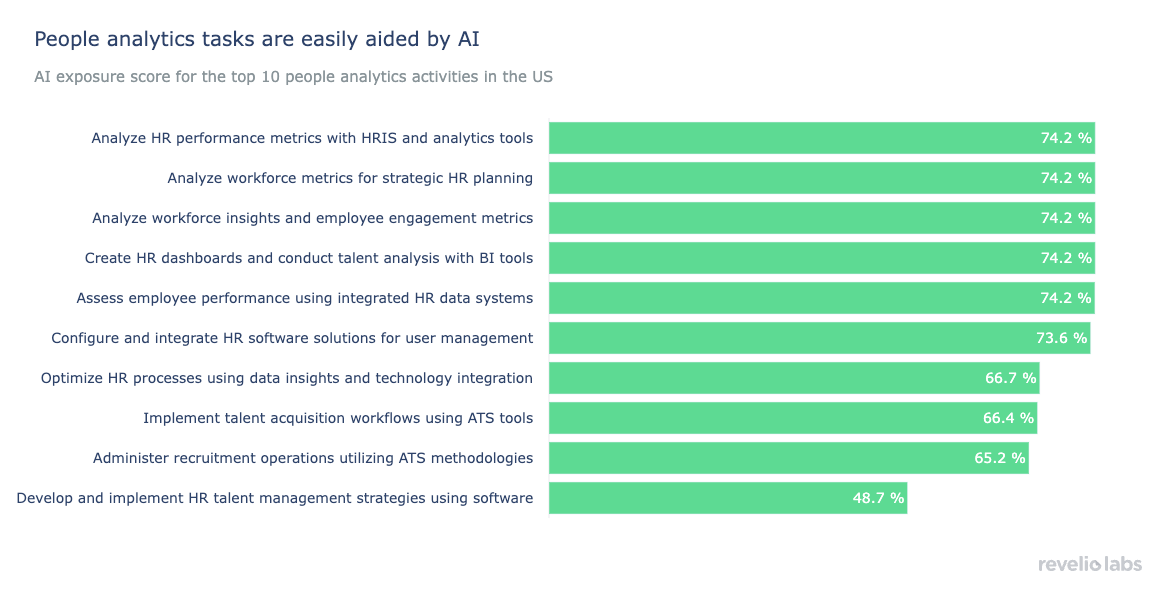
These differences in AI exposure stem largely from task composition. When looking at the activity profiles, people analytics professionals are more likely to engage in analytical tasks that involve optimizing HR processes using data insights, assessing employee performance through integrated HR systems, analyzing workforce and HR performance metrics, and building dashboards using HRIS and BI tools. These activities are well suited to augmentation by AI systems and analytics platforms because they rely on large volumes of structured organizational data, repeatable workflows, and digital infrastructure. AI tools can assist with data processing, pattern detection, predictive modeling, dashboard generation, and system optimization. In that sense, AI tools are not a substitute for people analytics professionals, but a complement to the analytical and technology-driven responsibilities that define the function.
Sign up for our newsletter
Our weekly data driven newsletter provides in-depth analysis of workforce trends and news, delivered straight to your inbox!
How AI in People Analytics Shows Up in Job Postings
Tool adoption patterns among people analytics professionals reinforce these task-level requirements. Core AI capabilities including machine learning, natural language processing, and neural networks, now appear in roughly one out of five active people analytics postings. In practice, these tools are being used to automate reporting workflows, enhance predictive models of attrition and performance, extract insights from employee feedback and survey text, and improve talent matching and workforce planning processes.
Scaling Up Without Scaling Headcount
Adoption of AI tools appears to extend analytical capacity enabling relatively small teams to manage larger datasets, generate insights more quickly, and support strategic decision-making more efficiently. This shift is also reflected in changing organizational expectations around how the function operates. In the US, the number of employees supported per people analytics role increased in the second half of 2025. This increase coincided with a higher share of people analytics postings listing AI technologies as requirements. Together, these shifts suggest that organizations expect these teams to expand their scope without proportional increases in staffing, placing greater emphasis on tooling, automation, and more efficient use of data.
What This Means for People Analytics Teams
Given the rapid advancement of AI technologies and the inherently data-driven nature of people analytics work, the function is well positioned to benefit from these tools. AI in people analytics is enabling teams to scale through tool adoption rather than headcount growth. As organizations seek greater efficiency and increasingly rely on workforce insights to drive business outcomes, people analytics stands out as a function where AI adoption can directly improve decision quality and operational effectiveness, and as a leading indicator of how AI adoption may reshape other analytical and HR functions in turn.