


On online professional networking platforms, individuals often tailor their profiles to stand out to recruiters and potential employers. Users have the option not only to report their education and job history in the body of their profile, but also to more directly signal their credentials by including titles (e.g. “Dr.”) or post-nominal suffixes (e.g. “PhD”, “MBA”, or “MS”) in the names displayed on their profiles. Users may choose to include these credentials as a way to quickly communicate authority and credibility to both their direct connections and broader audiences. This week, we look into the prevalence of titles and post-nominal suffixes on online professional profiles and whether their inclusion reflects differences in educational background or other characteristics.
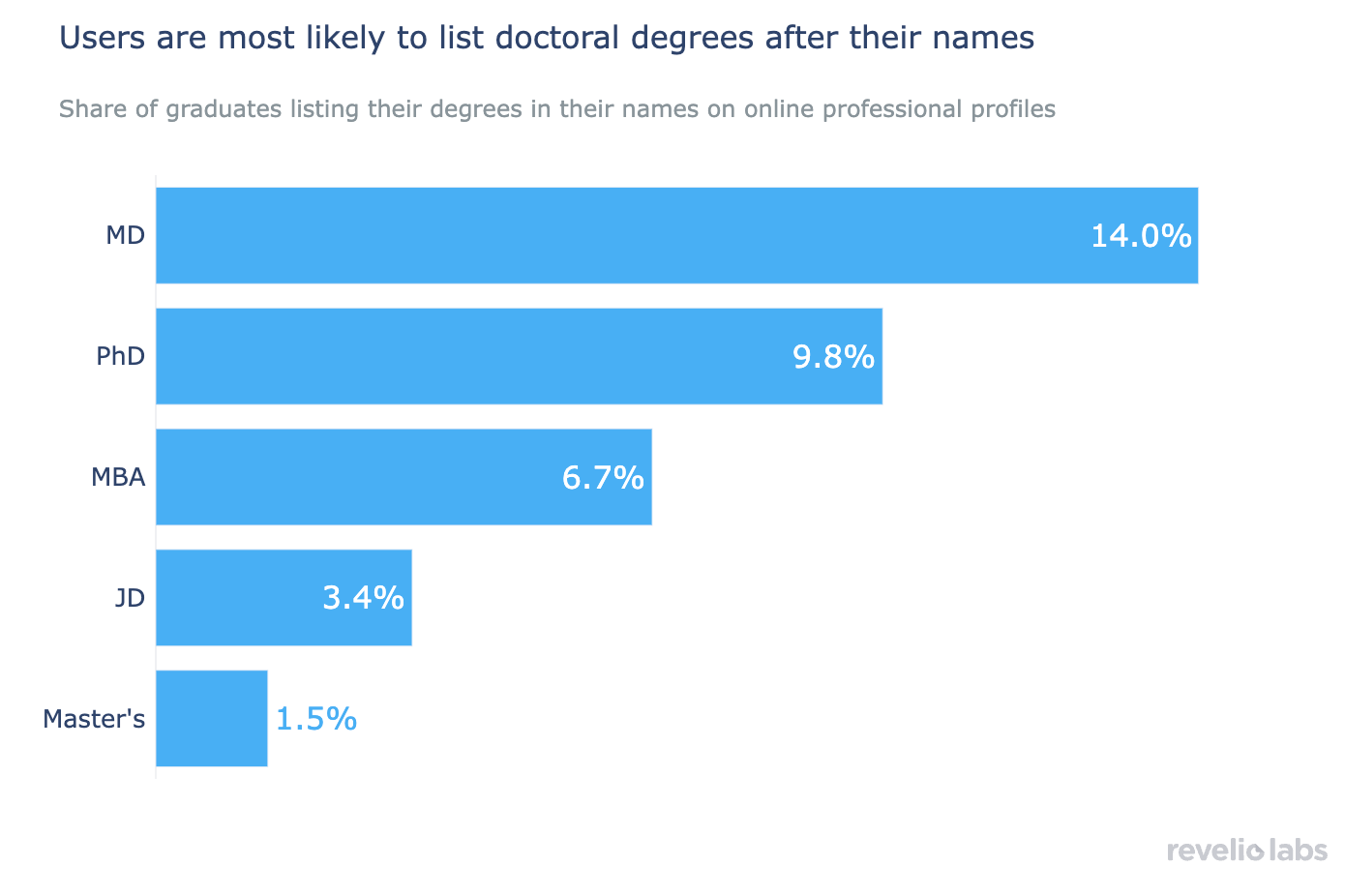
In our sample of US-based online professional profiles, we find that, among users who hold a graduate degree, only 3.5% include it in their name. Which degrees are most likely to be reported? Our data show that users are most likely to report doctoral degrees such as MDs and PhDs in their names, with 14% and 10% of degree holders respectively listing these credentials alongside their names. This may be unsurprising, as doctoral degrees are typically the highest level of academic achievement and often represent multiple years of specialization within a field. Medical degrees in particular may be commonly reported because “Dr.” is a standard term of address in the field, while reporting a PhD can serve as a quick signal of the ability to independently produce original research. However, considering the achievement and effort involved, the share of degree holders who actually showcase their credentials in their names is lower than one might expect.
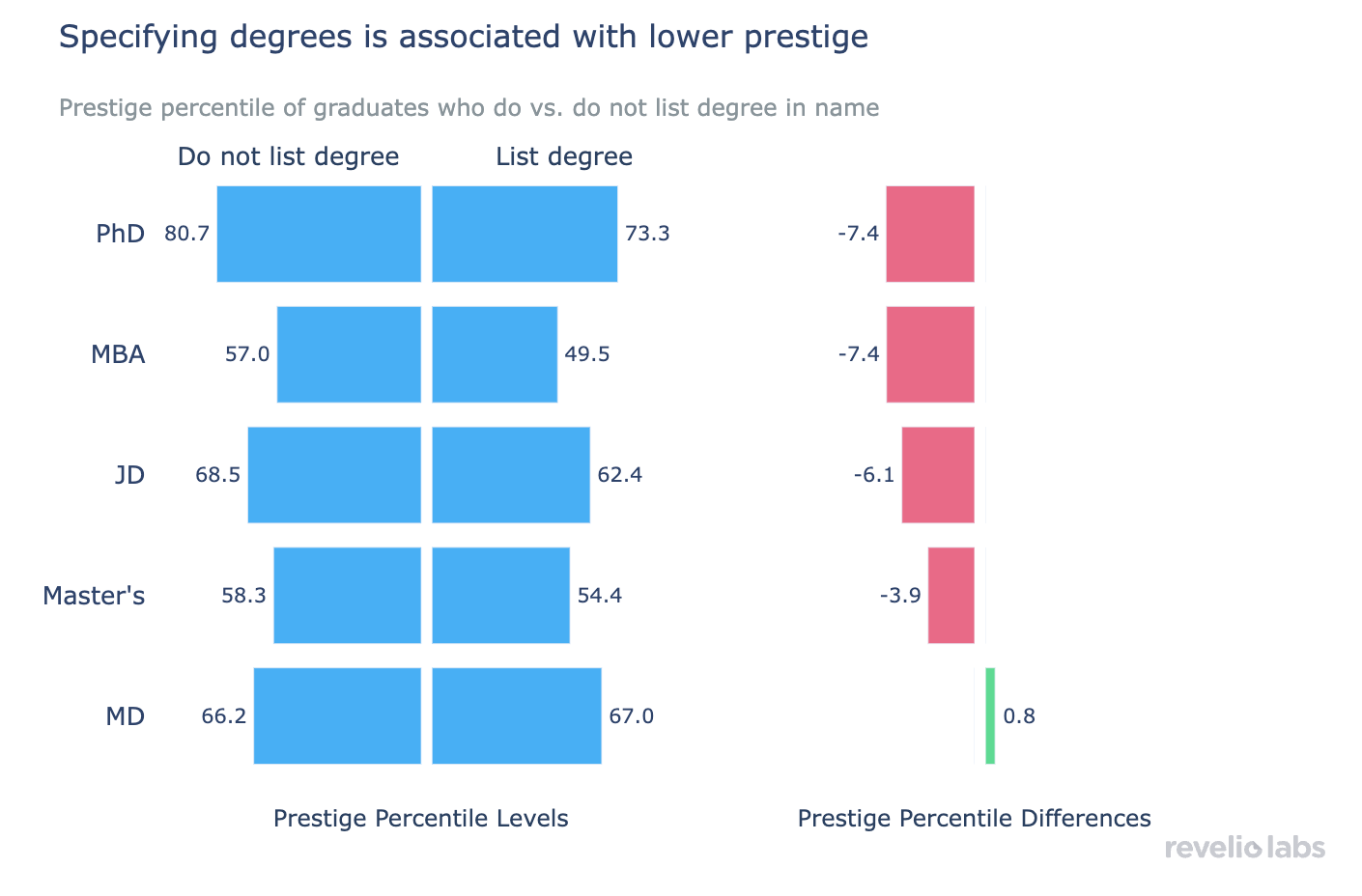
Does listing your degree in your name actually convey the intended signal? We next examine differences in prestige between degree holders who do and do not list their degrees. Revelio Labs’ user prestige scores take into account both the ranking of the schools and educational institutions they attended and the prestige of their employers as their careers progress. We find that listing degrees in one’s name is associated with lower prestige scores for nearly all degree types in our analysis, with the largest difference observed among PhDs and MBAs: Graduates who report PhDs or MBAs in their names are on average 7.4 percentiles lower in prestige than those who do not.
One reason for this difference may be that degree programs can vary widely in selectivity and quality. People who attended highly-ranked schools or worked for prestigious companies may prefer instead to highlight those experiences in the education or career history sections of their online profiles, with the institution and company names speaking for themselves. On the other hand, those who attended less prestigious institutions may be more likely to emphasize their degrees in their names because they are less able to rely on the recognition or reputation of their schools.
In addition to prestige, we also investigate differences in salary between graduates who list their degrees in their names and those who do not. We find large differences across degree types: While the salary differences associated with listing degrees are relatively small for PhD graduates, and even positive for MD graduates, wage penalties are largest among MBA graduates. MBA graduates who list their degrees in their names earn 16.7% less on average than those who do not.
These salary differences may reflect the prestige gap shown earlier if users from less prestigious backgrounds also earn lower salaries. However, our data also allow us to control for differences in institutional prestige by comparing salaries among graduates from the same schools and degree programs. We find that salary gaps between those who do and do not list their degrees in their names persist even after this more direct comparison. MBA, JD, and MA graduates who report their degrees in their names receive 6 to 7% lower salaries than those from the same schools who do not, while PhD and MD graduates receive higher salaries.
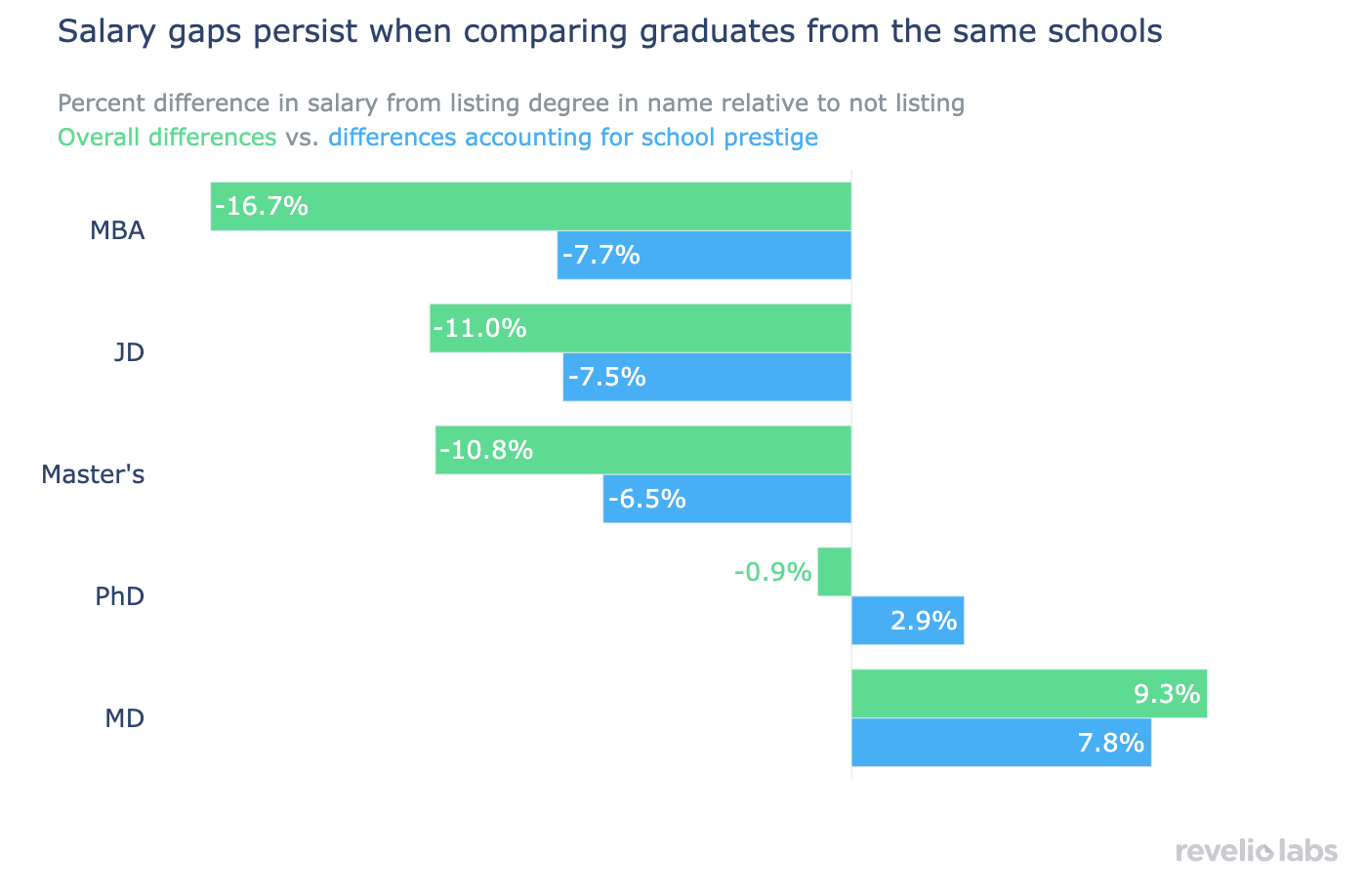
One potential mechanism could be further selection into who chooses to list their degrees, even among graduates from the same schools. For example, the salary differences between graduates, even when controlling for school, may reflect the nature of the degrees themselves. Many pursue MBAs mid-career, often with the aim of transitioning into leadership or strategy roles. Those who list their degrees may still be in transition and do so with the intention of positioning themselves for new and potentially higher-paying opportunities, rather than already holding those positions. Individuals who have completed the transition and reached high-earning positions, such as partners or directors, may not feel the need to include “MBA” after their names even if they do hold these degrees. On the other hand, PhD and MD graduates who are employed in more “traditional” fields, including academia and medicine, may not feel the need to specify their degrees given the prevalence of these degrees in such fields. However, PhD and MD graduates who work in industry, where these degrees are less common, may choose to list their degrees in their names as a marker of distinction. At the same time, industry positions may also offer higher pay.
In conclusion, reporting degrees in names on online professional profiles is one way users can quickly signal their educational achievements to their networks. Users with doctorates are most likely to report their degrees after their names, followed closely by users with MBAs. Despite user intentions, however, we find that there are on average negative associations between degree-dropping and prestige or salary, with the differences particularly large for MBA graduates. While institutional prestige can explain part of the salary differences between those who list their degrees in their names and those who do not, wage gaps persist even when comparing graduates from the same degree programs. Still, these associations could be driven by selection into who specifies their degrees rather than a causal effect of doing so, and individual users may still find this practice to be an effective way of communicating experience or expertise in their fields.
Free to reproduce with attribution and a link to reveliolabs.com.
Cite this article
- Plain text
- Revelio Labs, "Listing Your Degree in Your Name May Not Signal What You Think," March 3, 2026.
- HTML
- Revelio Labs, "<a href="https://www.reveliolabs.com/news/social/listing-your-degree-in-your-name-may-not-signal-what-you-think">Listing Your Degree in Your Name May Not Signal What You Think</a>," March 3, 2026.
- Academic
- Hao, S. (2026, March 3). Listing Your Degree in Your Name May Not Signal What You Think. Revelio Labs.


